Today's military field ration is not simply a collection of canned food, crackers, and drink packets. Behind it are decades of research into nutrition, preservation technology, packaging, and logistics. The military had to solve what at first seemed like a simple problem: how to provide a service member with enough calories and nutrients when there is no kitchen, refrigerator, store, or time to prepare food nearby?
The answer changed along with warfare. Ancient armies largely depended on local supplies and the ability to prepare food on site. Later came standardized rations, canned food, dehydrated products, and eventually MREs (Meal, Ready-to-Eat), which can be consumed without a full field kitchen.
The history of the field ration is essentially the history of finding a compromise between four things: calorie content, weight, shelf life, and the ability to quickly obtain food where there is no proper kitchen. Let's look at how it really happened in this guide from Punisher military store.
Military food before the field ration
The problem of feeding an army arose long before the very concept of a “dry ration” appeared. Ancient Egyptian troops, Roman legions, and medieval armies all depended on what could be transported, preserved, or obtained directly on site.
The Roman army had a significant advantage over many of its predecessors: a developed road and supply system made it possible to provide legionaries centrally. The diet was based on grain products, as well as meat, olive oil, and wine.
In the Middle Ages, the situation was much less standardized. A soldier might receive bread, salted fish, thick porridge-like dishes, beer, or wine, but the specific selection of food depended heavily on the army, region, and supply capabilities.
In other words, the first military rations were not so much “rations” in the modern sense as an organized supply of food for cooking.

Logistics was already no less important than food itself in ancient armies. If an army lost access to food supplies, soldiers had to hunt, gather food, buy it, or take local supplies. The development of military logistics eventually made standardized rations a reality.
1775: one of the first standardized U.S. military rations
The American Revolution was an important milestone. In November 1775, the Second Continental Congress approved a standardized ration for the Continental Army.
A typical daily ration provided approximately 1 pound of bread or flour and 1 pound of beef or fish, or 3/4 pound of pork. Legumes, milk, rice or cornmeal, and other foods were provided separately.
This was fundamentally different from the situational feeding practices of previous centuries: the government was attempting to define not only what a soldier should receive, but also how much.
However, what existed on paper and what reached the front could differ considerably. Army historical materials explicitly note that fresh food often failed to reach field units because of transportation and supply problems.
The Continental Army ration included 1 pint of milk per day, while legumes were issued on a weekly basis – 3 pints of peas or beans per week. In practice, delivering all the food specified in the regulations to soldiers was much more difficult than writing it into the standard.
The 19th century: more standards, but still far from a field ration
During the War of 1812, the American Army ration remained largely a collection of basic foods: beef, flour, rum, vinegar, salt, and other components.
During the U.S. Civil War, military nutrition was also largely built around foods that could be stored and transported for long periods. Coffee became a characteristic component, while tea, seasonings, and potatoes were also used in the ration.
It was during this period that it became clear how important not only the calorie content of food was, but also how it was preserved. Armies needed food that would not spoil during transportation, would not take up too much space, and would not require complicated preparation.
The next major step was canned food.
Canned food changes the military ration
Canning became one of the most important technological breakthroughs in military food. Food could be prepared in advance, hermetically sealed, and stored for much longer than fresh food.
But the first generations of canned food were not perfect. Quality depended on the manufacturing process, packaging integrity, temperature, and storage duration.
Gradually, canned food became an integral part of American military nutrition. By the 20th century, it had become the basis of individual field rations.
World War I: food becomes part of a large logistics system
By the time the United States entered World War I, the Army already had several types of field provisions, including Reserve, Trench, and Emergency rations.
The Reserve ration was designed to provide a service member with basic foods for an extended period. According to the U.S. Army museum, its energy value was approximately 3,300 kcal per day, while its weight was about 2 pounds.
This is an important moment in the history of the field ration: the Army began to view field food not simply as a “supply of food”, but as a separate system that had to meet specific requirements for weight, calorie content, shelf life, and method of use.
C-ration: the transition to individual ready-to-eat food
In the 1930s, the U.S. military began actively looking for a replacement for bulky field foods.
In 1937, William McReynolds investigated the possibility of creating a new individual combat ration. In 1939, Field Ration C was officially adopted.
C-ration consisted of canned components that could be issued to an individual service member. At an early stage, the set included three cans of meat-and-vegetable products and three cans containing crackers, sugar, and instant coffee. The total energy value was approximately 2,974 kcal, with about 114 g of protein.
For its time, this was a significant step forward: the soldier received not simply raw ingredients for a field kitchen, but a compact supply of ready-to-eat food.
C-ration had one serious problem that would later affect military food for decades: monotony. Even a technologically advanced ration quickly becomes tiresome if it has to be eaten for weeks. U.S. Army materials explicitly mention the problem of monotonous canned menus.
K-ration: when weight becomes critical
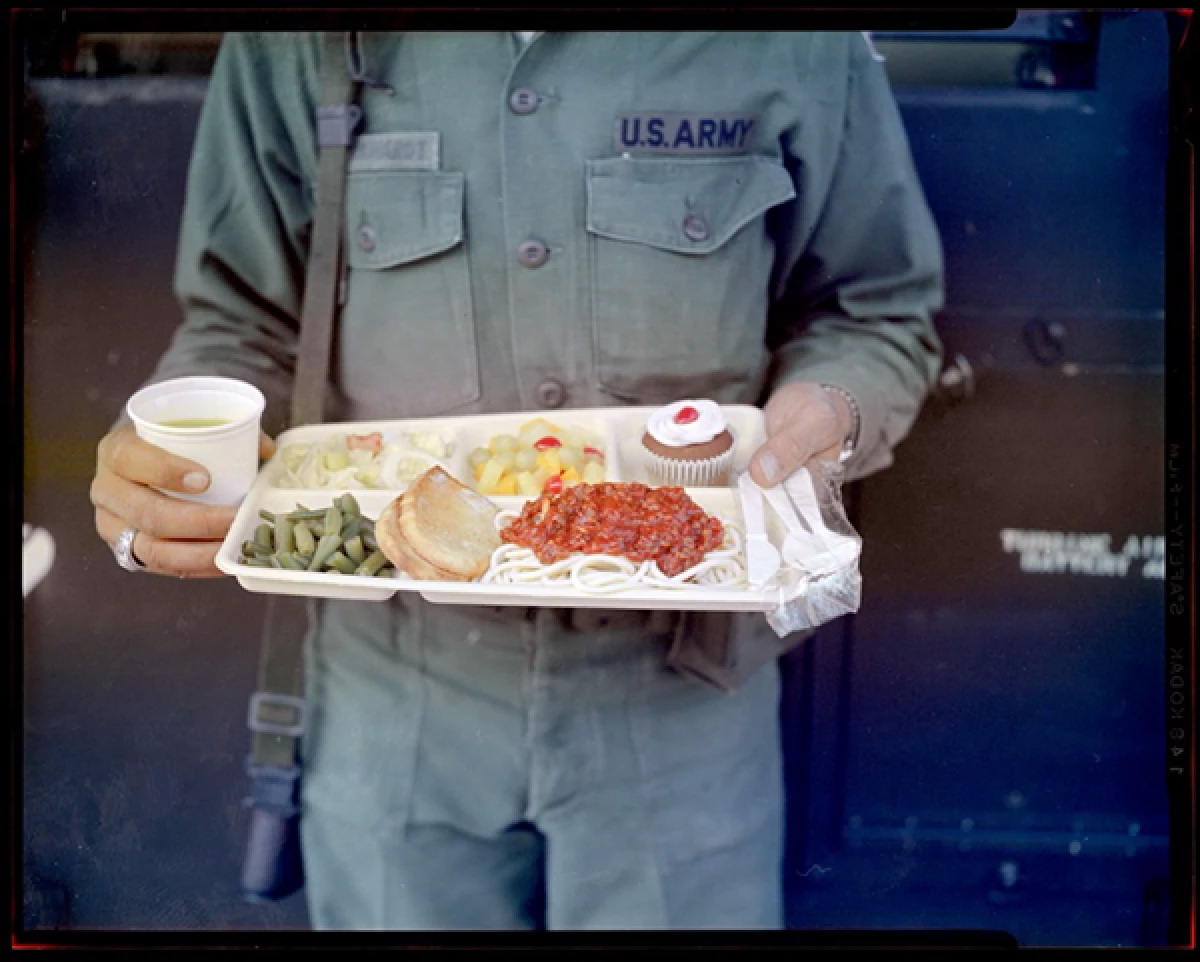
During World War II, the Army needed an even more compact ration. K-ration appeared for service members who moved extensively and could not rely on regular food service.
It was significantly more compact than the standard combat ration and was designed for mobile units, including paratroopers and other service members for whom it was important to carry food without unnecessary weight.
In 1942, K-ration was officially adopted. Interestingly, the letter K was not an abbreviation for any particular word – it was simply a designation that became associated with the ration.
C-ration did not disappear, however: it remained the primary individual U.S. field ration throughout World War II and continued to be used in subsequent conflicts.
From canned food to dehydrated food
The next problem was obvious: canned food is reliable, but heavy.
The military therefore began making greater use of dehydration and freeze-drying. Removing water made it possible to reduce the weight of food without having to transport a significant amount of liquid.
In 1964, the U.S. Army introduced the LRP – Long Range Reconnaissance Patrol ration. It was a compact, lightweight dehydrated ration for service members carrying out extended missions far from the main forces.
LRP became an important step toward future lightweight rations: a service member no longer had to carry several heavy cans to get a complete meal.
LRP was one of the first U.S. military rations in which the principle of “remove the water until the moment of consumption” became a central part of the design. This made it possible to significantly reduce the weight and volume of the food.

MRE: the emergence of the modern field ration
By the late 1970s, it had become clear that canned food had technological limitations. The military needed food that would be lighter, more varied, durable, and suitable for consumption without a full kitchen.
This led to the MRE – Meal, Ready-to-Eat, literally “food ready to eat”.
The military history of the MRE is more complicated than the popular version suggesting that it was simply invented in one particular year. The first modern-type prototypes appeared in the 1970s, requirements for the new ration were developed over the following years, full-scale production began in 1980, and the first MREs were issued to military personnel in 1983.
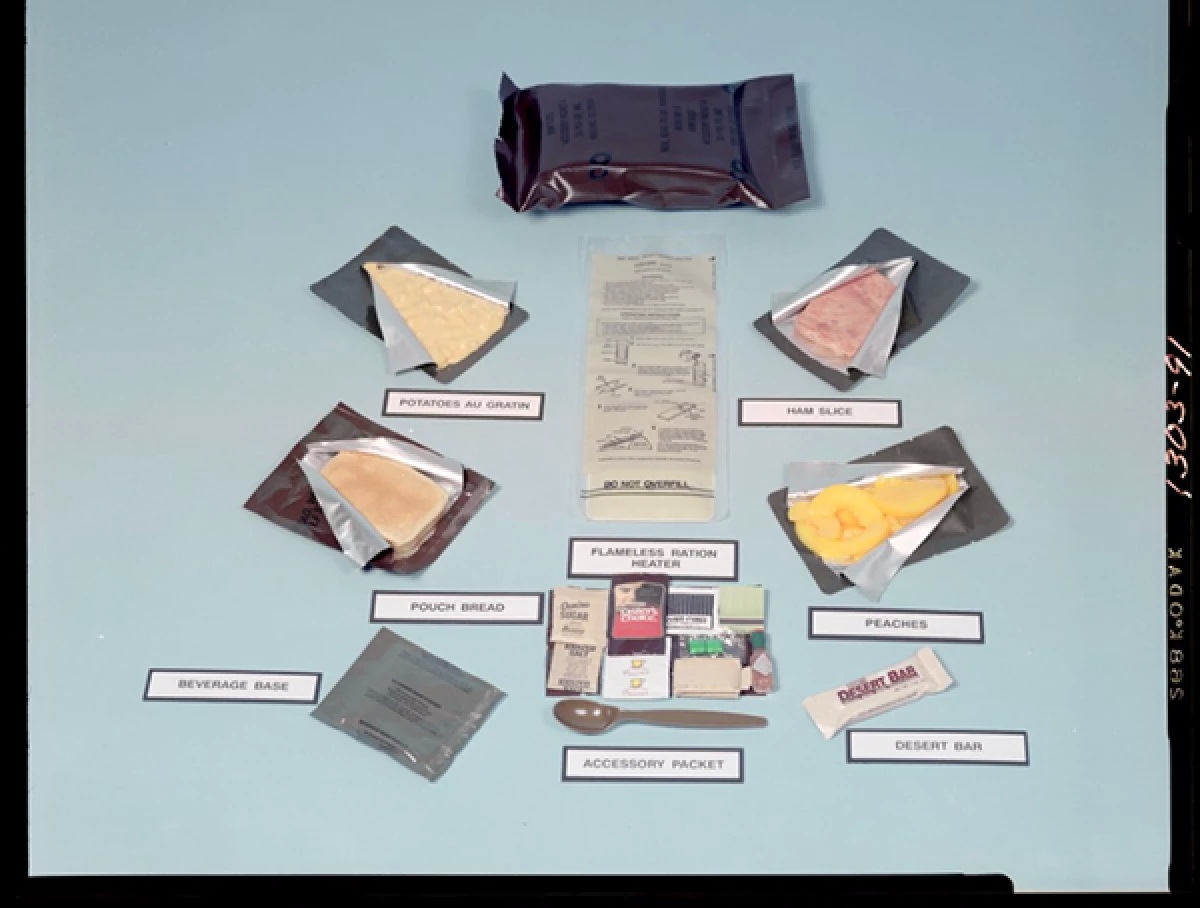
The main change was not only the food itself, but also the packaging. Instead of heavy metal cans, flexible multilayer pouches were used that could withstand long-term storage and transportation.
This is where the familiar modern principle of military food was finally established: open the package, and the food is already ready.
What is an MRE today?
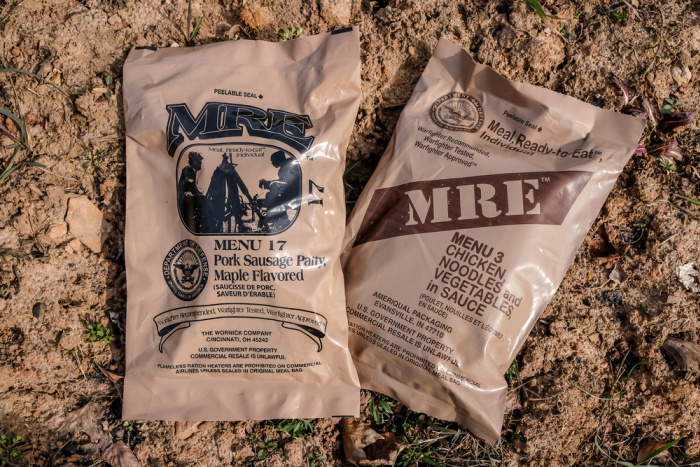
A modern MRE is not simply one meal. It is an individual meal that usually includes a main entrée, side dishes or snacks, a beverage, and additional components.
U.S. Army materials indicate an energy value of approximately 1,285-1,300 kcal per MRE. Three MREs are used as a complete daily food ration.
A modern MRE also has 24 menus, and the composition of the ration is regularly reviewed. Developers analyze service member feedback and try to add new products or replace those that are least popular.
This demonstrates the main difference between the MRE and older rations: the modern ration is designed not only from the perspective of calorie content. Nutritional value, weight, convenience, taste, variety, and intended use scenario are all taken into account.
One modern MRE contains about 1,300 kcal, but this does not mean that this is all a service member needs per day. Three MREs provide about 3,900 kcal, while requirements can be even higher under very intense physical workloads. This is why the U.S. system also has supplementary rations and energy products.
Flameless heater: another MRE revolution
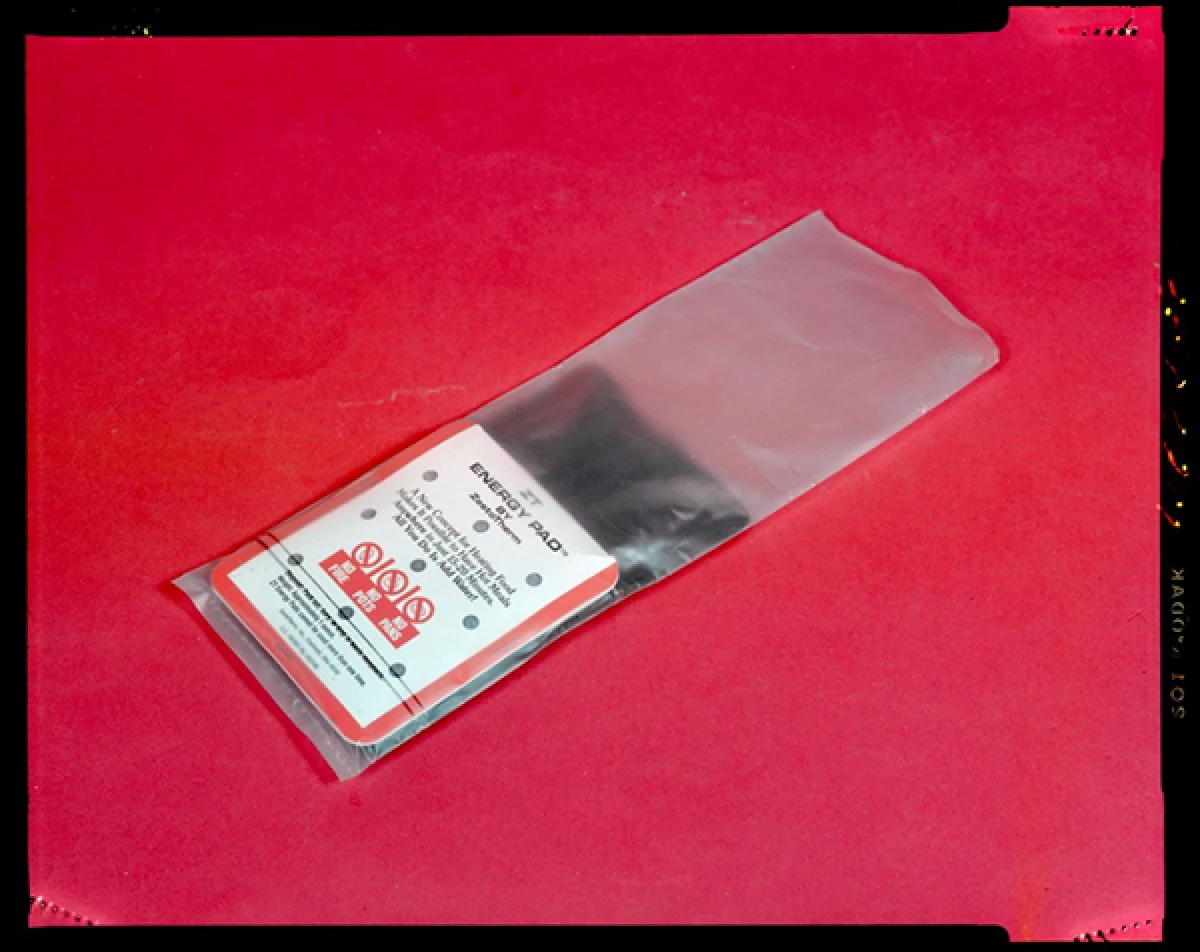
Another characteristic feature of the MRE is the FRH (Flameless Ration Heater), a flameless heater.
Its task is simple: heat the main entrée without a fire, burner, or field kitchen. For a military unit, this means less dependence on external conditions and the ability to obtain hot food where starting a fire is undesirable or there simply is not enough time.
Army research shows that the heater can raise the temperature of the main entrée by approximately 100°F in about 12 minutes.
The technology seems simple, but it is precisely details like these that turn a field ration from a “food supply” into an autonomous feeding system.
Why MREs keep changing
With the old military ration, the main question was: “Can it be stored and delivered?”
For a modern MRE, the question is much broader:
-
does the service member receive enough calories;
-
does the ration match the physical workload;
-
can it be eaten without a kitchen;
-
will the packaging withstand long-term storage;
-
does the menu become monotonous;
-
is the ration suitable for heat, cold, or a prolonged march?
This is why other specialized rations exist alongside MREs.
For example, the FSR (First Strike Ration) is designed for situations in which a service member has to eat literally while moving. MCW (Meal, Cold Weather) is intended for cold climates, while MORE (Modular Operational Ration Enhancement) makes it possible to increase the energy value of the basic ration when requirements are higher.
Modern U.S. materials also feature the CCAR (Close Combat Assault Ration) – a compact daily ration for extended autonomous operations.
In other words, today it is more accurate to speak not of a single “modern field ration”, but of an entire system of specialized rations.
The field ration today: from military ration to autonomous nutrition
The modern field ration has long moved beyond the traditional army kitchen. It is used by military personnel, tourists, rescuers, travelers, and people who need a food supply independent of a refrigerator and kitchen.
The technologies continue to develop as well. Freeze-drying makes it possible to significantly reduce the weight of food, dehydration creates lightweight products with long shelf lives, and retort packaging makes it possible to preserve ready-to-eat meals without a traditional metal can.
We have covered how modern preservation technologies actually work, what types of field rations exist, and where they are used today in a separate article, “Modern Field Rations: How Technology Changed Field Nutrition”.
And if what you need is not simply a historical example but a real American MRE, today's market offers both individual rations and 12-meal cases. For example, the American MRE sold by Punisher contains approximately 1,250 kcal per pouch, while a case of 12 rations weighs approximately 13-20 lb, depending on the configuration.
In the modern American system, even cold-weather conditions can affect the choice of ration. Army materials note that a standard MRE contains approximately 8 fluid ounces of water, so its contents can freeze in extreme cold. Special MCW rations and additional energy products are used for such conditions.
The history of the military field ration is a journey from a simple collection of food products to a high-tech field feeding system. At first, the main task was simply to feed the soldier. Requirements for weight, shelf life, transportation, calorie content, and preparation method were added later.
C-ration solved the problem of ready-to-eat canned food, LRP demonstrated the advantages of lightweight dehydrated products, and MRE combined a ready-to-eat meal, specialized packaging, and autonomous heating. Today, military nutrition has gone even further: different types of rations are used for different tasks, while menus and composition are constantly reviewed.
Therefore, the modern field ration is no longer simply “food in a box”. It is the result of decades of development in military logistics, food science, and packaging technology.

Igor Ivandikov — author of the article
Project Manager
Has over 3 years of experience working in the field of camping equipment. Well-versed in products for tourism, camping, and outdoor recreation.
Responsible for coordinating projects, monitoring deadlines, and ensuring the quality of task completion.
He enjoys football (soccer) and billiards, participates in competitions, and has won prizes on numerous occasions. He is a fan of active recreation.
FAQ: Answers to Frequently Asked Questions
1. What is an MRE?
2. When did the modern MRE appear?
3. What is included in a modern field ration?
4. How is an MRE different from an ordinary field ration?