Until relatively recently, most unmanned ground vehicles could only be seen at specialized exhibitions or during proving ground trials. Today, however, they are increasingly operating alongside infantry, delivering ammunition, evacuating the wounded, conducting reconnaissance, or supporting assault groups with suppressive fire. While FPV drones have already become the "eyes" of the modern military, ground robots are gradually turning into its resilient "hands".
We’ve already covered the history of ground-based robotic systems in detail in a separate article, including their evolution from the first remotely controlled vehicles to modern combat platforms. This time, our guide from the Punisher military store suggests focusing on the most interesting aspects: which Ukrainian ground-based robotic systems are already in use on the battlefield, how they differ from one another, what technologies underpin them, what global counterparts to these systems exist, and what the next generation of combat robots will look like.

From the Proving Ground to the Frontline: Why UGVs Began Developing at an Explosive Pace After 2022
The full-scale war has altered not only the nature of combat operations but also the very philosophy behind creating military equipment. While developers were previously required to produce multi-purpose platforms capable of performing a wide range of tasks, today the primary criterion is practical efficiency.
The frontline quickly demonstrated that a robot does not necessarily need to do everything. A specialized system that flawlessly performs one specific task – delivering ammunition, evacuating the wounded, transporting a mortar, conducting reconnaissance, or supporting infantry with fire – is significantly more valuable. This is precisely why modern Ukrainian UGVs increasingly resemble a set of highly specific tools. Just as a good mechanic has a separate wrench for every single nut, a modern military unit is gradually receiving a dedicated robot for every dangerous mission.
According to estimates by Ukrainian military experts, a single logistics robot can accomplish work within twenty-four hours that previously required multiple runs by a resupply team under constant threat of mortar fire and FPV drone strikes. Most importantly, it is a machine risking itself rather than a human being.
A Modern Ground Robot Is No Longer Just a "Remote-Controlled Car"
Many people still picture a UGV as a wheeled platform with a basic remote control. In reality, a modern combat robot is much closer to a self-driving car than to a toy model. A typical Ukrainian unmanned ground vehicle consists of several interconnected systems:
-
A modular chassis.
-
An electric or hybrid powertrain.
-
A digital autopilot.
-
Inertial and satellite navigation.
-
A suite of daylight and thermal imaging cameras.
-
Laser rangefinders or other sensors.
-
A secure digital communication channel.
-
Software that coordinates the operation of all systems.
Effectively, it is a compact autonomous vehicle that an operator can control from tens of miles away from the line of contact.
Depending on the platform class, the payload capacity of modern Ukrainian UGVs ranges roughly from 110 to 175 pounds for compact logistics robots up to 1,760 to 2,640 pounds for heavy transport systems. The maximum speed is typically between 6 and 15 miles per hour on rugged terrain, although certain wheeled models can travel significantly faster on paved roads. Furthermore, most modern platforms feature an operational range spanning from 12 to 25 miles in difficult conditions up to 60 miles or more, depending on the drive type, terrain topography, and cargo weight.
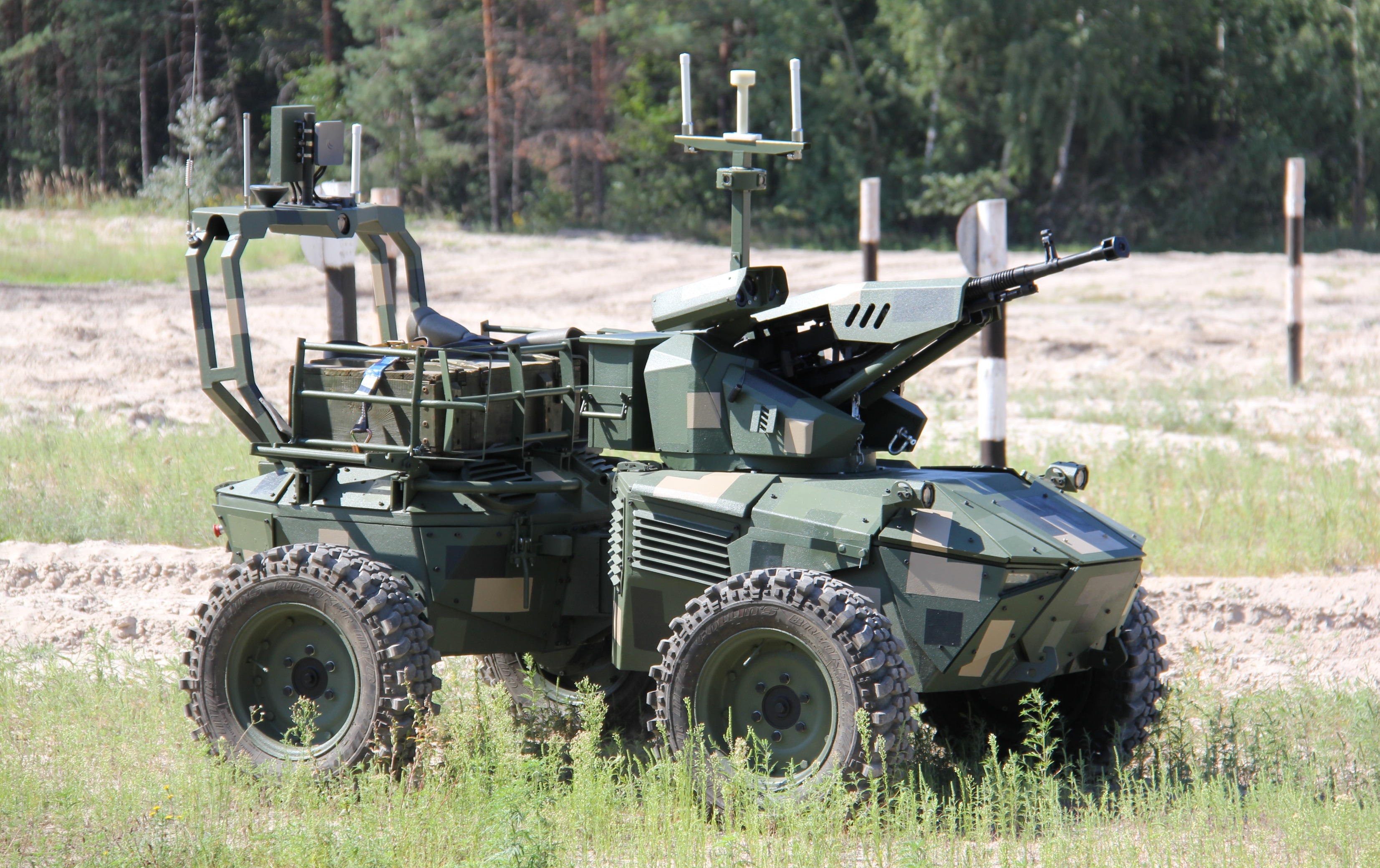
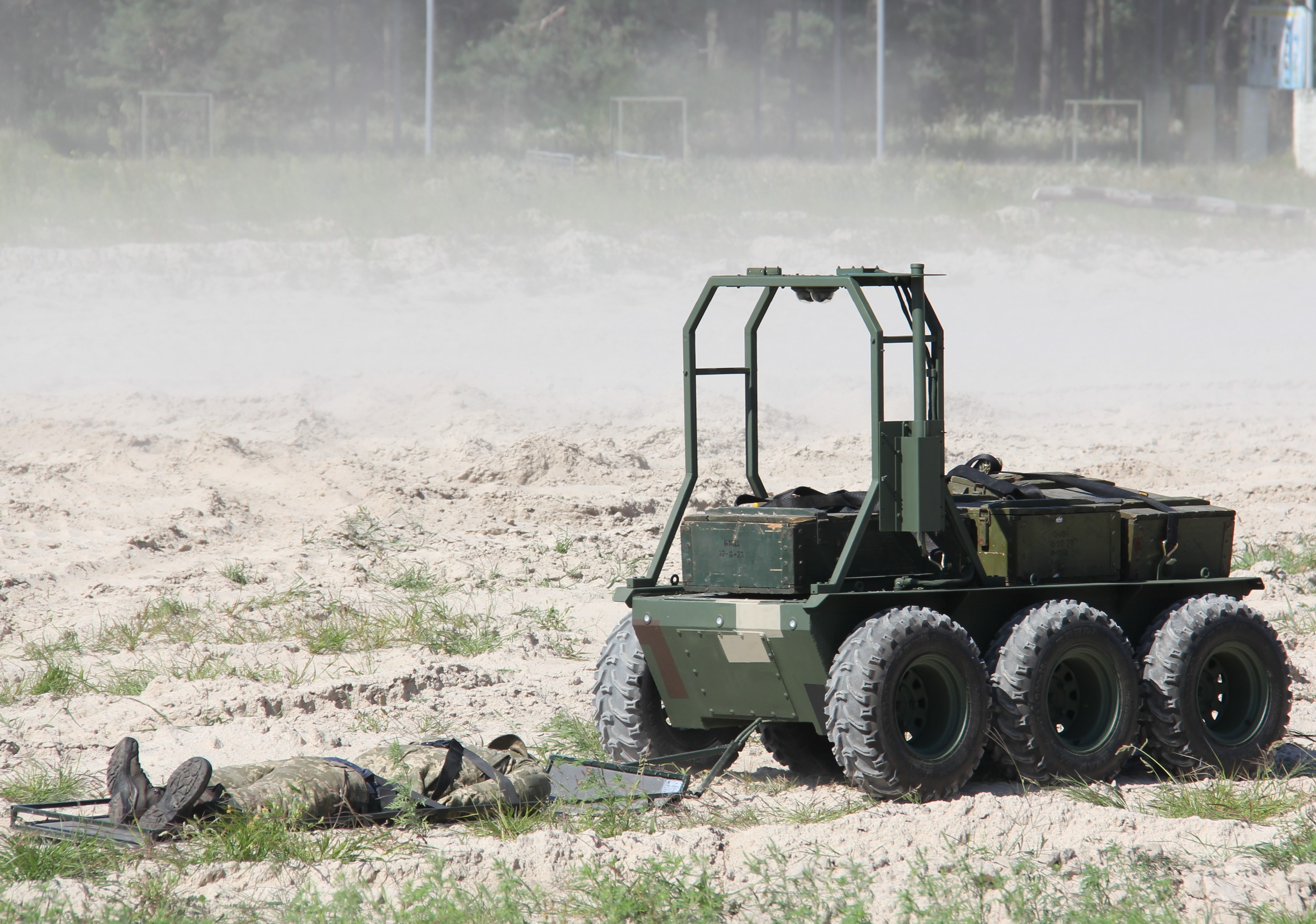
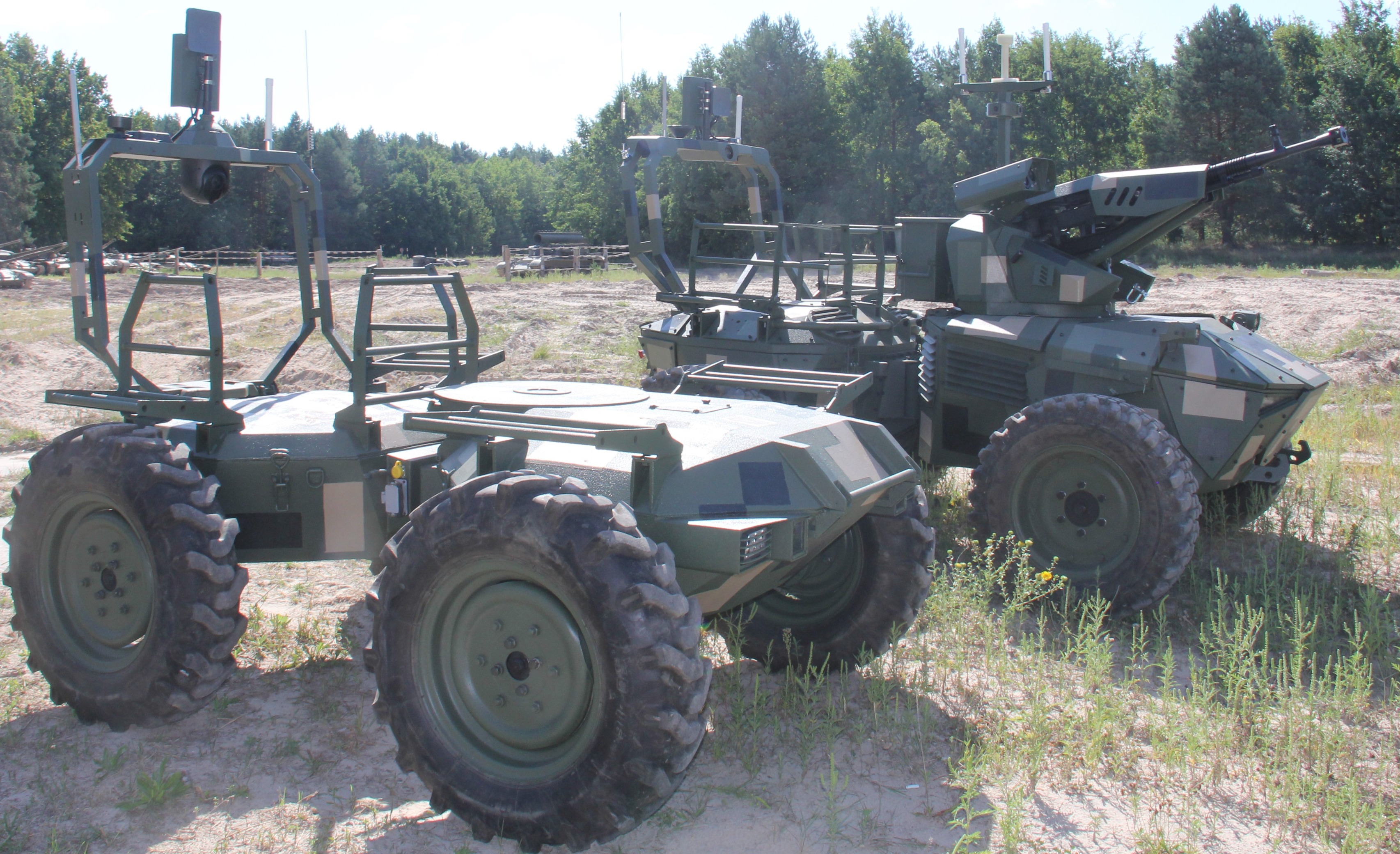
In 2021, at the Prince Yaroslav the Wise 169th Training Center in Desna, a series of domestic robotic platforms was demonstrated to the Ministry of Defense of Ukraine for the first time. Back then, it looked like a promising developmental direction. Today, most of the ideas conceived at that time have passed the harshest trial of all: actual combat.
Ukrainian Ground Robots Already Hard at Work on the Frontline
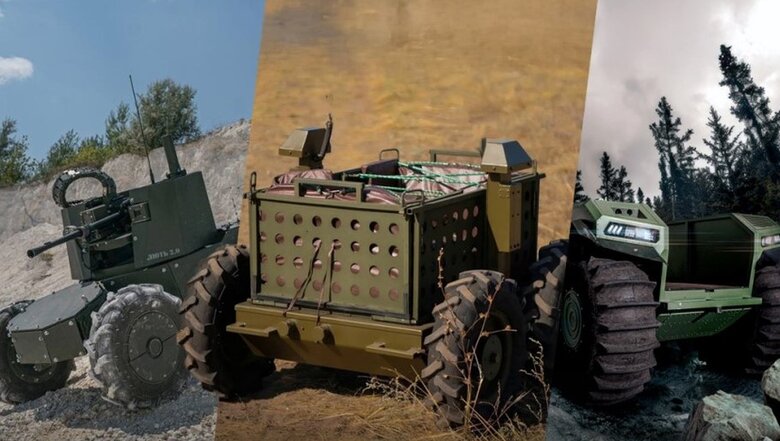
While a few years ago one could only speak of isolated experimental prototypes, today an entire generation of proprietary robotic platforms has emerged in Ukraine. Each was built for specific combat tasks, meaning universal machines practically do not exist.
"Lyut" (Fury) – The First Ukrainian Next-Generation Combat Robot
One of the most famous Ukrainian developments is the "Lyut" unmanned ground vehicle, officially approved for operation within the Defense Forces of Ukraine. Unlike logistics platforms, its primary objective is to provide direct fire support to units.
The system features a remote weapon station armed with a machine gun, daylight and thermal cameras, a weapon stabilization system, and a digital control link. This allows the operator to observe and open fire while remaining at a safe distance.
The designers paid special attention to cross-country mobility. Large wheels, independent suspension, and a low center of mass ensure steady movement over rough terrain, trenches, and ruined landscapes where conventional vehicles frequently lose mobility.
The operating principle of "Lyut" closely resembles an uncrewed armored car: the machine can be the first to enter hazardous zones, cover assault groups, or observe the enemy without exposing personnel to unnecessary risk.
TerMIT – The Logistics Robot Lifting the Weight
One of the most successful Ukrainian transport platforms is the TerMIT. Its primary mission is not to shoot, but to assist soldiers where every extra pound literally drains physical strength. The system transports:
-
ammunition;
-
water;
-
fuel;
-
engineering equipment;
-
generators;
-
medical supplies;
-
casualty evacuation gear.
Depending on the modification, the platform can transport several hundred pounds of cargo and move confidently across challenging terrain. For logistics units, this translates to a significant reduction in the number of dangerous sorties personnel must make under artillery or FPV drone strikes.
As the soldiers themselves note, the main advantage of the TerMIT lies not only in its payload capacity. The robot does not get tired, requires no rest, and can repeatedly make round trips between the rear and the forward edge, conserving the energy of the troops.
Ratel S – A Compact Robot for the Most Hazardous Missions
Among Ukrainian robotic platforms, the Ratel family, developed by Stark Defence, draws particular attention. While most UGVs were created as multi-purpose workhorses, the Ratel was designed from the outset for maximum-risk operations where sending humans would mean unjustifiably risking their lives.
The most famous variant is the Ratel S. It is a compact, high-speed wheeled platform with a low silhouette, capable of quickly crossing open areas of terrain. Thanks to its small dimensions, the robot is less visible to the enemy, and its high maneuverability allows it to operate effectively even in complex cross-country environments.
Depending on the task at hand, the platform can be utilized for engineering operations, delivering specialized equipment, or executing other missions requiring uncrewed transport. The architecture was built on a modular principle, which significantly simplifies adaptation to the various needs of different units.
An important feature of the Ratel is the widespread use of commercial-off-the-shelf components. This shortens production time, eases repairs, and lowers operational costs – a factor that during wartime sometimes carries as much weight as record-breaking technical specifications.
Camel – When a Robot Becomes a Frontline Truck
The Camel did not get its name by accident. Much like a real camel, this robot is built to transport substantial payloads under harsh conditions where conventional vehicles or humans encounter immense difficulties.
The primary purpose of the system is to supply forward positions with everything necessary. Ammunition, water, fuel, rations, spare batteries for FPV drones, and medical equipment – the Camel can deliver all of this without human involvement.
In practice, this seemingly straightforward function is of paramount importance. According to modern combat statistics, a significant portion of casualties occurs not only during assaults, but also during routine ammunition resupply or casualty evacuation. If a robot takes over this hazardous duty, the risk to personnel drops substantially.
The engineers paid close attention to off-road capability. Large wheels or tracked modifications (depending on the version) allow it to traverse dirt roads, sand, snow, mud, and highly uneven terrain surfaces.
According to military logistics experts, in modern warfare, a single successful run by a transport UGV sometimes saves more human resources than an additional armored car. The robot does not require an armored cabin, crew life-support systems, or rest, and it is ready to hit the route again immediately after recharging or refueling.
Ardal – Relying on Versatility
Not all Ukrainian robots are built for narrow specialization. One example of a different approach is the Ardal platform, which was developed as a multifunctional base for mounting diverse equipment.
Effectively, the Ardal can be compared to a LEGO set for the military. The same chassis can be fitted with a transport module, evacuation gear, a reconnaissance suite, or engineering tools. This approach significantly simplifies the production and maintenance of the hardware.
Another advantage is rapid adaptation to new challenges. If the military requires a new type of equipment tomorrow, it is sufficient to design the corresponding module rather than engineering an entirely new machine from scratch. Modularity is currently considered one of the leading global trends in unmanned ground platform development.
Sirko – The Compact Infantry Helper
Another avenue of Ukrainian development involves ultra-light mobile robots that can operate directly alongside assault teams. The Sirko belongs to this class of platforms. Its primary advantage is its small footprint. Because of this, the robot is easily transported by a car or trailer, deploys rapidly at a position, and requires no complex infrastructure. Such systems are most frequently used for:
-
delivering ammunition;
-
bringing up water;
-
evacuating the wounded;
-
transporting FPV drones;
-
moving generators and batteries;
-
supplying positions in hard-to-reach areas.
These machines are increasingly referred to as the "last mile of military logistics" – they deliver cargo to places where large vehicles can no longer safely or physically venture.
Ironclad – The Ukrainian Take on the Combat Robot of the Future
Among promising Ukrainian platforms, the Ironclad project deserves special mention. It is being created as a universal robotic base for executing varied combat assignments.
The core concept of the system lies in integrating advanced digital control systems, secure communications, and a modular architecture. This allows the platform to be adapted for transport missions as well as for mounting a variety of specialized gear.
This approach aligns with global trends: developers are increasingly creating universal platforms that can swiftly pivot their specialization depending on the needs of a specific operation, rather than building single-purpose machines.

Ukrainian UGVs: Hard Figures That Speak for Themselves
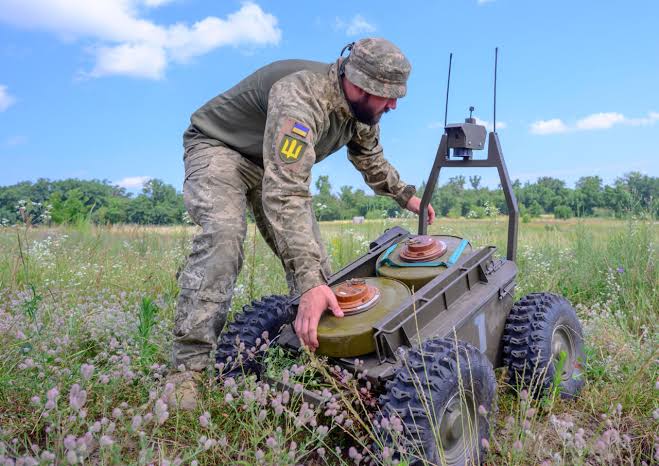
Despite the diversity of models, most modern Ukrainian robotic platforms share common technical traits. The average specifications of contemporary UGVs look approximately like this:
|
Parameter |
Typical Values |
|
Payload Capacity |
330 to 2,640 pounds |
|
Maximum Speed |
6 to 15 miles per hour off-road |
|
Operational Range |
12 to 60+ miles |
|
Drive Type |
Electric or hybrid |
|
Control Link |
Secure digital |
|
Navigation |
GNSS + inertial system |
|
Cameras |
Daylight, thermal, night vision |
|
Operating Temperature |
Approximately -4 to +122 °F (depending on the model) |
These figures can vary depending on the specific model and configuration, and the detailed specifications of many combat platforms remain classified for security reasons. However, even the publicly available data demonstrates how rapidly the Ukrainian engineering school has closed the gap with leading global manufacturers.
Another striking fact is that while at the beginning of the full-scale invasion, most robotic platforms existed as isolated experimental prototypes, today the Ministry of Defense of Ukraine has already codified dozens of domestic UGVs for various purposes – ranging from compact logistics robots to combat platforms featuring remote weapon stations. This indicates a transition from scattered developments to the formation of a fully realized ecosystem of Ukrainian ground robotics.
Next-Generation Technologies: What Will UGVs Look Like Tomorrow?
If you compare a modern unmanned ground vehicle with models from even three years ago, the difference is roughly equivalent to that between a basic flip phone and a modern smartphone. Externally, they might perform similar functions, but internally, completely different technologies are at work.
The primary direction of development today is not increasing caliber or payload capacity, but enhancing autonomy, situational awareness, and battlefield survivability. Software is increasingly determining the combat value of a machine just as much as its armor or engine.
Machine Vision: When a Robot Begins to "See"
Until recently, an operator had to steer the platform almost continuously, carefully watching every turn of the wheels through a video camera feed. Today, more and more Ukrainian and foreign developments are receiving elements of Computer Vision. The software is already capable of:
-
Recognizing roads.
-
Identifying major obstacles.
-
Tracking moving objects.
-
Automatically maintaining a route.
-
Assisting the operator during maneuvering.
While fully autonomous combat solutions are rarely deployed at present, even partial automation substantially reduces the cognitive load on the crew. In effect, the operator is gradually transitioning from a driver into a commander of a robotic system.
Over the past few years, the computational power of the compact processors installed in military robots has grown to such an extent that individual machine vision modules can now operate without connecting to cloud services. The robot analyzes video feeds directly "onboard", which is critically important in environments lacking internet access and characterized by active electronic warfare.

Autonomous Navigation: Moving Even Without GPS
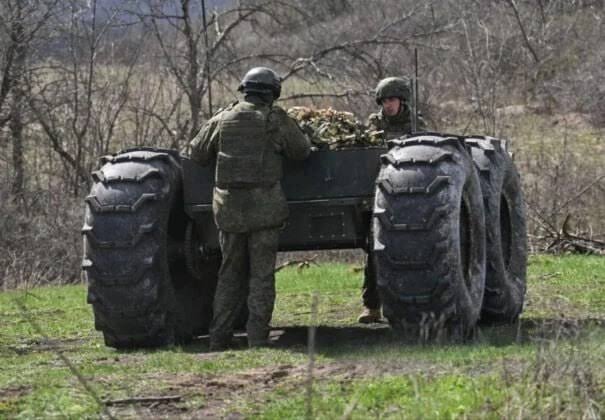
One of the main challenges of modern warfare has been the ubiquitous operation of electronic warfare systems. While a few years ago most unmanned systems relied primarily on satellite navigation, today that is no longer sufficient. Consequently, modern UGVs are increasingly employing multiple coordinate determination systems simultaneously:
-
GNSS (GPS, Galileo, and other satellite systems);
-
inertial navigation modules;
-
digital terrain maps;
-
visual navigation via cameras;
-
odometry (determining displacement based on the rotation of wheels or tracks).
It is precisely the combination of these technologies that allows the platform to keep moving even when the satellite signal is lost or intentionally jammed.
EW Resistance: A Daily Struggle
Virtually every modern robot becomes a participant in an invisible duel between communication systems and electronic warfare complexes. Therefore, manufacturers are actively working on:
-
Digital secure communication channels.
-
Automatic frequency hopping.
-
Telemetry encryption.
-
Redundant control channels.
-
Autonomous return-to-base modes.
In the event of a total loss of signal, the platform does not simply grind to a halt; it executes a pre-programmed algorithm: returning to its starting position, seeking cover, or completing its assigned task.
Mesh Networks: When Robots Help One Another
Another promising direction is the utilization of Mesh Networks. Unlike the traditional setup, where each robot communicates directly with the operator, a Mesh Network allows all platforms to exchange information among themselves. As a result:
-
the range of stable communication increases;
-
individual robots can act as relays;
-
the system becomes less vulnerable to the loss of a single node;
-
the efficiency of an entire group operating together is enhanced.
This is exactly how modern, next-generation military networks operate.
Fiber-Optic Control: A New Trend in Warfare
Following the massive deployment of FPV drones operating via fiber-optic cables, a similar principle is beginning to be considered for certain ground robots. The concept is quite simple. Instead of transmitting signals via radio waves, a thin fiber-optic cable is used, unspooling as the platform moves. The primary advantages include:
-
Virtual immunity to electronic warfare.
-
Stable, high-definition video quality.
-
Minimal signal latency.
-
Impossibility of radio interception.
However, there are obvious drawbacks: limited range, the risk of mechanical cable damage, and the difficulty of operating across dense terrain. Therefore, this technology is unlikely to become universal, but for specific tasks, it can prove highly effective.
The fiber-optic cable used by modern unmanned systems is often only a few tenths of a millimeter thick. Despite this, it is capable of transmitting high-quality video and telemetry virtually lag-free while remaining immune to most electronic warfare assets.
Robot + Drone = A New Level of Interaction
Just a few years ago, ground robots and unmanned aerial vehicles operated separately. Today, they are increasingly becoming a unified combat system. A typical scenario unfolds as follows:
-
An FPV or reconnaissance UAV locates a target.
-
The coordinates are automatically transmitted to the ground robot.
-
The UGV advances via a concealed route.
-
The robot executes the assigned task.
-
The drone monitors the outcome and adjusts subsequent actions.
This principle significantly compresses reaction times and minimizes risks to military personnel.
Global Counterparts: Who Else Is Developing Ground Robots?
Although Ukraine currently possesses unprecedented practical experience in operational UGV deployment, leading nations around the world are also actively working on similar systems.
The United States
The U.S. Army is executing the Robotic Combat Vehicle (RCV) programs, which encompass light, medium, and heavy combat robots. Companies like General Dynamics, Textron, QinetiQ, and others are creating platforms for:
-
conducting reconnaissance;
-
escorting infantry;
-
remote precision strikes;
-
logistics.
Special emphasis is placed on autonomy and artificial intelligence integration.
Israel
Israel is traditionally one of the global leaders in unmanned technology. The Jaguar UGV platform, created by IAI, is already deployed for border security operations. It comes equipped with:
-
a remote weapon station;
-
thermal imaging cameras;
-
automated detection systems;
-
a high level of autonomy.
Germany
Rheinmetall has developed the Mission Master family of robotic platforms, which can perform dozens of different functions due to their modular design. Variants include:
-
transport;
-
medical;
-
reconnaissance;
-
combat;
-
engineering.
Modularity is increasingly becoming the baseline standard of the global market.
Estonia
Despite the country's small size, Milrem Robotics has created one of the most famous platforms in the world: the THeMIS. Today, it is in service or undergoing trials in more than a dozen NATO countries. The THeMIS is used for:
-
casualty evacuation;
-
cargo delivery;
-
engineering works;
-
mounting combat modules.
The German Sd.Kfz. 302 Goliath is frequently cited as the first production combat ground robot. Despite appearing over eighty years ago, its core concept – delivering an explosive charge to a target without risking the operator – is effectively experiencing a second birth today in the form of modern kamikaze robotic platforms.


Why Is Ukraine Setting the Pace Today?
Paradoxically, the main advantage for Ukrainian developers has been real-world combat experience. Where foreign companies conduct proving ground trials a few times a year, Ukrainian engineers receive a massive volume of practical data literally every day. Every deployment of a robot to the frontline becomes a source of fresh data: what needs reinforcement, which components are operating at their absolute limits, how the hardware behaves under fire, in thick mud, under EW exposure, or after repeated high-impact loads.
Because of this, the refinement cycle for Ukrainian platforms is measured not in years, but sometimes in just a few weeks. This is a priceless experience that manufacturers and military specialists worldwide are studying intently today. In modern warfare, victory does not go to the one who built a perfect machine once, but to the one capable of adapting it to new threats the fastest.
During just the first half of the year 2026, the Ministry of Defense of Ukraine has already contracted over 22,000 UGVs for the needs of the Armed Forces of Ukraine, which is nearly double the amount contracted during the entirety of the previous year, 2025.
What Will the Next Generation of Ground Robots Look Like?
If you look closely at the trajectory of modern technology, it becomes obvious: we are only at the beginning of a major robotic revolution. Today, most ground complexes still require constant operator oversight; however, in the coming years, their role will transform drastically. The future belongs not to isolated robots but to networks of robotic systems working in concert with drones, electronic warfare assets, artillery, reconnaissance suites, and a unified digital command-and-control network.
Imagine a scenario: a reconnaissance UAV spots the enemy, an algorithm instantly assesses the threat level, the command post automatically determines the optimal response, and the nearest ground robot receives a route and sets off toward the designated point autonomously. The human no longer steers every movement of the machine, but instead merely monitors the execution of the combat mission and makes the ultimate decision regarding weapon employment. This very concept is being actively explored by the defense departments of the United States, the United Kingdom, Israel, and other NATO member states.
Another promising direction is the integration of robotic platforms with advanced military exoskeletons. While an exoskeleton will enhance the physical capabilities of an individual soldier, a ground robot will become their constant companion, carrying ammunition, water, spare batteries, communication equipment, or even automatically evacuating them if they are wounded. This tandem will allow an infantryman to remain maximally mobile and focused on the combat objective.
Medical technologies are developing no less dynamically. Biometric sensors capable of tracking a service member's pulse, body temperature, physical exertion levels, and other vital signs are already being tested. In the future, such data could be automatically relayed to a command post or medical service, and the nearest evacuation UGV would receive a command before the soldier even has a chance to report a wound.
In other words, the ground robot of the future is no longer just a remote-controlled cart or a platform fitted with a weapon. It is a fully integrated element of the digital battlefield, constantly exchanging information with other participants in the combat network.
Military analysts are increasingly using the term Manned-Unmanned Teaming (MUM-T). Initially, this concept applied exclusively to combat aviation, but today it is being actively adapted for ground robots. In the near future, a single service member could simultaneously coordinate the actions of several UGVs performing distinct tasks on the battlefield.
See Also
If you are interested in other cutting-edge military technologies, we recommend checking out the materials on the Punisher blog:
-
Unmanned Ground Vehicles (UGVs): The Infantryman's Faithful Companion;
-
Drone Interceptors: Fighting Fire with Fire or an Effective Response to Modern Threats;
-
Modern Ballistic Helmets: A Multi-Layered Understanding of Protection.


Unmanned ground vehicles have ceased to be a futuristic concept or mere demonstration experiments at proving grounds. They are steadily becoming a fully realized tool of modern warfare, taking on the most hazardous tasks – from delivering ammunition and evacuating the wounded to conducting reconnaissance, providing engineering support, and providing fire support. Where service members risked their lives just a few years ago, machines are now increasingly stepping in.
It is particularly gratifying that Ukraine is not merely utilizing global developments but is one of the leaders driving this field forward. Domestic platforms are constantly refined in actual combat conditions, and their designs frequently evolve faster than corresponding foreign projects can pass a single testing phase. It is this invaluable practical experience that makes Ukrainian UGVs highly competitive globally.
The future of war increasingly resembles a complex mechanism in which humans, drones, ground robots, artificial intelligence, and digital networks operate as a single organism. And while a robot will not be able to fully replace a soldier for a long time to come, becoming their dependable partner that takes on the highest-risk work is entirely achievable today. That is why the development of unmanned ground vehicles is not just another chapter in military history, but one of the core directions shaping the army of the future. And to increase the chances of living to see that future, acquiring high-quality equipment and protection for the soldier remains paramount today!

Vitalii Buniak — article author
Military gear consultant
Before 2022, he worked as a sales assistant at the Panisher store. After the start of the full-scale invasion, he joined the Armed Forces of Ukraine, gaining real combat experience.
Thanks to his combat experience and deep knowledge of tactical gear, Vitalii serves as a personal expert of the Panisher online store in the fields of:
- Clothing and footwear
- Equipment
His recommendations help customers choose reliable and functional gear for any conditions.
FAQ: Answers to Frequently Asked Questions
1. Can ground robots completely replace military personnel?
2. How effective are UGVs in environments with active electronic warfare?
3. What tasks do modern Ukrainian ground robots perform most frequently?
4. What future lies ahead for unmanned ground vehicles?