Until quite recently, the very idea of a drone hunting another drone sounded like something on the verge of science fiction – as if military techno-thriller screenwriters had gotten a bit too carried away with the future. But war, as has happened more than once in history, does not ask if the world is ready for new rules. It simply erases the old ones. And if just yesterday the sky was considered the territory of missiles, aviation, and large radars, today a new class of weapons is operating in it with growing confidence: interceptor drones.
For Ukraine, this is no longer an exotic concept or an experimental "engineer's toy." It is a response to a very specific problem: the mass employment of enemy unmanned aerial vehicles (UAVs), ranging from reconnaissance "eyes" to loitering munitions like the Shahed. And this response was born not in the quiet of offices, but under the pressure of real war, where every mistake carries a price and every successful solution immediately undergoes a trial by fire.
Today, the sky over Ukraine increasingly resembles a multi-tiered battlefield, where reconnaissance assets, strike UAVs, FPV drones, loitering munitions, electronic warfare (EW) systems, and conventional air defense operate simultaneously at different altitudes. And among all these elements, an increasingly prominent role is being played by FPV interceptors and other specialized drones designed to destroy enemy UAVs.
In a sense, this is the new logic of modern warfare: when a threat comes from the sky in the form of cheap, mass-produced, and relatively simple drones, the defense must also be mobile, mass-produced, fast, and economically viable. This is exactly why the "drone-versus-drone" concept has ceased to be a bold theory and has turned into one of the most promising directions in the development of counter-UAS technologies. The topic is highly fascinating and filled with nuances, so make yourselves comfortable! Let's dive into the details together with an expert from the Punisher military store.

How Humanity Arrived at the Idea of "Drone Hunters"
Any military technology follows roughly the same path. At first, it seems like an expensive hobby for a narrow circle of specialists. Then, it becomes a useful but niche tool. And eventually, after a major conflict, it suddenly becomes the norm. This is precisely what happened with drones.
The first UAVs were primarily reconnaissance platforms. Large, expensive, and complex, they were accessible to very few armies. They operated as "flying eyes" – monitoring, transmitting coordinates, and helping correct artillery fire. The threat from them existed, but it was not yet a mass phenomenon.
The turning point occurred when several technological trends converged at a single point:
-
compact electronics became cheaper;
-
electric motors became more accessible and efficient;
-
navigation systems simplified the operation of small platforms;
-
civilian quadcopters learned to fly stably, far, and relatively easily.
And so, what yesterday was filming weddings, rooftops, or Carpathian slopes today began correcting artillery, dropping munitions, and functioning as strike systems. The war in Ukraine has only accelerated this process to the speed of a jet engine.
After 2022, it became obvious: drones are not a supporting element of war, but a separate dimension of combat operations. FPV drones have transformed into a tool for destroying hardware and positions, reconnaissance UAVs have become the nervous system of units, and long-range strike drones have become a means of applying pressure on the rear, infrastructure, and logistics.
Along with this, another problem arose: how do you shoot all of this down?
When an enemy drone costs several times less than an air defense missile, conventional air defense begins playing an economically disadvantageous game. It is like trying to put out a campfire with gold ingots: technically possible, but you cannot last long that way. This is exactly where a logical question arises, one that effectively became the birth point of a new class of weapons: can a means of interception be created that matches the target itself in price?
The answer came in the form of interceptor drones.

Why Interceptor Drones Have Become So Relevant Right Now
There is more than one reason. In fact, there are several – and they all come down to the new economics of war.
Once, the main aerial threats were airplanes, helicopters, and cruise missiles – targets that were expensive, complex, and relatively few in number. It was logical to deploy expensive effectors against them. Today, the situation is different: one side can launch dozens or even hundreds of cheap drones over the course of a single night, forcing the defense to react to a mass of relatively small targets.
For air defense, this creates several problems at once:
-
it is necessary to track many aerial targets simultaneously;
-
expensive interceptors must be spent on objects that cost significantly less;
-
the workload on air defense crews increases;
-
the question arises not just "can we shoot it down?", but also "how much does one shoot-down cost?".
This is exactly why interceptor drones today are not just a new type of UAV, but an attempt to balance the cost of attack versus the cost of defense. If an FPV interceptor can destroy an enemy drone for noticeably less money than an anti-aircraft missile, it becomes more than just useful – it becomes strategically essential.
Another point is also vital: interceptor drones are not trying to "cancel" conventional air defense. They close its most painful gap – the fight against massed, small-sized aerial targets, where using a heavy missile or an air defense system is simply economically unviable.
And that is their main strength. They do not claim to be a universal weapon against everything that flies. They occupy their own niche – and they are doing so with increasing conviction.

How an Interceptor Drone Works: From Target Detection to Attack
Despite the futurism of the term, the operational logic of an interceptor drone is quite straightforward. To simplify, it is a small aerial fighter that must ascend into the sky as quickly as possible, find the target, catch up with it, and neutralize it.
The operational workflow typically looks like this:
1. Enemy Drone Detection
First, someone has to spot the target. This can be achieved by:
-
radars;
-
acoustic systems;
-
optical observation posts;
-
specialized airspace monitoring assets;
-
a network of operators and observers.
In modern warfare, information is often more valuable than the drone itself. An interceptor without target data is like a hunter in the fog: it might be very fast, but it will be hunting blindly.
2. Interceptor Launch
After receiving the coordinates or the direction of the target, the operator launches the drone into the air. Critical factors here include:
-
launch speed;
-
rate of climb;
-
connection stability;
-
the crew's readiness to launch literally "on the fly".
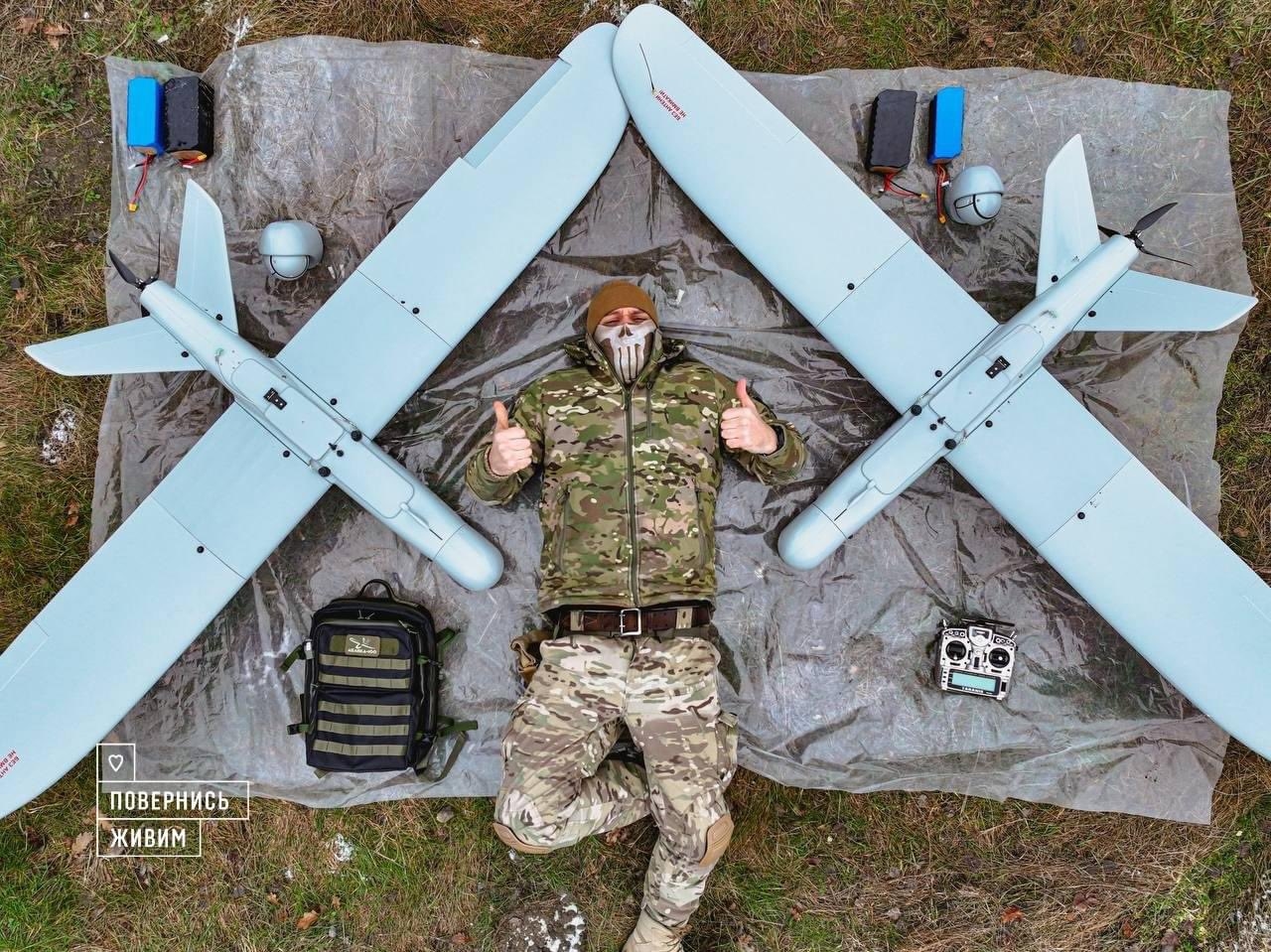
This is why the topic of mobile crews and FPV drone backpacks is not secondary here – it directly impacts combat effectiveness. An interceptor must be fast not only in the sky but also on the ground: in deployment, preparation, transport, battery swapping, and re-launching.
3. Search, Interception, and Tracking
This is the most difficult stage. Relatively speaking, the drone needs to do what fighter jets used to do: locate a target in space, intercept its path, and hold it within the engagement zone.
Crucial elements here include:
-
maximum speed;
-
maneuverability;
-
video feed quality;
-
control stability;
-
operator experience;
-
increasingly – computer vision and automated target tracking elements.
This is where the interceptor drone stops being "just an FPV". It begins to resemble a miniature fighter jet that requires not just a motor and a camera, but a complete combination of aerodynamics, software, electronics, and tactics.
4. Final Attack
After locking onto the target, the interceptor enters the engagement phase. Depending on the design, this can involve:
-
a kinetic ramming attack;
-
contact detonation of a warhead;
-
detonation near the target;
-
advanced solutions featuring AI guidance and more precise selection of the impact point.
And this is where the most interesting engineering question begins: is it better to simply bring down the platform or strike it in a way that minimizes risks on the ground?

Not Just Shooting Down, But Neutralizing: Why Detonating the Warhead in the Air Is Being Talked About More Often
At first glance, the logic is simple: if an enemy drone is flying toward a target, it just needs to be destroyed. But in reality, it is more complicated. Because a downed drone does not disappear – it falls. And if it is a Shahed, a loitering munition, or a UAV carrying a warhead, the fall can create a new threat on the ground.
That is why the modern logic of counter-drone warfare is gradually shifting from the principle of "destroy at all costs" to the principle of "neutralize the threat in a way that minimizes consequences".
The Problem with Conventional Downings
If an interception occurs via ramming or a nearby explosion, the results can be as follows:
-
the target falls uncontrollably;
-
the munition remains active;
-
debris scatters over a large area;
-
the crash site is often unpredictable.
This is particularly critical for:
-
loitering munitions like Shahed/Geran;
-
UAVs with high-explosive warheads;
-
aerial targets over cities, roads, energy facilities, or dense urban areas.
Where Development is Heading
The most promising direction is the controlled destruction of critical components or the warhead of the target in the air, rather than a crude "breaking of the entire machine". Broadly, this can be called a transition from "shooting down" to "controlled neutralization".
Several approaches are being considered here:
1. Striking the Warhead or a Critical Component
The idea is simple: you do not necessarily have to blow up the entire drone. Sometimes it is more advantageous to hit the part that:
-
is responsible for detonation;
-
holds the fuel system;
-
controls the flight;
-
provides the platform's stability.
Theoretically, this allows the defense to either trigger a mid-air detonation or deprive the drone of its ability to continue its mission in a more controlled manner.
2. Proximity Engagement at Close Range
One of the most promising directions for next-generation interceptor drones is abandoning mandatory ramming. The interceptor approaches the target to a critical distance and detonates a small charge next to a vulnerable zone.
The advantage is obvious: fewer chaotic collisions, less randomness, and a better chance of detectably destroying the exact dangerous element.
3. AI Analysis of Vulnerable Zones
Another important vector involves computer vision and artificial intelligence, which can help determine:
-
where the warhead is located on a specific type of UAV;
-
where the engine is;
-
where the control unit is;
-
where it is best to strike to ensure the attack is completely disrupted, rather than just "damaged."
This sounds highly logical, but there is also a sober reality: hitting a specific warhead is significantly more difficult than simply hitting a drone. It is almost like trying not just to hit a car, but at a speed of 125 mph, precisely hitting its most vulnerable component. Therefore, in the coming years, the real path will likely be a hybrid one: first, reliable interception, and in parallel, a gradual increase in the precision and control of the strike.
What kinds of interceptor drones are currently operating in Ukrainian airspace?
While just a few years ago, drone interception was talked about primarily as a prospect, it has now become a distinct class of weaponry developing literally in real time. And Ukraine has become one of the primary catalysts for this process.
The reason is simple: no one else in the world has gained such a dense, diverse, and brutal combat experience in countering drones as Ukraine. FPV drones, Shaheds, reconnaissance UAVs, "flying wings", multi-rotor craft, long-range strike systems – all of this has forced a search not for a single "magic button," but for an entire line of solutions.
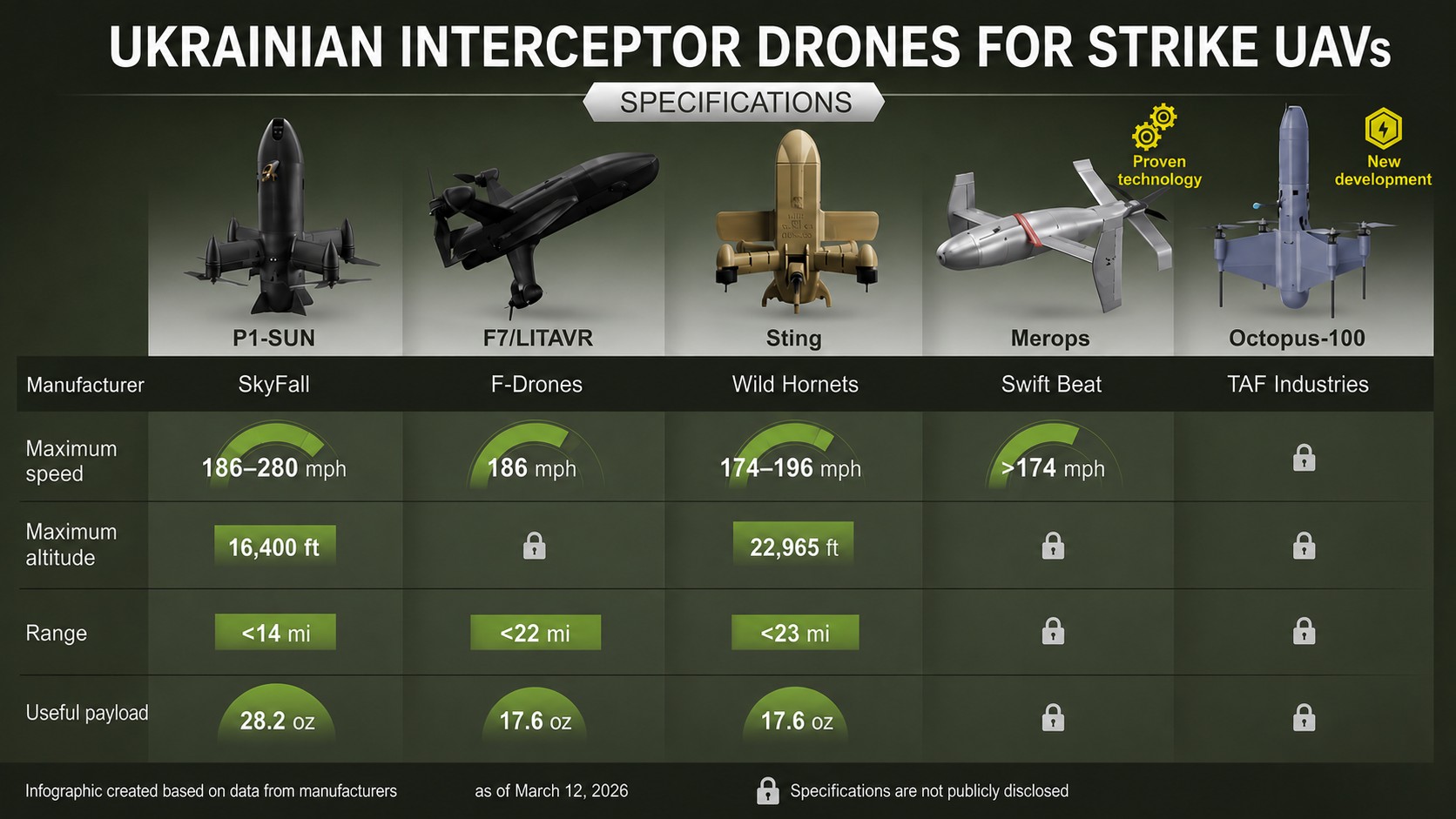
Sting – A Bet on Speed
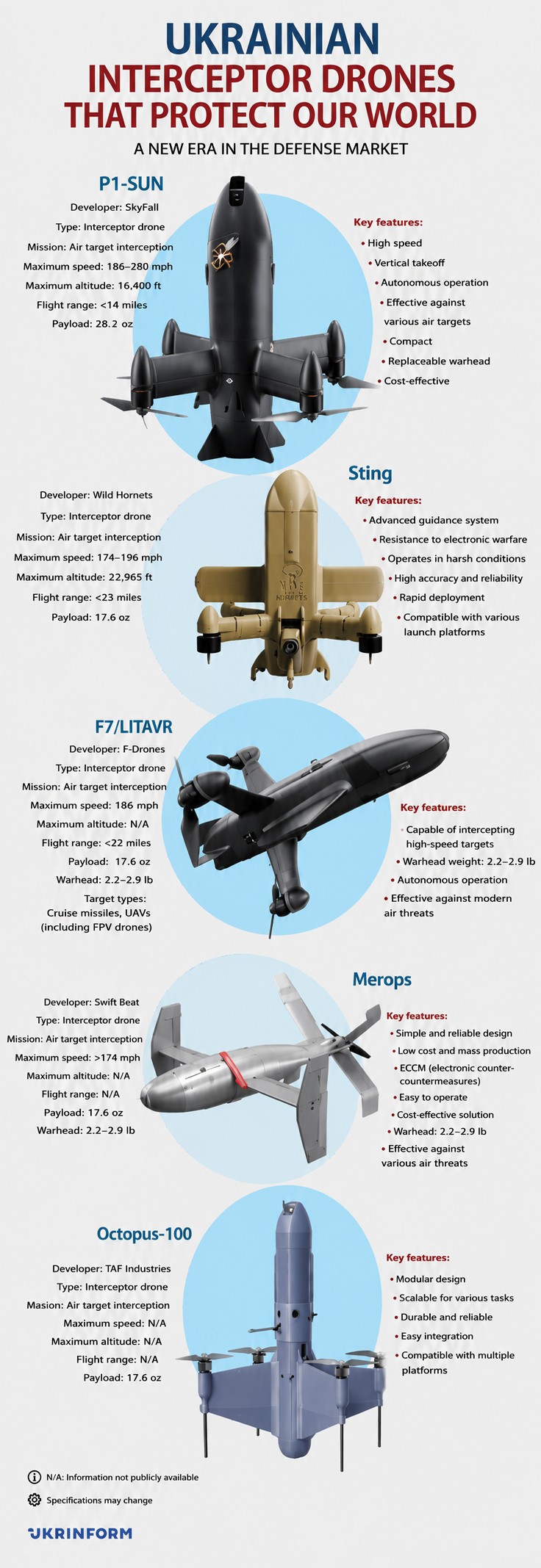
One of the most prominent Ukrainian projects in this field is Sting. Its concept is simple yet ruthless: catch up, intercept, destroy. The primary emphasis is placed on countering strike drones like the Shahed and other targets operating at medium altitudes that require high closing speeds.
Relatively speaking, if a classic FPV drone can be compared to a maneuverable motorcycle, then Sting is a race car on steroids, tailored for a short, aggressive, and effective aerial dash.
For this class of interceptors, the following are critically important:
-
a powerful propulsion system;
-
minimal weight;
-
a stable control link;
-
fast autopilot response;
-
well-engineered body aerodynamics.
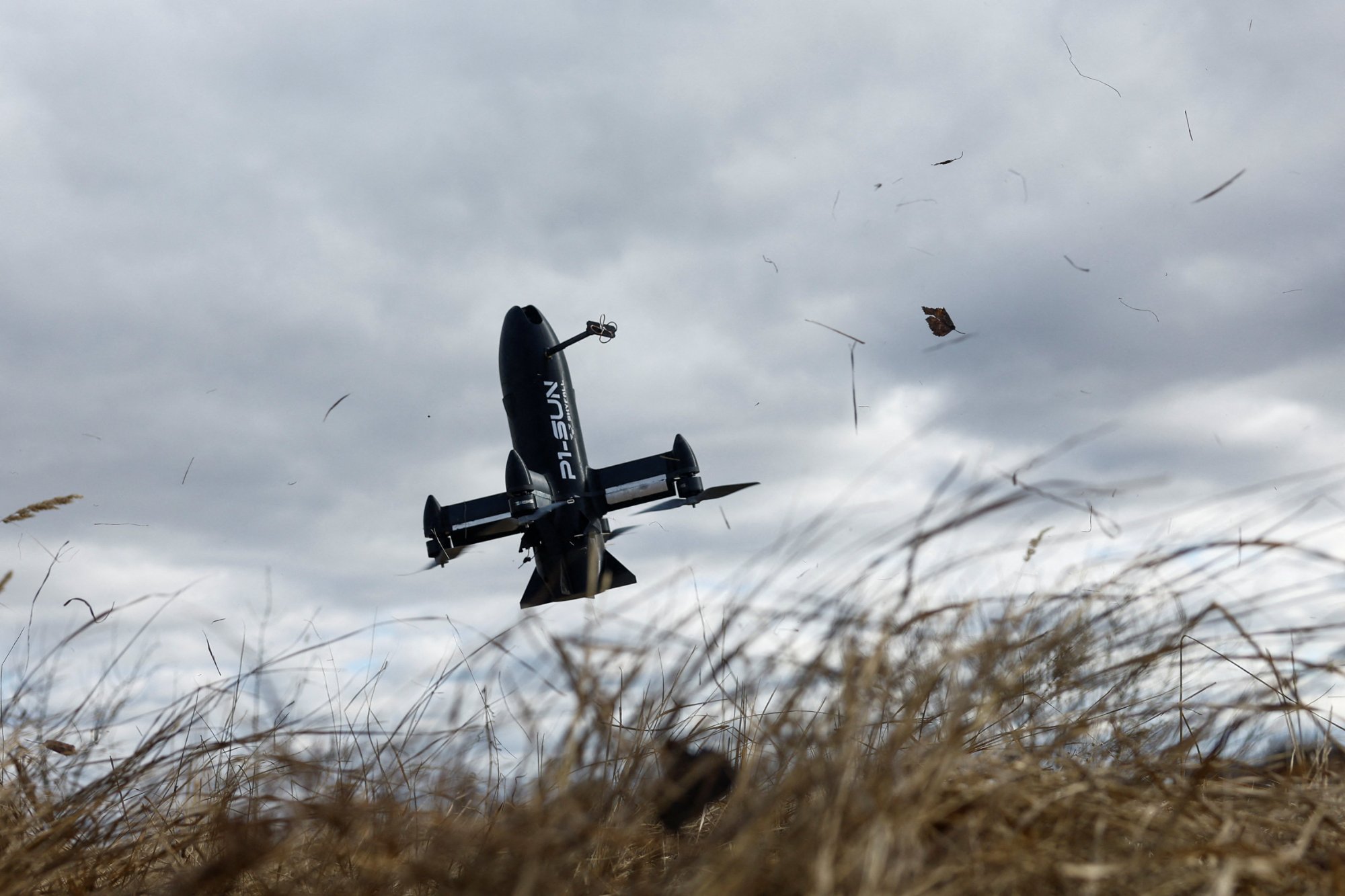
P1-SUN – A Bet on the "Brain"
Another development track focuses not only on speed but also on automation. This is where systems like P1-SUN enter the game, where computer vision algorithms play a key role.
In plain terms, it means this: the operator no longer has to "manually push" the drone toward the target during every single meter of the final approach. Once the object is locked, the system can help keep it in the field of view, compensate for some errors, and stabilize the attack run.
This is especially important when:
-
the target is actively maneuvering;
-
visibility deteriorates;
-
there is a strong crosswind;
-
the closing speed is extremely high;
-
the pilot has only a few seconds to make a decision.
Octopus-100, Striker, Merops, F7, and Others
And here it is important not to fall into the trap of oversimplification. An interceptor drone is not a single model or a single school of design. The Ukrainian market and frontline developments are moving in several directions at once:
-
ultra-fast FPV interceptors;
-
solutions tailored for Shahed interception;
-
distinct systems against reconnaissance UAVs;
-
multi-purpose craft;
-
platforms with greater range and autonomy.
Among publicly mentioned developments, systems like Octopus-100, Striker, Merops, F7, and a number of others often appear, though their full specifications are not always officially disclosed. And this makes perfect sense: a combat drone is not a smartphone with a public spec sheet. A portion of the solutions intentionally remains "in the shadows," because excessive publicity in war is not always an ally.


Which Targets Do Interceptor Drones Operate Against?
A modern interceptor drone is not a universal answer to everything that flies. Its effectiveness depends on the target type, its speed, altitude, trajectory, size, and even its application profile.
Most often, we are talking about the following aerial threats:
-
Shahed/Geran and other loitering munitions;
-
reconnaissance UAVs like Orlan, ZALA, and Supercam;
-
light "flying wings";
-
certain multi-rotor reconnaissance craft;
-
a portion of FPV drones;
-
small-sized tactical-level aerial targets.
Conversely, against:
-
ballistic missiles;
-
supersonic targets;
-
modern combat aviation;
-
a large portion of cruise missiles
such interceptors are not a full replacement for conventional air defense. And this needs to be stated honestly. Because a strong defense system is not a single universal tool, but a multi-layered architecture where every asset occupies its place: from EW and mobile groups to radars, anti-aircraft artillery, and missile systems.
In modern counter-drone warfare, what matters increasingly is not just the fact of interception, but the cost of a single successful shoot-down. It is almost a new kind of military math: you need to win not just in the air, but in the calculator as well.

How Interceptor Drones Supercede Classical Air Defense – and Where They Fall Short
To put it briefly, the main advantage of an interceptor drone is not that it is "better than air defense," but that it covers a task that conventional air defense solves in a manner that is too expensive or too cumbersome.
Advantages of Interceptor Drones
1. Cost-effectiveness
This is the first and most obvious argument. If the cost of interception approaches the cost of the target itself, the defense becomes significantly more sustainable in a long war. And a long war is exactly what demands not beautiful presentations, but mathematics that do not kill the budget faster than the enemy does.
2. Scalability
The production of FPV interceptors or related systems can be scaled up faster than the manufacture of complex anti-aircraft missile systems. For a country living under the constant threat of mass attacks, this is critical.
3. High Mobility
A crew of a few people can quickly change position, deploy equipment, and begin operating literally within minutes. This is a completely different tactic compared to large stationary or semi-stationary systems.
4. Rapid Modernization
Software, guidance algorithms, computer vision, automatic tracking, and sensor integration logic – all of this can be updated faster than conventional missile weaponry. In the world of drones, software evolution is sometimes no less important than hardware.

Now Honestly: Downsides and Limitations
There will be no marketing euphoria here. Interceptor drones are a very promising tool, but they are not without weak spots.
Weather Dependency
Strong winds, rain, fog, icing, and challenging visibility can all seriously affect flight performance, video link stability, and attack precision. The sky does not forgive small details, and a drone is not a heavy fighter jet with a massive power reserve.
Vulnerability to EW
Despite the development of digital communication systems, the adversary actively employs electronic warfare. This is why autonomous flight modes, inertial scenarios, computer vision, and shorter "see-catch-destroy" attack cycles are becoming increasingly vital.
The Human Factor
Even the best interceptor depends heavily on the operator's training level. And a good pilot is not a "gamer with a controller", but a specialist who possesses a sense of space, speed, distance, reaction time, and target behavior. In other words, you can buy a drone, but you cannot buy a flight school; it has to be built.
Limited Flight Time
Fast interceptors typically have high energy appetites. They are not designed for long loitering patrols. Their operational logic resembles an interceptor aircraft more closely: a rapid start, a short dash to the sector, an aggressive attack, and mission completion.

Can Interceptor Drones Be Transported in FPV Backpacks?
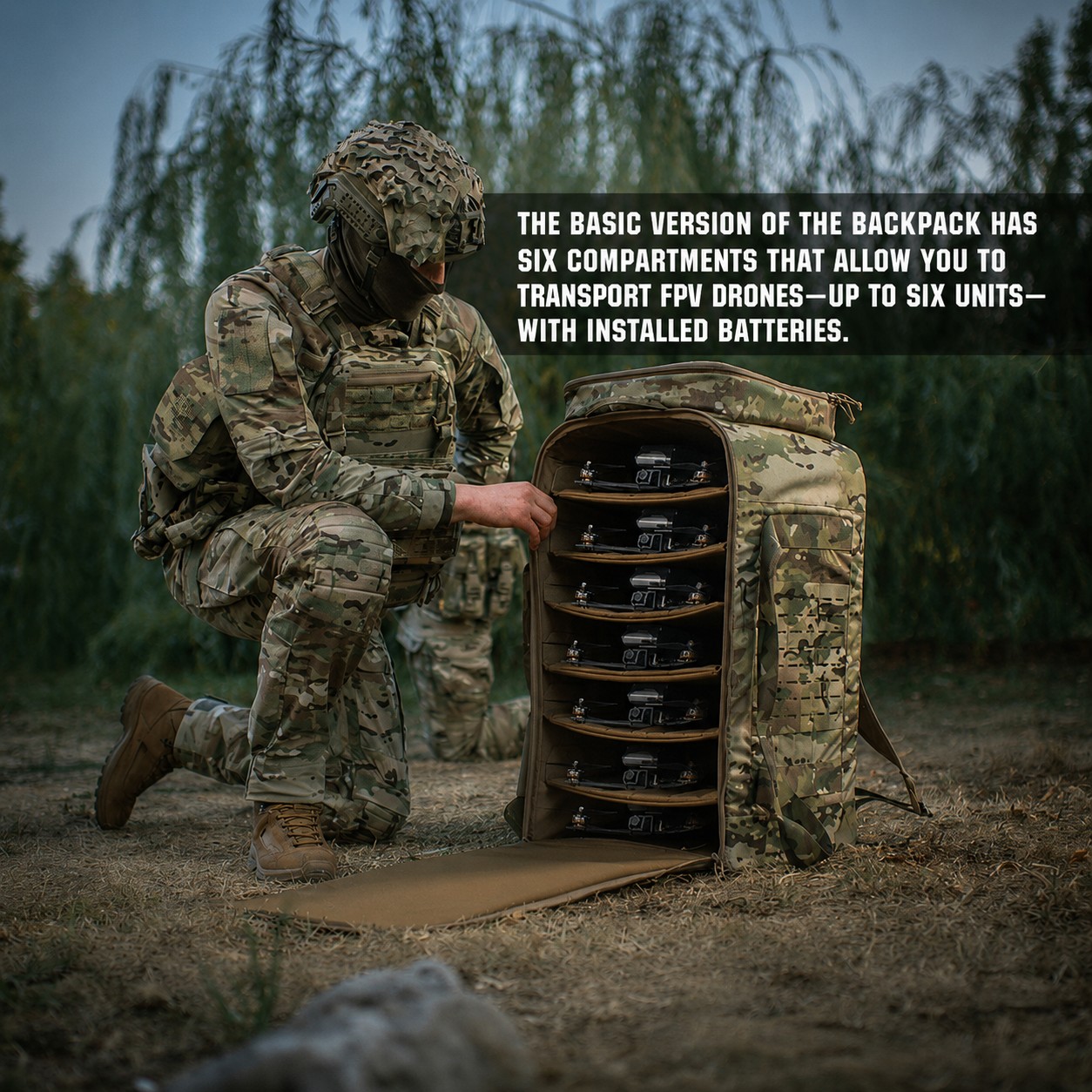
The short answer is yes, in most cases they can, and this is no longer a theory but a highly logical practice for compact FPV interceptors. But a qualification must be made immediately: not all interceptor drones are equally "backpackable."
When an FPV Backpack Truly Works
If we are talking about:
-
light FPV interceptors;
-
compact quadcopter or similar solutions;
-
craft launched without a catapult and complex ground infrastructure;
-
systems designed for a mobile team's operation,
then an FPV backpack or a modular transport kit is entirely justified.
In this format, a crew can carry:
-
1 to 3 interceptor drones;
-
batteries;
-
a controller;
-
FPV goggles;
-
a repeater or an auxiliary communications module;
-
spare propellers and a basic repair kit.
And this offers a major tactical advantage. Effectively, the backpack turns into a carrier of a "portable close-range air defense ammunition load." The team is not tied to heavy vehicles, can quickly change positions, disperse, and launch exactly where needed right now.
When a Backpack No Longer Works
However, for:
-
large interceptors of the "mini-airplane" type;
-
platforms featuring catapult launches;
-
craft with a large wing area;
-
more complex systems with bulky sensors
a standard FPV backpack will no longer be a viable solution. This requires different transport schemes, different cases, and a different level of logistics.
Thus, the formula is simple: FPV backpack = tactical mobile level, not a universal answer for all types of counter-drone systems.


What Global Analogues of Interceptor Drones Exist?
It would be a mistake to think that the "drone-versus-drone" idea is an exclusively Ukrainian invention. No. Similar solutions are being developed by the US, the UK, Israel, Germany, France, Turkey, South Korea, and other nations. But there is one nuance that separates Ukraine from most of them: in our country, these systems are not just being tested – they are being fought with.
And that is a massive difference.
A test range provides technical data. War provides tactics, error statistics, real target behavior, real EW operations, real weather impacts, panic, overloading, and time pressure. This is exactly why Ukrainian experience today is so valuable: it is not sterile; it is forged in combat.
Broadly speaking, global counter-drone systems can be divided into several directions:
Kinetic Interceptors
These are the closest relatives of Ukrainian FPV interceptors. They physically destroy the target – via ramming, proximity detonation, or another kinetic method.
Pros: can operate even against autonomous drones; do not depend on the frequency the adversary is using; can be effective in active EW environments.
Cons: the interceptor is often lost after the attack.
Net Guns
The concept looks almost comical: a drone fires a net that entangles the target's propellers. While this occasionally works against slow civilian quadcopters, it performs significantly worse against fast FPV drones or Shaheds.
Laser Systems
Laser weapons have long moved out of the "science fiction" category. Their strong suit is an database-theoretically infinite "ammo capacity," provided there is sufficient power supply.
However, there are rigid limitations: rain, fog, smoke, dust, and the requirement to hold the beam on the target for a certain period of time. Therefore, for now, lasers are a supplement to the system rather than a full replacement for all other means.
EW Assets
Electronic warfare remains one of the most effective ways to counter drones, especially if they depend critically on GPS or a control link. But here, too, the situation is changing: modern strike UAVs are increasingly receiving:
-
inertial navigation systems;
-
protected communication channels;
-
automated flight modes;
-
obstacle avoidance algorithms.
This is exactly why EW and an interceptor drone today are not competitors, but allies within a single system.
The term Counter-UAS or Counter-Drone is not the name of a specific device. It is an entire ecosystem that can include radars, optical stations, EW assets, command posts, software, anti-aircraft systems, and interceptor drones. This is why the future of protecting the skies lies not in a single "superdrone," but in the correct combination of all these tools.

The Near Horizon: What Will Change in the Coming Years
If one looks at the development of interceptor drones not as isolated models but as an ecosystem, the main trend becomes visible: the greatest changes will occur not just in the "hardware", but in the brains of the system.
1. Artificial Intelligence Will Become the Standard
Today, the operator still performs a massive portion of the work manually. Tomorrow, their role will increasingly resemble that of a dispatcher or a tactical manager rather than a "pilot who guides the drone to the strike manually".
AI will be able to: detect a target; classify it; predict its trajectory; determine the optimal intercept scenario; suggest the attack point; compensate for sudden enemy maneuvers.
2. Swarm Technologies
One interceptor is good. But a group of drones exchanging information in real time represents a completely different level. If one drone loses a target, another picks it up. If one is shot down, the rest restructure the attack plan. This is the logic of a pack, a flock, a collective intellect – and it is drawing closer to reality.
3. Integration into a Unified Air Defense System
In the future, a typical interception scenario might look like this:
-
A radar or acoustic system detects a target.
-
An algorithm determines its type.
-
The system evaluates the speed, altitude, direction, and threat level.
-
The software automatically suggests the most viable effector: an FPV interceptor, an EW asset, an anti-aircraft gun, a laser, or an anti-aircraft missile.
-
The operator merely confirms the decision or intervenes in a complex scenario.
This is the future of Counter-UAS/Counter-Drone systems – not a single superweapon, but a linked ecosystem where all components operate as a single organism.
What is happening today with interceptor drones closely mirrors the development history of fighter aviation in the 20th century. Back then, designers argued over what was more important – speed, maneuverability, or armament. Today, the same debates are taking place around FPV interceptors: some projects bet on a lightning-fast dash to the target, while others rely on "smart" auto-tracking and final attack precision.

See Also
If you are interested in how modern warfare is changing under the pressure of unmanned technologies, EW assets, and robotic platforms, we recommend continuing your reading with these materials from Punisher:
-
Drones: From the Past to the Future – on how drones traveled the path from an auxiliary reconnaissance tool to one of the main instruments of modern combat.
-
EW Assets: A New Level of Protection – an in-depth look at electronic warfare, its principles of operation, and its role in countering enemy drones and communication systems.
-
Uncrewed Surface Vessels (USVs): The Fleet of the Future – on naval drone platforms that are already changing the rules of the game on the water just as FPVs and strike UAVs changed the sky.
-
Uncrewed Ground Vehicles (UGVs): The Infantryman's Faithful Ally – on robotic ground systems taking over logistics, evacuation, reconnaissance, and fire support on the most dangerous sectors of the front line.

Will Interceptor Drones Replace Conventional Air Defense?
Most likely – no. And there is no defeat for the concept in that. On the contrary, it is a sign of its maturity.
The history of military hardware demonstrates clearly: new types of weapons rarely eliminate previous ones entirely. They either supplement them or take over a portion of their tasks. In the same way, tanks did not cancel artillery, and fighter jets did not render anti-aircraft missile systems unnecessary.
Interceptor drones perform best against:
-
FPV drones;
-
reconnaissance UAVs;
-
small-scale strike targets;
-
loitering munitions;
-
specific types of Shahed-like threats.
However, the fight against cruise missiles, ballistics, and combat aviation will remain the domain of specialized air defense. This means the future belongs not to an "either/or" formula, but to an "and/and" formula: missiles, EW, radars, mobile groups, anti-aircraft artillery, lasers, FPV interceptors, and other counter-drone systems must work in tandem.

Interceptor drones have already ceased to be an experiment on exhibition floors and in presentations. Today, it is one of the most dynamic directions in the development of Ukraine's modern air defense, born not in theory but in the highly brutal practice of war. The mass employment of drones has forced the military to re-examine the very logic of protecting the sky, and along with it, the criteria of effectiveness. Now, it is not just range or accuracy that matters, but also the cost of interception, reaction speed, crew mobility, production scalability, and the system's ability to learn quickly.
This is exactly why an interceptor drone today is not just another UAV. It is an element of a new defensive architecture where aerial combat increasingly resembles not a classical "missile-versus-aircraft" standoff, but a clash of networks, sensors, algorithms, and mobile platforms. In this new reality, the winner is not the one who merely possesses a stronger warhead, but the one who detects faster, decides faster, intercepts cheaper, and integrates all defensive links into a single mechanism better.
Ukraine is not a mere observer in this story. It is one of the world's primary testing grounds, design bureaus, and training centers simultaneously. Here, counter-drone technologies, FPV interceptors, computer vision systems, and new interception methods undergo the strictest audit of all – the audit of combat. And it is here that it becomes clear that the future belongs not to a "magical superweapon", but to a multi-layered sky defense system where interceptor drones will occupy their own highly important, and at times critical, niche.
And if yesterday the phrase "fight fire with fire" (or literally in Ukrainian/Russian, "knocking out a wedge with a wedge") sounded like an old proverb, today it increasingly describes one of the main trends of modern war: the sky is beginning to be protected by the very same drones that until recently were considered solely an instrument of attack.

Vitalii Buniak — article author
Military gear consultant
Before 2022, he worked as a sales assistant at the Panisher store. After the start of the full-scale invasion, he joined the Armed Forces of Ukraine, gaining real combat experience.
Thanks to his combat experience and deep knowledge of tactical gear, Vitalii serves as a personal expert of the Panisher online store in the fields of:
- Clothing and footwear
- Equipment
His recommendations help customers choose reliable and functional gear for any conditions.
FAQ: Answers to Frequently Asked Questions
1. What is an interceptor drone in simple terms?
2. Can interceptor drones operate without an operator?
3. Is it realistic to shoot down an enemy drone in a way that destroys the warhead specifically in the air?
4. Will interceptor drones replace conventional air defense?