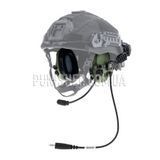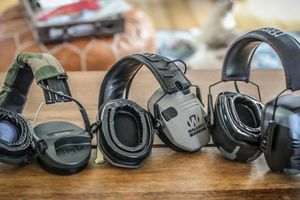
An active headset is far more than just protective earmuffs with a microphone. Modern 3M PELTOR and Sordin headsets simultaneously protect your hearing from dangerous noise, reproduce ambient sounds to maintain situational awareness, and integrate with two-way radios. For example, the 3M PELTOR ComTac VIII features a noise-canceling speech microphone with a frequency range of 200 Hz-7 kHz, an impedance of approximately 150 ohms, and an IP68 protection rating. The Sordin Supreme T2 utilizes the SordinHEAR2 system with four audio profiles, two AUX inputs, and support for a communication suite with a PTT.
However, this is precisely where the problem arises: an expensive headset plus a good two-way radio still does not guarantee high-quality communications. Positioned between them are the PTT, connectors, cables, and electrical interface, and in some configurations, additional adapters. An incorrectly selected component can leave incoming reception working normally while making outgoing transmissions quiet, distorted, or completely non-functional.
Therefore, it is more accurate to speak not about "connecting headphones to a walkie-talkie", but about building a compatible system: headset → PTT → two-way radio. Together with this guide from the Punisher military store, we break down how to do this correctly and why a connector plug that merely fits physically guarantees nothing.
How the "Headset – PTT – Two-Way Radio" Link Works
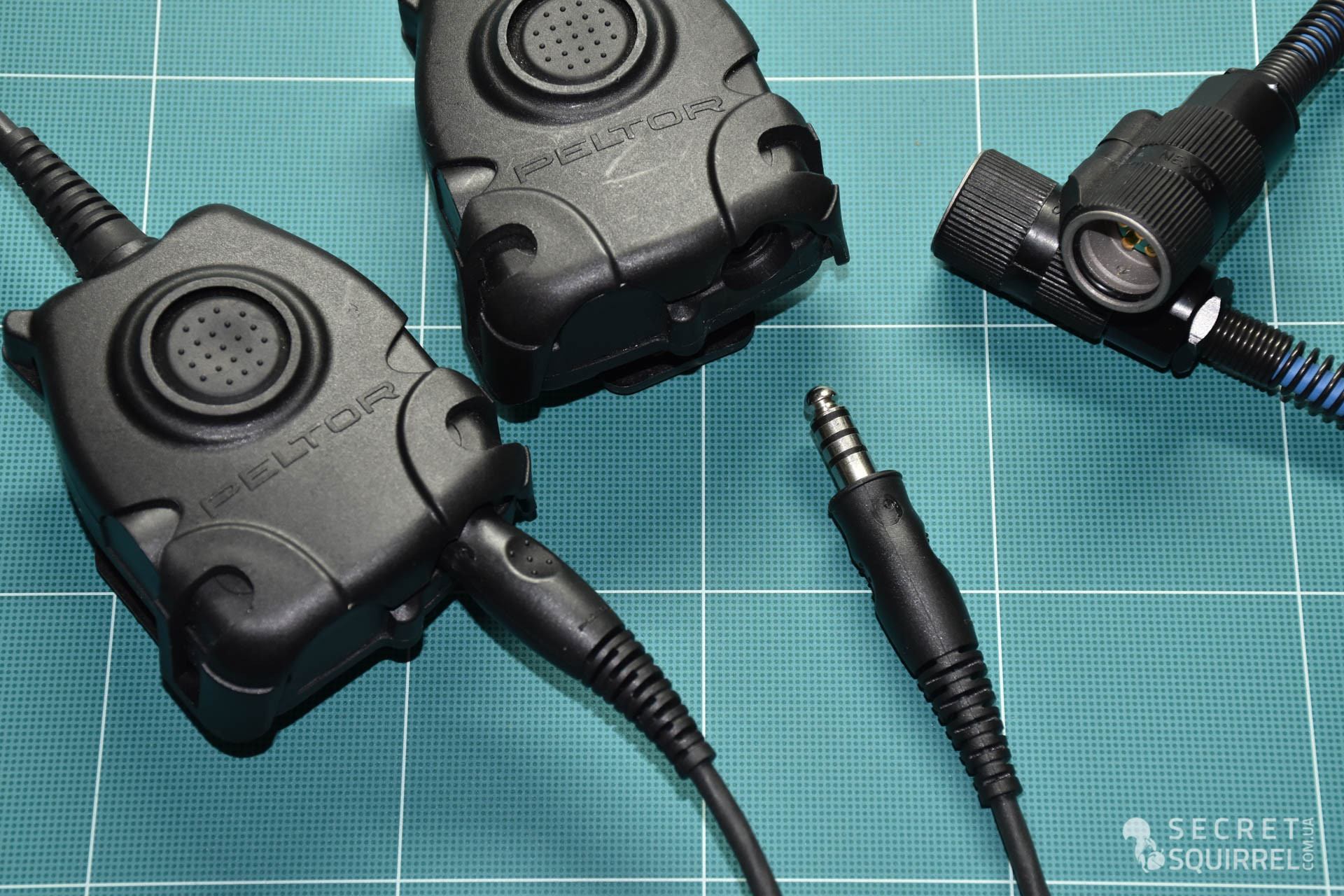
In the simplest scenario, the system consists of three core components: active headset → PTT → two-way radio. The headset handles radio signal audio playback and user voice transmission, while the PTT (Push-To-Talk) manages transmission control and serves as the interface between the headset and the specific radio.
When the user presses the PTT button, the radio switches from receive mode (RX) to transmit mode (TX), and the voice from the headset microphone is transmitted to the radio. It sounds simple, but in practice, a PTT is not a basic adapter. 3M manufactures dedicated PELTOR PTTs for various radio models and manufacturers, and certain systems require specialized configurations for different connection types. The manufacturer itself recommends selecting a PTT based on the headset model, radio manufacturer, and radio model. Thus, the fundamental rule is this: a PTT is not selected merely for the headset or merely for the radio – it must match the entire specific setup.
Why Knowing You Have a PELTOR or Sordin Is Not Enough
Saying "I have a PELTOR" is insufficient information for selecting a PTT. For example, official 3M PELTOR ComTac VIII specifications list multiple comms connection options:
-
4-pin U/174 for NATO wiring;
-
4-pin U/174 for PELTOR wiring;
-
5-pin U-384/U for Dual Comm;
-
additionally, a version with LEMO exists.
This means that even within a single model like the ComTac VIII, different physical implementations exist.
With Sordin, the situation similarly depends on the specific model. For instance, the Supreme Pro-X features a 3.5 mm (0.14 in) AUX input for an external audio source, such as a radio, whereas the Supreme T2 features two AUX inputs and supports dedicated single- and dual-channel PTTs. Therefore, before purchasing a cable or PTT, you must know not only the brand name, but the complete model number and exact headset wiring configuration.
In the world of PELTOR, the appearance of a connector plug alone does not tell the full story. That is why 3M developed a dedicated PTT selection tool where you specify the region, headset model, radio manufacturer, and radio model. The result provides a specific, compatible adapter.


Connectors: Why an Identical Plug Guarantees Nothing
One of the most common mistakes is focusing solely on mechanical compatibility. "The plug fits, so it should work." In reality, it does not. A connector may fit physically while having a different pinout, wiring layout, or electrical specifications. That is precisely why manufacturers produce different versions of cables and PTTs for professional equipment.
On the ComTac VIII, for instance, two 4-pin U/174 variants serve different purposes: NATO wired (-86) and PELTOR wired (-38). While physically identical as 4-pin U/174 plugs, system compatibility is not universal. Furthermore, for Dual Comm configurations, a 5-pin U-384/U connector is used instead.
PTT: The Key Link in Radio Communications
If the headset is the user interface, the PTT can be considered its communication gateway to the radio. More passes through it than just a simple "transmit" command. It ensures proper electrical matching between the headset's audio path and the radio, as well as managing TX/RX switching. Consequently, an incorrect PTT produces very distinct issues: you can hear the radio, but no one hears you. Or: they hear you, but extremely quietly. Or: your voice is transmitted, but heavily distorted. Or: pressing the button fails to trigger transmission on the radio altogether.
This clearly illustrates why using a high-end headset with a random PTT of unknown compatibility results in your most expensive component being bottlenecked by its weakest link.
Voice Quality: Where "Quiet", "Muffled", or "Noisy" Audio Originates
Transmission quality depends on more than just the radio itself. The entire chain is active: voice → microphone → headset audio circuit → PTT → radio → radio frequency channel → receiving party's radio. If a failure occurs at any stage, the user may perceive it simply as "poor signal". However, these are fundamentally different problems. For instance, the speech microphone on the PELTOR ComTac VIII features:
-
Dynamic operating principle.
-
Noise reduction.
-
Frequency response of 200 Hz-7 kHz.
-
Impedance around 150 ohms.
-
IP68 water resistance.
-
Submersibility rating of 9.8 ft for 30 minutes for the microphone.
This provides far more technical context than a generic "noise-canceling microphone" label. Yet even an outstanding microphone cannot save a system if its signal is improperly matched to the radio.
The ComTac VIII microphone operates across 200 Hz-7 kHz with an impedance of approximately 150 ohms. While users do not need to calculate PTT electrical parameters manually, this highlights why a tactical comms headset is far more than just "headphones with a wire".


Active Headsets Do Not Increase Radio Signal Range
This is another misconception that must be clearly addressed. Active electronics primarily process ambient environmental sound. For example, the Sordin Supreme Pro-X uses SordinHEAR2 to amplify weak ambient sounds, while capping sound reproduction via its level-dependent system at a maximum of 82 dB(A). The headset also features an NRR of 21 dB, SNR of 28 dB, and an estimated battery life of approximately 400 hours.
The Sordin Supreme T2 offers an NRR of 23 dB and SNR of 29 dB, with its SordinHEAR2 system likewise limiting ambient audio output to 82 dB(A). However, none of these figures translate to an increase in radio transmitter output power.
If a radio suffers from antenna issues, power supply problems, bad channels, unfavorable terrain obstructions, or is simply outside effective coverage range, a PELTOR or Sordin will not extend its transmission distance.
-
Sometimes a "poor comms" issue has nothing to do with radio RF signals. If a receiving party hears you quietly, but people standing right next to you hear your speech at normal volume, inspect the microphone circuit, PTT, and physical connections first before troubleshooting antennas or transmission range.
-
In modern active headsets, controlling sound is just as vital as amplifying it. The Sordin Supreme Pro-X limits ambient audio in level-dependent mode to 82 dB(A). For the Supreme T2, the manufacturer similarly states a maximum output cap of 82 dB(A) for ambient listening. The goal of the onboard electronics is not to make everything as loud as possible, but to ensure quiet sounds remain audible while strictly clamping dangerous noise levels.
What Happens to Radio Audio?
It is essential to distinguish between two separate audio channels. Ambient audio refers to the sounds of your surrounding environment. Communication audio refers to incoming transmissions from the radio. A headset must allow the operator to process both clearly, but they are handled differently.
The PELTOR ComTac VIII incorporates a feature called Soundscaping, designed to enhance speech intelligibility during radio communications. Additionally, the headset includes several Mission Audio Profiles: Observation, Patrolling, Conversation, Comfort, and OFF.
The Sordin Supreme T2 offers four distinct audio profiles: Tactical, Comfort, Dual, and Ambient Off. Thus, a modern active headset acts as a compact digital audio processor rather than passive earmuffs.
Dual Comm: When One Radio Is Not Enough
When operating across two radio networks simultaneously, system complexity increases. This requires a dedicated setup: headset → Dual Comm interface → dual PTT → two radios. For example, the ComTac VIII has a specific 5-pin U-384/U variant built for Dual Comm operations. The Sordin Supreme T2 features two AUX inputs, and the manufacturer offers a dedicated Sordin PTT Dual capable of connecting up to two radios to the headset. Depending on connector wiring, the two channels can be routed to both earcups or split individually between the left and right sides. Dual-comm capability is not merely "a single PTT with two buttons," but a distinct communication system architecture.
Can You Connect a PELTOR or Sordin to a Baofeng Radio?
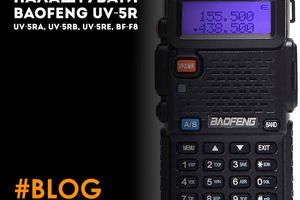
In many cases, yes, but there is no universal "Baofeng PTT." Baofeng encompasses a wide range of different radio models utilizing distinct connector interfaces. First, identify the exact radio model. Then, verify cross-compatibility between the specific PTT, headset, and radio model.
The same principle applies to Motorola, Kenwood, Icom, Hytera, and other radio manufacturers. The radio brand is merely the initial piece of information; the exact model number is required.
Should You Use Cheap Universal Adapters?
The answer depends on the operational context. For simple recreational use where the user is willing to troubleshoot, a cheap adapter cable may function adequately. However, if team operations depend on reliable comms, critical communication lines should never be built on random adapters.
The risks extend beyond poor audio quality to mechanical failure points:
-
Intermittent electrical contact;
-
Loose connection tolerances;
-
Signal dropping during movement;
-
Cable strain or physical damage;
-
Accidental disconnection;
-
Difficult field troubleshooting.
Therefore, a good PTT is not necessarily the most expensive one – it is a compatible PTT providing predictable performance and solid mechanical construction.
In professional communications, PTTs are so specialized that 3M offers different models even for distinct radio series within the same brand lineup. For example, the PELTOR catalog lists separate PTTs for Motorola, Kenwood, Icom, TETRA systems, and military tactical radios. This demonstrates why the universal assumption that "any PTT works with any radio" fails in practice.


How to Select the Correct Setup
Follow this straightforward algorithm:
-
Identify the Exact Headset Model
Do not stop at "PELTOR" or "Sordin". For example: the 3M PELTOR ComTac VIII MT14H418A-86 and 3M PELTOR ComTac VIII MT14H418A-38 represent entirely different electrical wiring configurations.
-
Identify the Exact Radio Model
Specify the precise model number rather than just "Motorola", "Baofeng", or "Kenwood".
-
Determine the Number of Radios
Single radio? You require a single-comm setup. Two radios? Look toward a dual-comm headset variant and a matching dual PTT.
-
Verify Connection Types
Confirm compatibility across the chain: headset → PTT → radio. Verify both physical pinouts and manufacturer-stated electrical compatibility.
-
Purchase the PTT Last
Follow this exact order to prevent component mismatch.

HEADSETS AND RADIO EQUIPMENT
Full range of equipment for tactical communications in our catalog
Browse and choose!
One of the most frequent operational mistakes is stacking multiple adapter cables together. Every added interface introduces an additional potential point of failure.
How to Test a Completed System
After assembling the system, do not stop at a basic "I hear the radio" check. Perform a complete four-point test:
-
RX: Confirm you receive incoming audio clearly.
-
TX: Confirm the receiving party hears your transmission clearly.
-
PTT: Verify the radio reliably keys up and switches into transmit mode.
-
Mechanical integrity: Ensure cable movement or button pressure does not disrupt the connection.
Conduct these tests outside a quiet environment. Test the setup outdoors, while moving, in windy conditions, and in high-noise environments. These conditions reveal how effectively the microphone, PTT, and hearing protection function together.
Troubleshooting Poor Transmission Quality
If the receiving party reports poor audio quality, follow this diagnostic sequence:
-
Microphone Placement
Ensure the speech microphone is positioned correctly relative to your mouth.
-
Connectors
Inspect all plugs to verify they are fully seated with no loose play, dirt, corrosion, or physical damage.
-
PTT Compatibility
Verify the PTT is explicitly matched to both your exact radio model and your specific headset wiring.
-
Two-Way Radio Settings
Check radio settings, power levels, antenna seating, and RF coverage conditions.
-
Headset Inspection
If the issue arose after replacing a headset, cable, or PTT, re-verify component compatibility. This approach is far more efficient than replacing entire setups at random.
The EMEA/APAC version of the PELTOR ComTac VIII operates on 2×AAA alkaline batteries, yielding approximately 50 hours of battery life. It incorporates automated and profile-based audio processing while operating in extreme temperatures ranging from −40°F to +131°F.
By comparison, the Sordin Supreme Pro-X specifies roughly 400 hours of runtime on two standard AAA batteries, while the Supreme T2 achieves approximately 120 hours using Varta Ultra Lithium batteries. This demonstrates why evaluating headsets strictly on price is inaccurate: electronic architecture and intended operational profiles differ significantly.


Connecting a PELTOR or Sordin active headset to a two-way radio involves far more than matching plug diameters. It requires selecting an integrated communication system where the headset model, wiring configuration, PTT type, radio model, channel count, and connection integrity all play critical roles. The ComTac VIII officially offers 4-pin NATO, 4-pin PELTOR, 5-pin Dual Comm, and LEMO wiring options, while Sordin's T2 offers distinct single- and dual-PTT solutions.
Technical specifications highlight the complexity of this equipment. The ComTac VIII features a microphone rated from 200 Hz–7 kHz with ~150 ohms impedance, IP68 water resistance, ~50 hours of operation on two AAA batteries, and an operating temperature range of −40°F to +131°F. The Sordin Supreme Pro-X specifies an NRR of 21 dB, SNR of 28 dB, and ~400 hours of battery life, while the Supreme T2 specifies an NRR of 23 dB, SNR of 29 dB, and ~120 hours of runtime.
The golden rule is straightforward: never select a PTT based solely on physical connector appearance. Identify the exact headset and radio models first, verify PTT cross-compatibility, and assemble your system accordingly. A properly matched configuration allows you to leverage the full benefits of a PELTOR or Sordin headset – hearing protection, situational awareness, and clear voice transmission – without leaving radio reliability to chance.
NEED HELP CHOOSING?
Our specialists will help you select a headset, radio, and the necessary components based on your needs and equipment compatibility.
Get a consultation

Vitalii Buniak — article author
Military gear consultant
Before 2022, he worked as a sales assistant at the Panisher store. After the start of the full-scale invasion, he joined the Armed Forces of Ukraine, gaining real combat experience.
Thanks to his combat experience and deep knowledge of tactical gear, Vitalii serves as a personal expert of the Panisher online store in the fields of:
- Clothing and footwear
- Equipment
His recommendations help customers choose reliable and functional gear for any conditions.
FAQ: Answers to Frequently Asked Questions
1. Can I connect a PELTOR headset to any two-way radio?
2. Why can I hear incoming radio audio, but no one hears me transmit?
3. Does a PELTOR or Sordin headset increase radio range?
4. How do I choose the correct PTT?