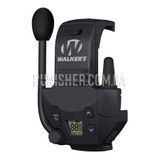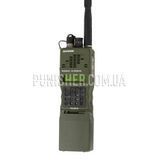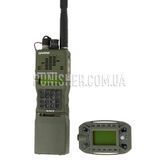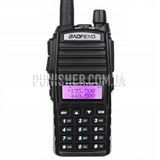
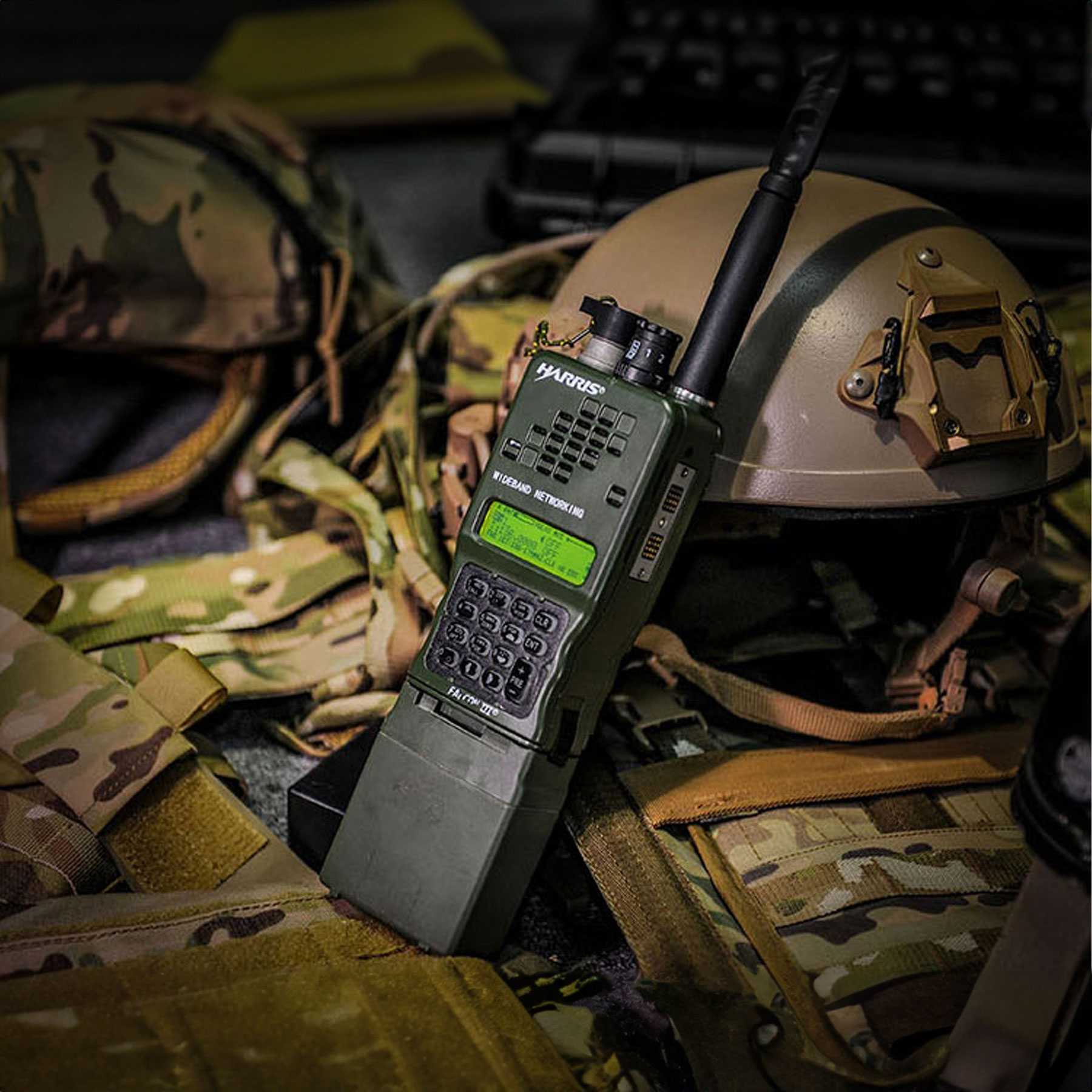
In the tactical communications market, there are few models around which such a strong reputation has formed as around the Harris AN/PRC-152A. This exact radio station has remained one of the symbols of modern military communication for many years, so it is no surprise that various manufacturers attempt to recreate it in the form of functional replicas. One of the most interesting among them today is the FCS AN/PRC-152A – a model that not only inherited the appearance of the legendary original, but also received its own electronic platform, modern software, and support for professional tactical accessories.
In this review, together with a specialist from the Punisher military store, we will analyze in detail the capabilities of the FCS AN/PRC-152A, explain every technical characteristic in simple words, compare it with the popular TCA AN/PRC-152A, Baofeng UV-5R, and other portable radio stations, and also determine who will truly benefit from such a model, and who will find significantly cheaper analogs sufficient.
Why Does the FCS AN/PRC-152A Attract So Much Attention?
If you look only at photographs, you might get the impression that we have yet another copy of a famous military radio. In reality, that is only part of the truth. Most replica manufacturers attempt to copy the appearance of the AN/PRC-152A as accurately as possible, but inside they use electronics that differ very little from ordinary amateur radios. As a result, the user gets a beautiful housing, but almost no new capabilities.
FCS took a different path. Yes, the construction, placement of controls, battery block, antenna interface, and compatibility with some military accessories are brought as close as possible to the original Harris. However, the manufacturer did not copy someone else's software platform. Instead, they created their own software, which is updated regularly, supports modern configuration capabilities, and even opens an application programming interface for developers.
That is why it is more correct to call the FCS not merely a replica, but an individual product built around the ergonomics of the legendary AN/PRC-152A. And this is one of the main reasons why this model has recently been appearing more and more frequently not only among airsofters or historical reenactors, but also among military instructors, volunteers, and civilian users who want to work with gear brought as close as possible to modern military standards.
During the development of military equipment, engineers change the electronics significantly more often than the external construction of the product. If the ergonomics proved successful, they can remain virtually unchanged for decades. That is precisely why even modern replicas of the AN/PRC-152 are so similar to original military radio stations.
Technical Characteristics of the FCS AN/PRC-152A: What Do All These Numbers Actually Mean?
Technical characteristics are often perceived as a simple list of parameters, even though they are what determine how comfortably the radio station will operate in field conditions. Some numbers affect communication range, others affect operating time, and still others affect compatibility with military accessories. That is why we will break down each of them separately.
Aluminum Housing
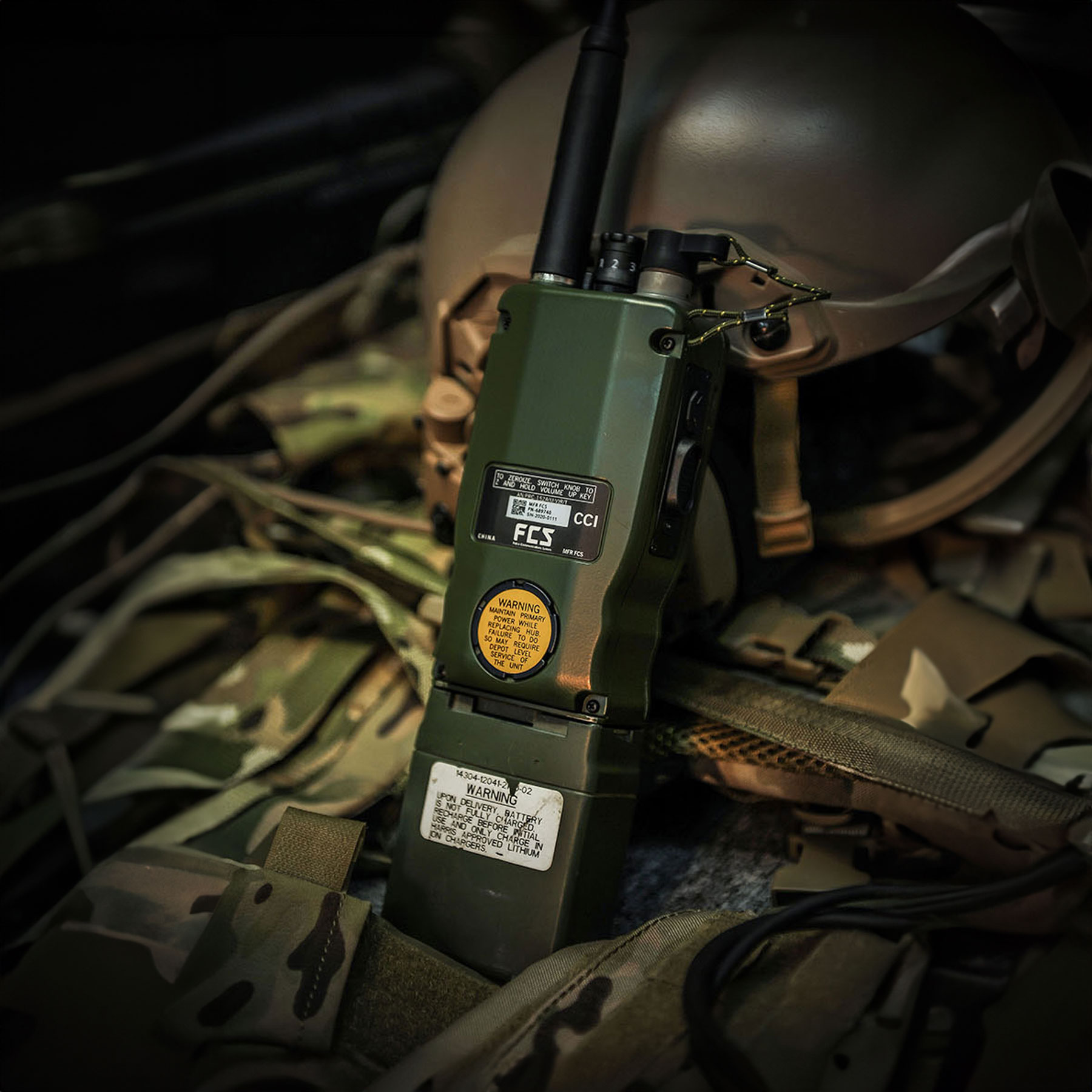
The first special feature of the FCS AN/PRC-152A is its housing. Unlike most civilian portable radios, which are manufactured primarily from impact-resistant plastic, an aluminum alloy is used here.
In practice, this provides several advantages at once. First, metal tolerates impacts, drops, and constant mechanical stress significantly better. Second, it dissipates heat from electronic components more efficiently, which positively affects operational stability during long transmission sessions. Finally, the housing itself works as an additional structural load-bearing element, thanks to which the radio station feels almost non-hollow and sturdy.
Precisely because of the use of metal, the FCS weighs significantly more than most civilian models. For comparison:
-
Baofeng UV-5R – approximately eight point five ounces.
-
Quansheng UV-K5 – about eight point three ounces.
-
FCS AN/PRC-152A – approximately one pound five point two ounces without batteries.
After installing four eighteen-six-fifty format power elements, the total mass approaches approximately one pound twelve point two ounces, which is more than three times the weight of a standard portable amateur walkie-talkie.
Is this a drawback? Not entirely. Because the FCS was not created as a compact hiking radio station. Its construction is brought as close as possible to the military prototype, so the increased mass is a consequence of using a metal housing, a full-sized battery block, and professional connectors.
For the user, this means one thing: you immediately feel in your hands that you have a serious device designed for intensive exploitation, rather than a budget plastic walkie-talkie.
Support for Two Bands (Very High Frequency/Ultra High Frequency): Why Did One Hundred Thirty-Six to One Hundred Seventy-Four and Four Hundred to Four Hundred Eighty Megahertz Become the Standard?
One of the key advantages of the FCS AN/PRC-152A is its support for the two most widespread analog communication bands simultaneously:
-
Very High Frequency – one hundred thirty-six to one hundred seventy-four megahertz;
-
Ultra High Frequency – four hundred to four hundred eighty megahertz.
Right here, it is worth making a small clarification. On the manufacturer's website, the range one hundred sixty-three to one hundred seventy-four megahertz is encountered in certain specifications. However, this is most likely a simple description error. In technical documentation, the radio menu, software, and product page at Punisher, a full range of one hundred thirty-six to one hundred seventy-four megahertz is specified, which is standard for similar analog transceivers. And this is indeed important.
The range of one hundred thirty-six to one hundred seventy-four megahertz is widely used by communication services, radio amateurs, rescuers, and many professional users in various countries around the world. Thanks to a longer wavelength, Very High Frequency usually provides better communication range in open terrain, where the signal does not have to constantly overcome concrete structures or dense construction.
In contrast, Ultra High Frequency, four hundred to four hundred eighty megahertz, feels much better in the city, among industrial facilities, inside buildings, or in dense forest. Shorter waves pass through numerous obstacles more easily, which is why this range is most frequently used today by security structures, industrial enterprises, airsoft teams, and many other users.
In other words, two bands are not a marketing bonus, but an opportunity to choose the optimal operating mode for specific conditions.
Dual Watch: Two Frequencies Simultaneously
Another feature of the FCS AN/PRC-152A is support for Dual Watch mode. This is when two independent frequencies are displayed on the screen simultaneously, and they can belong to different bands. For example:
-
Top line – Very High Frequency one hundred forty-five point five hundred megahertz.
-
Bottom line – Ultra High Frequency four hundred forty-six point zero zero zero megahertz.
The radio station constantly monitors both channels, and the user selects with a single key press which one to transmit through. In field conditions, this is very practical.
For example, you can leave one channel for communication within a team, and use the second as a backup or command channel. In that case, the need to constantly change frequencies manually disappears, avoiding the risk of missing an important message. That is why the Dual Watch function has long been a standard for modern professional analog radio stations.
Maximum Output Power – Up to Five Watts
The transmitter of the FCS AN/PRC-152A has a maximum output power of five watts. For portable analog radio stations, this is effectively an industry standard. Most professional models of this class have this exact power. However, it would be a mistake to assume that power alone determines communication range. In reality, it is only one of many factors. In practice, a significantly greater impact comes from:
-
Antenna installation height;
-
Terrain topography;
-
Density of buildings;
-
Weather conditions;
-
Level of radio interference;
-
Quality of the antenna itself.
That is why two radio stations of equal power can demonstrate completely different results depending on operational conditions. And conversely—installing a higher-quality antenna frequently gives a significantly more noticeable effect than increasing the transmitter power.
What Does This Mean in Practice?
Support for Very High Frequency one hundred thirty-six to one hundred seventy-four megahertz, Ultra High Frequency four hundred to four hundred eighty megahertz, Dual Watch mode, and maximum power of five watts makes the FCS AN/PRC-152A a versatile platform for most civilian, training, and tactical usage scenarios.
Many believe that increasing transmitter power automatically doubles communication range. In reality, that is not so. To roughly double the distance in similar conditions, it is not enough to increase power from five to ten watts – a correctly selected antenna, a more advantageous operator location, or even raising the radio station just a few feet above ground level often produces a much greater effect. That is why professional communications specialists optimize the antenna system first, and only then think about transmitter power.

Complete Set: Everything Necessary to Begin Work
First acquaintance with any radio station begins even before turning it on. And while most civilian models are supplied in an ordinary cardboard box, the FCS AN/PRC-152A tries to follow a military approach at this stage already.
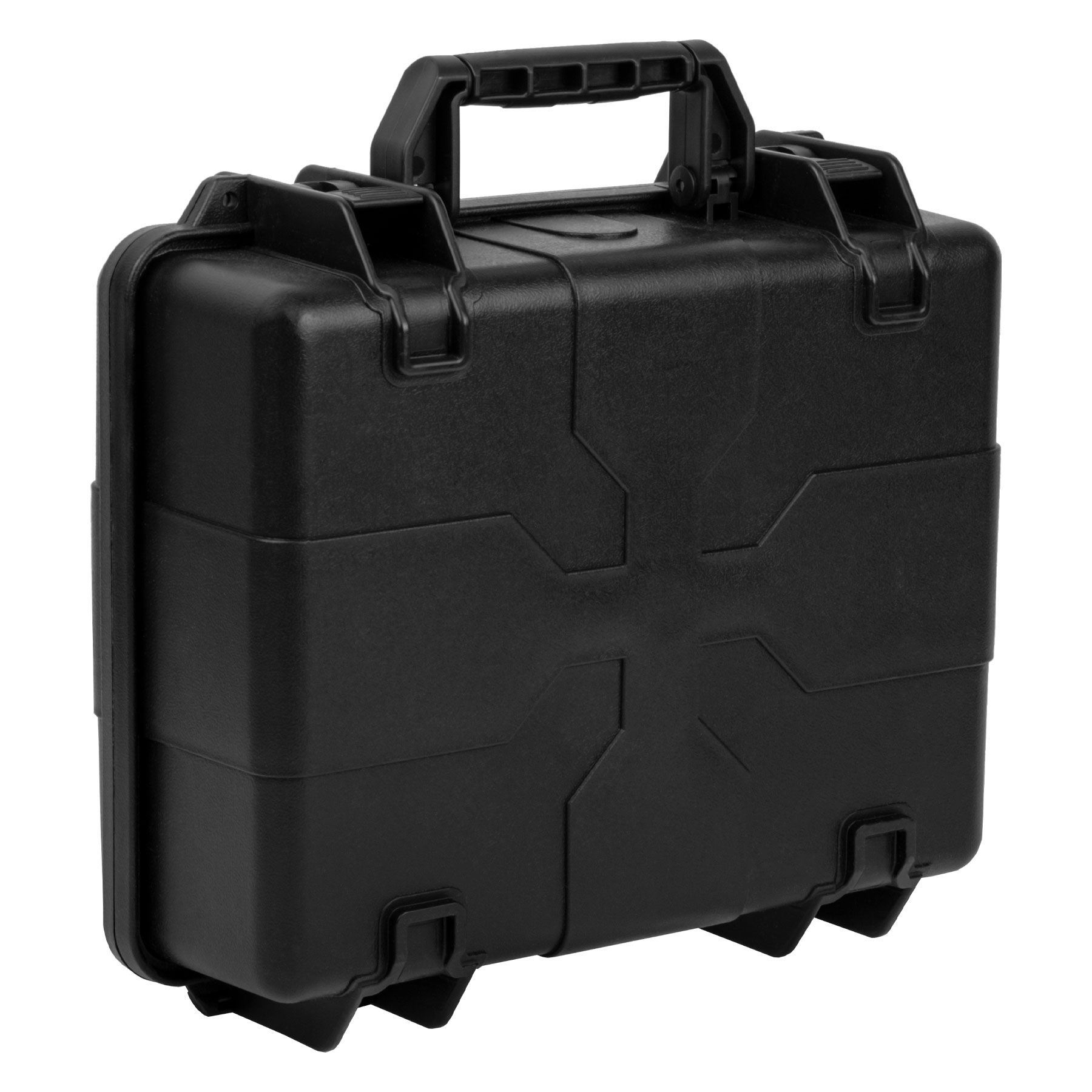
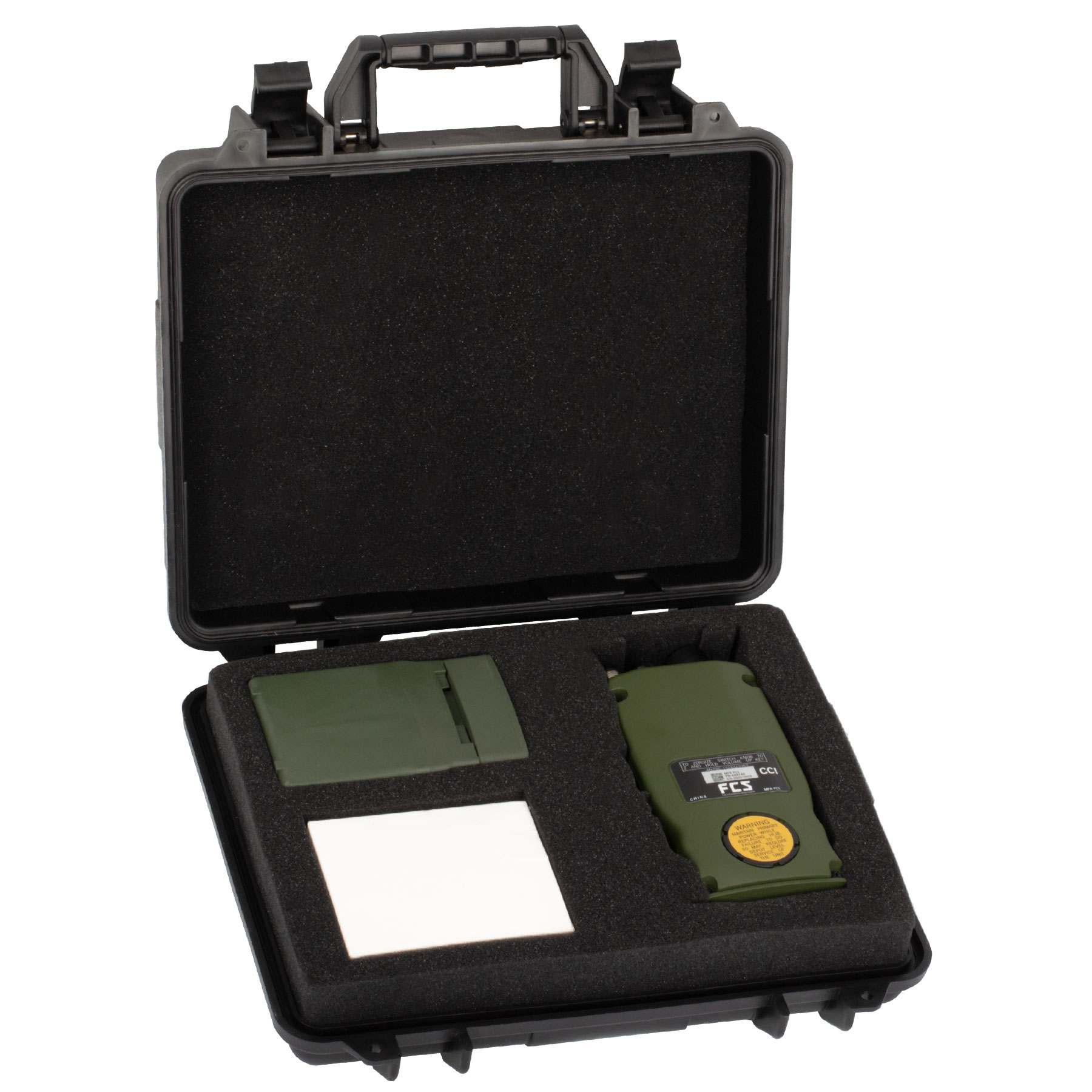
The kit is supplied in a rigid plastic case, which is significantly better suited for transportation and storage than ordinary packaging. It protects equipment from accidental impacts, dust, and mechanical damage, and also allows all components to be placed neatly in one spot. For those who frequently transport gear to training, shooting sessions, or airsoft games, this is significantly more practical than packing accessories into a backpack separately.
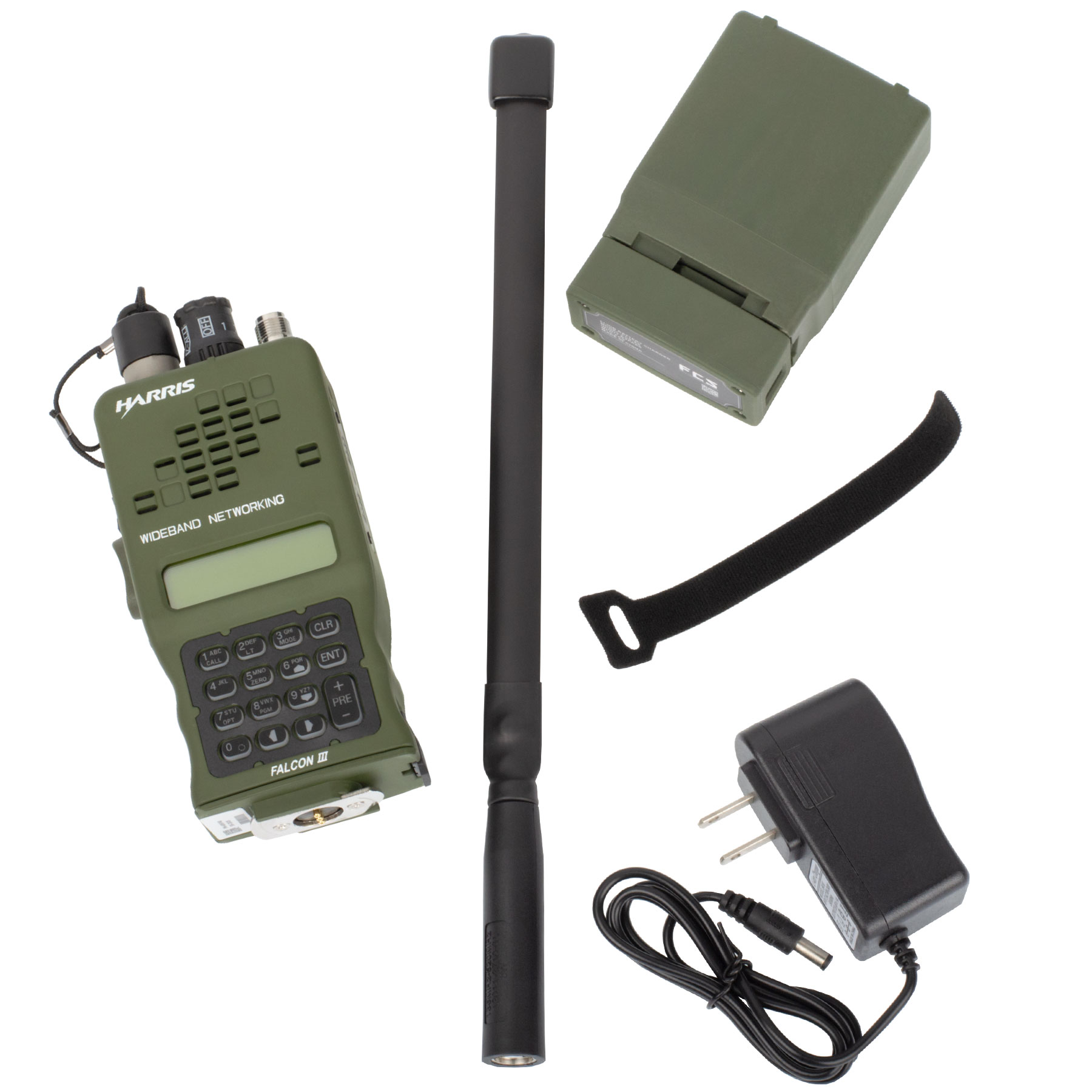
The complete set includes the FCS AN/PRC-152A radio station itself, battery block, charging dock station, main power adapter, standard folding antenna, and plastic case.
Dock Station Instead of an Ordinary Cable
One of the features of the package is the presence of a separate charging dock station. For replicas of military radios, this is a completely logical solution, since this exact method of charging is used on professional equipment as well.
In daily operation, this turns out to be significantly more convenient than connecting a cable directly to the radio station. It is sufficient to install the battery block into the dock station, and charging begins automatically. In addition, the radio station itself does not need to be left connected to the electrical grid each time, and the battery block can be charged separately.
Battery Block: Freedom of Choice for Batteries
Another interesting feature of the FCS lies in the construction of the battery block. Unlike many civilian radio stations with non-dismountable batteries, a housing designed for installing four eighteen-six-fifty format lithium-ion elements is used here.
At the same time, it is worth paying attention to an important nuance. Due to international restrictions on transporting lithium-ion batteries, the manufacturer equips the radio station with the battery block casing itself, whereas the presence of power elements themselves is usually lacking. That is why before purchasing it is advisable to clarify with the seller whether batteries are included in the delivery package.
Folding Antenna
A standard folding antenna is also supplied in the kit. It occupies less space during transportation, does not catch on gear, and easily returns to working position when needed. For most users, its capabilities will be completely sufficient, and thanks to the use of a standard threaded interface, the antenna can be replaced with another compatible model if desired.
What Does This Mean in Practice?
The FCS AN/PRC-152A package can hardly be called excessively rich, but it is well thought out. The manufacturer included precisely those accessories that are genuinely needed to begin work: a charging dock station, battery block, standard antenna, and a durable transport case. In the end, the user receives not just a radio station, but a virtually ready-to-use kit that only needs to be outfitted with batteries.

FCS AN/PRC-152(A) Radio
All information about the radio station is available on the product page
Go ahead and order!
Unlike most civilian portable radio stations where the charger is often an ordinary power adapter or Universal Serial Bus cable, professional military models traditionally use separate charging dock stations. This allows battery blocks to be changed quickly without removing the radio station itself from equipment, and significantly simplifies operation during long trips or training.
Battery Pack: Why Does FCS Use Four Eighteen-Six-Fifty Elements?
Operating time is one of those parameters that is often underestimated until the first long trip into the field. That is when it becomes clear that even the best radio station loses its value if the battery discharges at an inappropriate moment.
In the FCS AN/PRC-152A, the manufacturer used a solution that differs substantially from most civilian models. Instead of a non-dismountable lithium-ion battery, a full-sized battery block is applied here, inside of which four eighteen-six-fifty-size batteries are installed.
The word installed is key here. Unlike many other radio stations, the FCS battery pack is effectively a housing for power elements. In most cases, the batteries themselves are not included in the delivery set, so the user can independently select elements of the required capacity and manufacturer.
Why Is Around Seven Thousand Milliampere-Hours the “Golden Mean”?
During the preparation of this review, an interesting detail emerged. In various descriptions of the FCS, you can encounter numbers such as six thousand, seven thousand, seven thousand five hundred, or even eight thousand milliampere-hours. At first this might seem like a contradiction, but in reality the explanation is quite simple.
Since the battery block does not contain fixed batteries, its actual capacity depends entirely on which exact eighteen-six-fifty elements the owner installs. That is why it is more correct to speak not about a single value, but about an estimated capacity of the battery block. And when using high-quality modern batteries, it usually amounts to about six thousand to eight thousand milliampere-hours. That is why, for example, the value of seven thousand milliampere-hours is used on the product card at Punisher – it is a realistic and conservative estimate that does not mislead the buyer.
Four Separate Batteries Are Not Only About Operating Time
At first glance, it might seem that using four elements only increases operating time. In reality, there are many more advantages:
-
If one battery fails, it can simply be replaced without purchasing a new battery block.
-
If a long trip is planned, it is sufficient to bring along another set of charged eighteen-six-fifty elements, rather than a bulky spare battery of specific construction.
-
Furthermore, the eighteen-six-fifty format itself has long been one of the most mass-produced in the world. Such elements are used in flashlights, power banks, electric tools, measuring equipment, and many other devices. Finding high-quality Samsung, Panasonic, LG, Sony/Murata, or Molicel batteries today is significantly easier than searching for a specific battery for a concrete model of radio station.
Seven Point Four Volts Voltage – What Does It Mean?
The operating voltage of the FCS AN/PRC-152A is seven point four volts. For a person who is not interested in electronics, this figure says almost nothing. In reality, it explains how the power supply is organized.
Four batteries are assembled in a two-series, two-parallel scheme – two series pairs that are then connected in parallel. Such a solution provides several advantages at once:
-
The voltage necessary for electronics operation;
-
A large supply of capacity;
-
More stable current output during transmission;
-
Less load on each battery.
This exact scheme has long been a standard for many professional portable devices with increased energy consumption.
Charging and Maintenance
Another advantage of the construction lies in the fact that the user is not tied solely to the included charger. If necessary, the batteries can be:
-
Charged in external intelligent chargers.
-
Quickly replaced right in field conditions.
-
Used with elements of greater or lesser capacity.
-
Replaced as a single faulty battery without purchasing a new battery block.
A similar approach is especially valued by users who regularly work far from the electrical grid or already possess a fleet of eighteen-six-fifty batteries for other equipment.
What Does This Mean in Practice?
If you compare the FCS AN/PRC-152A with ordinary civilian portable walkie-talkies, the main advantage is not even record operating time, but flexibility. The owner decides which batteries to use, can easily replace them in field conditions, is not dependent on scarce proprietary batteries, and effectively receives a power system that can be maintained for many years without significant expenses.
The eighteen-six-fifty format is so successful that it is used not only in portable radio stations. The first battery packs of Tesla Roadster electric cars were assembled from such power elements, and today millions of batteries of this type work in professional flashlights, medical equipment, measuring devices, and industrial backup power systems. This is one of the reasons why the eighteen-six-fifty remains one of the most widespread standards of lithium-ion elements in the world.
Built-In Cross-Band Repeater: When One Radio Station Can Replace a Separate Relay Station
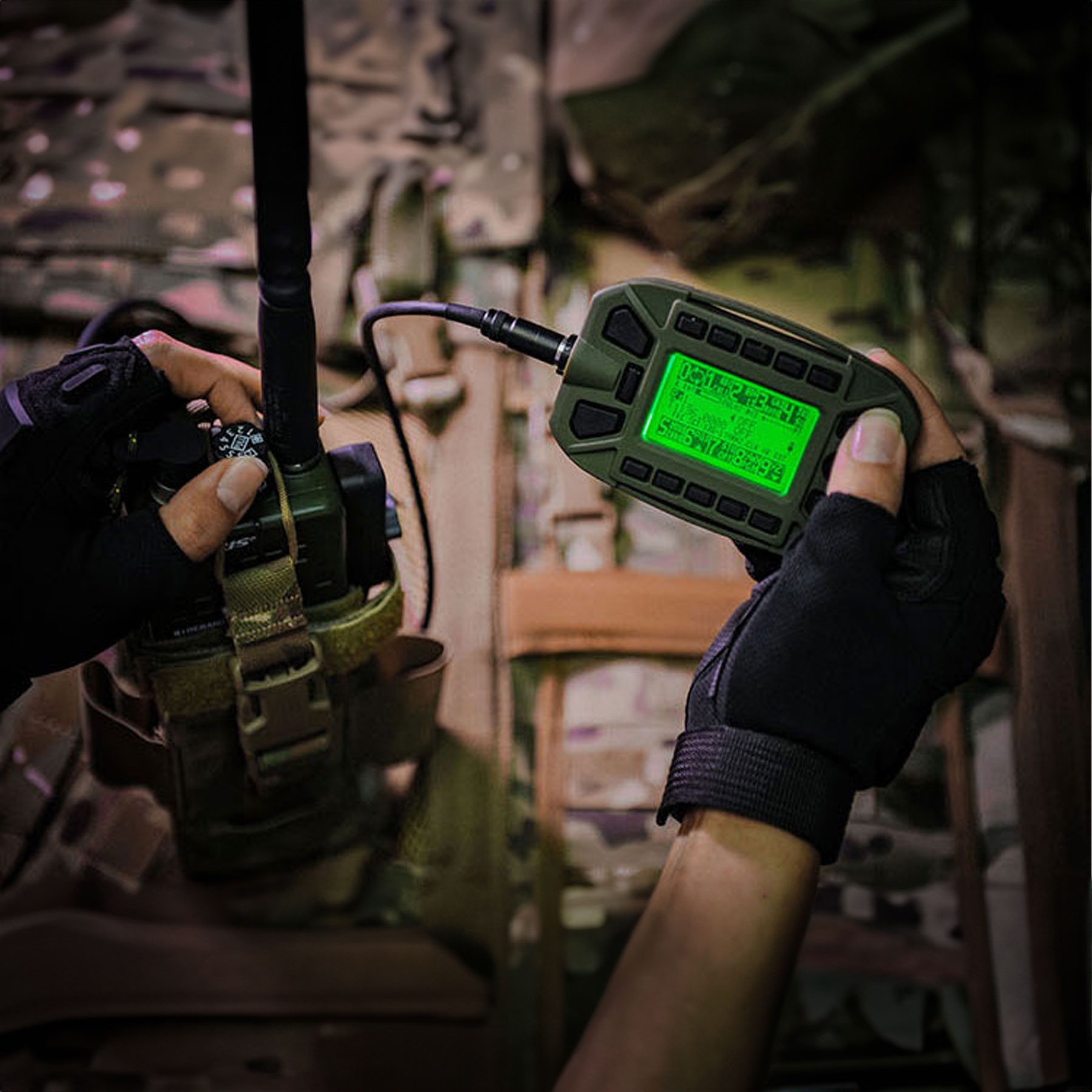
Among all characteristics of the FCS AN/PRC-152A, there is one that often remains unnoticed by buyers, even though it is what distinguishes this model most from majority budget portable radio stations. We are talking about the built-in Cross-band Repeater mode.
For many users, the word repeater sounds complicated, although the principle of its operation is quite simple. Imagine two people located on opposite sides of a hill or a large building. Directly, they do not hear each other, even if both use high-quality radio stations. If a third station is placed between them to receive the signal on one frequency and automatically transmit it on another, communication will be restored. That is exactly how a repeater works.
Why Is This Function So Useful?
In most cases, a separate stationary station mounted on a mast, high point, or building is used to organize repeating. The FCS AN/PRC-152A allows such a scenario to be realized without separate equipment. The radio station can be left at an advantageous point on the terrain, after which it will automatically transmit messages between two different channels. This is especially useful:
-
During training exercises;
-
On large airsoft grounds;
-
In rough terrain;
-
When organizing temporary field camps;
-
In situations where it is necessary to increase coverage area without installing a stationary repeater.
Cross-Band Repeating Specifically
During testing, it was confirmed that the FCS operates specifically in Very High Frequency <-> Ultra High Frequency mode. That is, the signal is received in one band and immediately transmitted in the other. For example:
-
Reception – one hundred forty-five point five hundred megahertz.
-
Transmission – four hundred thirty-three point five hundred megahertz.
That is why the mode is called a Cross-band Repeater. At the same time, using one and the same frequency for reception and transmission, as is implemented in certain professional stationary repeaters, is not permitted by this model. For most users, this will not become a problem, but it is worth knowing about such a feature prior to purchasing.
Airwaves Monitoring Is Preserved
A pleasant detail was that during repeater operation, the user does not lose their radio station. Many portable models in a similar mode effectively turn into a "black box" that only retransmits the signal. The FCS behaves differently. Through the built-in speaker, you can continue listening to messages arriving on the reception frequency. In other words, the operator simultaneously:
-
Controls the airwaves;
-
Uses the station as a repeater;
-
Does not require a second radio station for personal communication.
This small detail makes using the function significantly more comfortable.
Transmission Also Works Without Restrictions
When pressing the Push-To-Talk button, the user can transmit messages via the repeater's transmission frequency. That is, the operator not only services the network, but remains a full participant in it.
In practice, this is significantly more convenient than the classic scheme, where one has to use a separate stationary station for repeater operation, and another portable one for personal communication.
There Is One Particularity
During testing, another nuance was noticed. After activating repeater mode, changing power via the menu item POWER produced no result – the transmitter worked at maximum power. Most likely, this is a feature of the current software version, although the manufacturer does not comment on it officially.
For most users, this will not become a critical flaw, but in some scenarios it would be useful to have the ability to reduce power to save battery charge or minimize unwanted radio interference. That is why this point should be viewed not as a construction defect, but as one of the possible development points for future firmware versions.
What Does This Mean in Practice?
For most owners of the FCS AN/PRC-152A, repeater mode might remain a "just in case" feature. But if the need arises to quickly increase the coverage radius of a group without additional equipment, it can become one of the most useful tools of the radio station.
Stationary professional repeaters are often installed on mountain peaks, television towers, or roofs of high-rise buildings. Thanks to great elevation, one such station can provide reliable radio communication across tens or sometimes hundreds of miles. The operating principle of the FCS AN/PRC-152A is absolutely the same – only power, installation height, and coverage zone differ.
Compatibility with Original Headsets: One of the Main Reasons to Buy FCS Specifically
If you ask experienced users why people buy replicas of the AN/PRC-152A at all, most will not even mention external appearance. The answer will be significantly more pragmatic – compatibility with professional military headsets. And right here, FCS holds one of its strongest advantages.
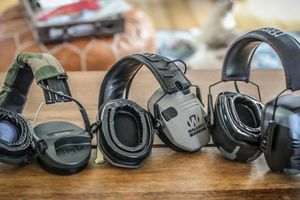
Most civilian radio stations use the familiar Kenwood K1 two-pin connector. It is simple, cheap, and universal, but it was not created for professional active headsets at all. Because of this, owners of 3M PELTOR ComTac, MSA Sordin, Ops-Core AMP, INVISIO, Silynx, and other military communication systems have to buy adapters, change Push-To-Talk modules, or even resolder microphones. In the case of the FCS AN/PRC-152A, the situation is completely different.
North Atlantic Treaty Organization U-Three-Twenty-Nine Standard
On the upper part of the housing, a six-pin North Atlantic Treaty Organization U-three-twenty-nine connector is installed, which is used on a large number of professional military items. Through it, the following are connected:
-
Active headsets;
-
Remote Push-To-Talk buttons;
-
Certain specialized accessories.
This means that the user works with gear exactly as intended by the manufacturer. No adapter cables hanging from equipment. No improvised home-made adapters. No compromises with contact quality.
Microphone Mode – A Small Menu Item That Saves a Lot of Nerves
One of the most interesting functions of the FCS is the ability to select the type of connected microphone. A parameter called Microphone Mode is available in the menu, allowing you to choose one of two operating modes:
-
Electret;
-
Dynamic.
Here is the complete translation into English. All abbreviations have been spelled out in full, and metric units have been converted to the imperial system (feet, pounds, yards, ounces, and inches) as requested.
For most people, these words do not mean much. In fact, it is precisely because of the different types of microphones that problems most often arise when connecting professional headsets to ordinary two-way radios. For example, many models of 3M PELTOR ComTac use dynamic microphones, while the vast majority of civilian radio stations are designed for electret ones. As a result, the user gets a familiar situation: You hear the other person perfectly fine. But they cannot hear you at all. Or they hear you very quietly. That is why owners of Baofeng often buy:
-
Separate amplifiers.
-
Special Push-To-Talk devices.
-
Adapters.
-
New microphones.
FCS allows solving this problem much more simply. It is enough to change the corresponding menu item.
Why is this more important than it seems?
At first glance, it might seem that supporting different types of microphones is a minor detail. In reality, it is precisely what largely determines compatibility with professional equipment. Because a high-quality active headset can cost several times more than the radio station itself. And if it cannot be properly connected without a dozen adapters, the user essentially loses the main advantage of such equipment. That is why the ability to work correctly with dynamic microphones is one of the strongest arguments in favor of FCS.
How does FCS differ from a standard portable two-way radio?
For clarity, it is enough to compare a typical connection scheme.
Baofeng UV-5R:
-
Kenwood K1 connector;
-
often requires a special Push-To-Talk device;
-
possible microphone compatibility issues;
-
sometimes additional adapters are required.
FCS AN/PRC-152A:
-
military connector North Atlantic Treaty Organization U-329;
-
support for professional Push-To-Talk devices;
-
ability to select the microphone type;
-
significantly lower chances of encountering compatibility issues.
That is why FCS is often chosen not because of longer communication range or higher power – they are practically no different from other analog models of this class – but because of the ability to integrate the radio station into an already existing set of tactical equipment without unnecessary compromises.
What does this mean in practice?
If you use a regular headset with a Kenwood connector, the advantages of FCS may not seem so obvious. But as soon as you switch to professional communication systems like 3M PELTOR, MSA Sordin, or Ops-Core, it becomes clear that compatibility with military standards is one of the main reasons for the existence of such radio stations.
FCS AN/PRC-152(A) Radio with KDU
All information about the radio station is available on the product page
Go ahead and order!
The cost of an original 3M PELTOR ComTac VIII active headset in maximum configuration can exceed 2,000 United States dollars. Against this backdrop, saving money on radio station compatibility looks questionable: it is much more important that all equipment works as a single system rather than requiring a set of adapters and non-standard solutions.
Controls: maximum similarity to the original
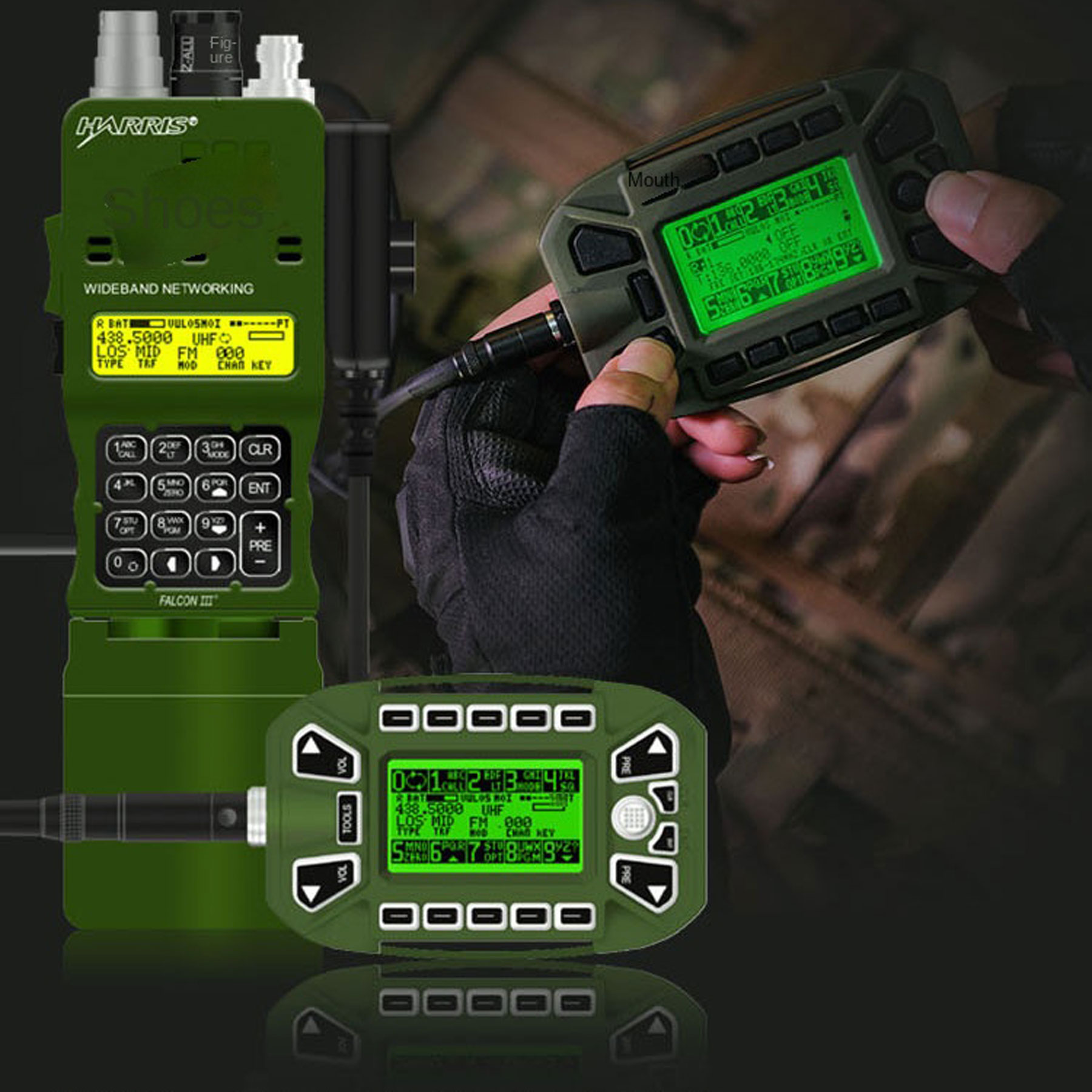
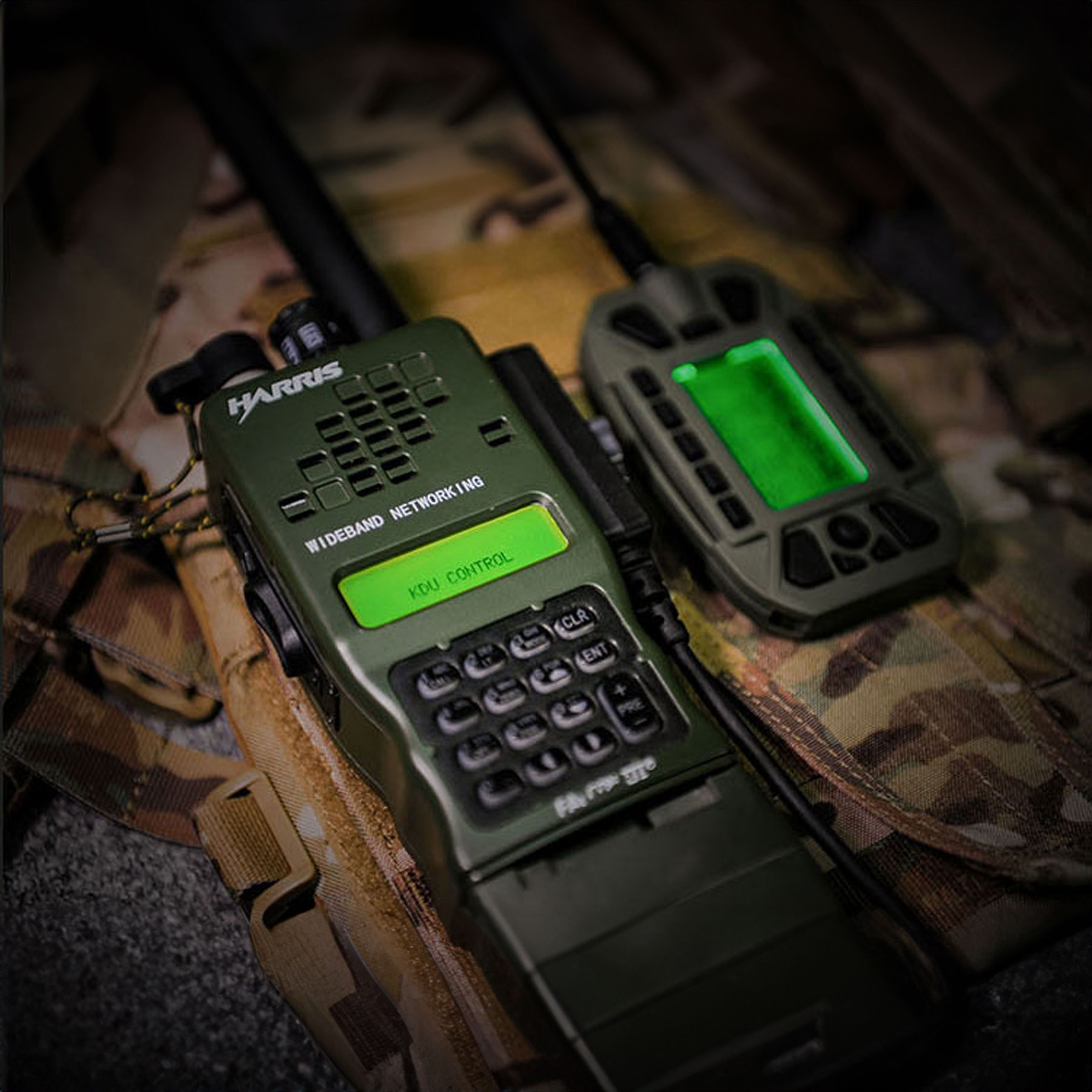
If you place the FCS AN/PRC-152A and the original Harris AN/PRC-152A side by side, it will not be easy to tell them apart at first glance. That is exactly what the manufacturer aimed for. They did not just copy the general outlines of the housing, but replicated as much as possible the ergonomics, the arrangement of controls, and the principle of interaction with the radio station.
Thanks to this, the user gets not just a radio in a "pretty" body, but a device that allows getting used to an operational logic that is as close as possible to the military original. This will be especially appreciated by military personnel, instructors, reenactors, and airsoft players who have already worked with or plan to work with real AN/PRC-152s.
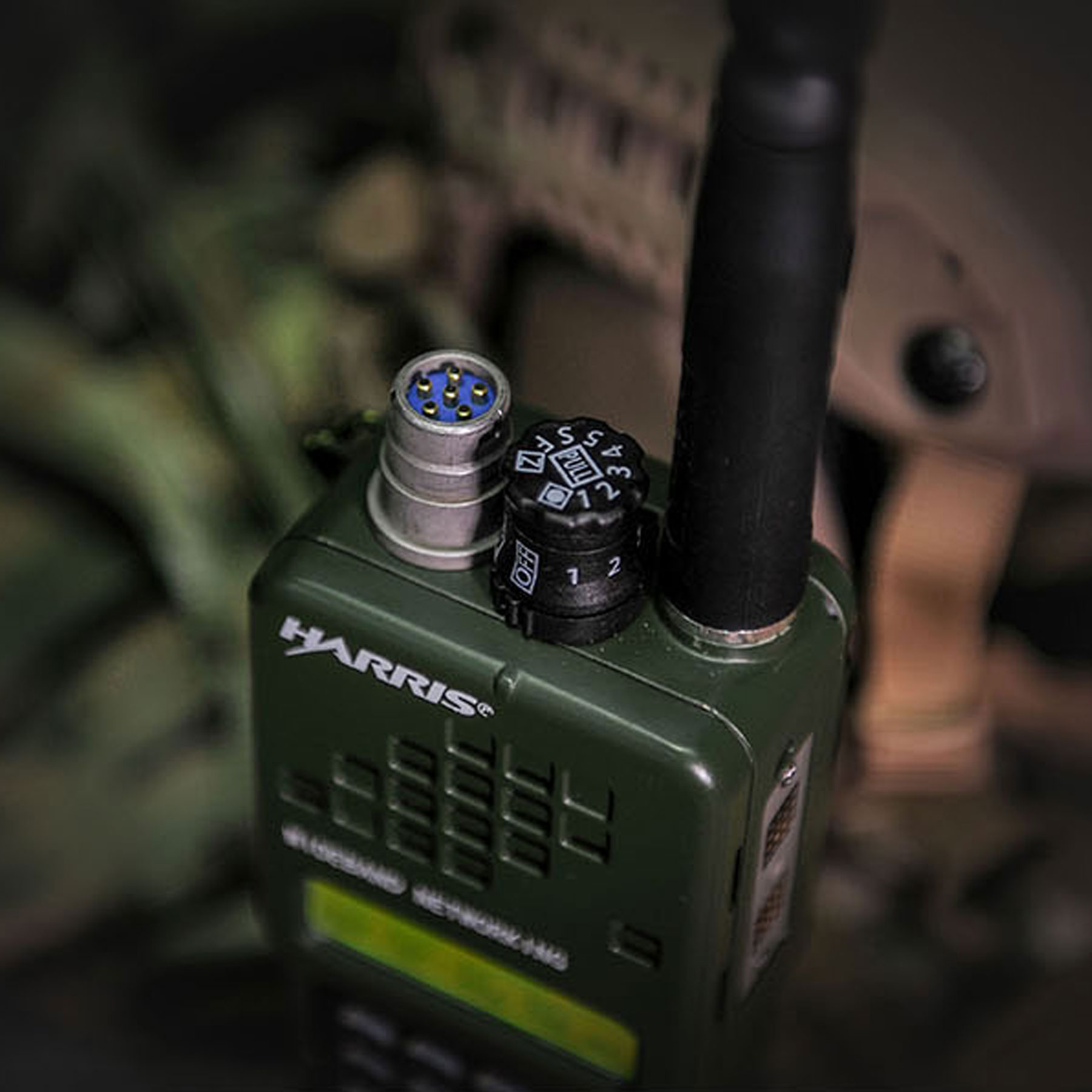
Top panel
All the main elements necessary for daily operation are located on the upper part of the body.
On the left is a Threaded Neill–Concelman connector, to which the standard folding antenna is connected.
On the right is a 6-contact connector, North Atlantic Treaty Organization U-329, intended for connecting military Push-To-Talk devices and active headsets. This is precisely what makes FCS interesting for owners of professional tactical gear.
Between them are two controls. The first is a volume knob that simultaneously performs the function of turning the radio station on and off. The second is a three-position operating mode switch.
Three-position mode selector
Unlike civilian portable radio stations, which usually use only one power switch, FCS inherited a separate mode selector from the military prototype. It has three positions:
-
PT – Plain Text, the normal operating mode.
-
LD – Load, the programming mode.
-
CT – Cipher Text, the digital voice processing mode.
The first is used for everyday operation of the radio station. The second is intended for connecting to a computer and programming the parameters of the station using special software. The third often raises the most questions. And despite the fact that in some descriptions it is sometimes called "encryption mode", this does not correspond to reality. FCS AN/PRC-152A does not support cryptographic secure communications characteristic of original Harris Falcon III radios. This mode uses digital voice processing or modulation, which may complicate eavesdropping on incompatible devices, but does not provide full-fledged encryption. That is why considering CT as an analog of military Communications Security is not worth it.
Left side face
The controls used most frequently are located right here.
In the upper part, there is a two-position key for switching the active channel between the upper and lower lines of the display.
Below is a large Push-To-Talk button, which has large enough dimensions to be conveniently used even in tactical gloves.
Under the transmission button is another programmable key, the functions of which depend on the current settings of the radio station.
Right side face
The right side of the body almost completely repeats the design of the original AN/PRC-152A. Under a protective cap, there is a service connector for programming the radio station. It is through this connector that setting up channel memory, operating parameters, and other service functions is performed using special software. For the average user, this connector will not be needed often, but it opens up much broader configuration options than manual programming via the keypad.
Front panel
The main means of interaction with the user remains a large monochrome backlit display and a digital keypad.
One of the advantages of FCS is the dual-line frequency display, which allows monitoring two independent channels simultaneously. This combines well with support for the Dual Watch function, which was mentioned earlier.
The digital keypad is used for:
-
entering frequencies;
-
menu navigation;
-
quick access to individual functions;
-
entering Dual-Tone Multi-Frequency codes.
Unlike many budget analogs, the buttons are quite large and well separated from each other, so you can work with them even in gloves.
Ergonomics in field conditions
Despite its considerable dimensions – 2.76 × 10.04 × 1.77 inches – using the FCS is quite comfortable. All main controls are located exactly where a person familiar with military radio stations of the PRC family expects to see them.
The weight of the device is directly related to its construction. The metal body, massive battery pack, and durable mechanical elements make the FCS heavier than most civilian portable models. At the same time, this provides a feeling of reliability and adds similarity to the original AN/PRC-152A, which is also not among the light radio stations.
What does this mean in practice?
FCS AN/PRC-152A does not try to look "more modern" than the original. On the contrary, the manufacturer has preserved as much as possible the familiar ergonomics of a military radio station, leaving the layout of controls, connectors, and the logic of interaction with the device almost unchanged. That is why the user gets not only a striking appearance, but also a user experience very close to that provided by a real AN/PRC-152A.
During the development of military radio stations, ergonomics are tested not only with bare hands. Tests are also conducted in winter and tactical gloves, in chemical protection gear, and even in complete darkness. That is why the buttons, switches, and knobs of professional models are usually much larger than those of standard civilian radio stations.
Menu and software features: more than just another replica
Most replicas of AN/PRC-152 work on the exact same principle: externally they differ little from the original, but inside they actually hide the electronics of a regular amateur radio station with a slightly modified interface. That is why after a few minutes of operation, experienced users quickly realize that they are looking at another variation of a well-known platform.
In the case of FCS AN/PRC-152A, the situation is different. The manufacturer went much further than simple copying of the appearance and implemented its own software platform. This does not make the radio station an equivalent of the original Harris Falcon III, but it allows for a much more modern menu, more configuration options, and better potential for further software development. That is why FCS can be viewed not just as a pretty replica, but as a standalone product with its own advantages.
More logical menu structure
Immediately after turning it on for the first time, it is noticeable that the manufacturer paid significant attention specifically to the user interface. Most functions are grouped quite logically, and navigating between menu items does not cause the feeling of chaos that often accompanies cheaper Chinese radio stations.
Of course, without an instruction manual, some parameters will still have to be studied on your own, but overall the logic of the menu structure looks much clearer than in many budget models.
MIC.MD – one of the most valuable features
If you were to highlight just one feature for which many users are willing to pay extra specifically for FCS, it would be MIC.MD (Microphone Mode). This menu item allows you to select the type of connected microphone:
-
Electret.
-
Dynamic.
At first glance, this might seem like a small detail. In reality, this exact feature solves one of the most common problems faced by owners of professional military headsets. Most civilian radio stations are designed for electret microphones, whereas original 3M Peltor ComTac, MSA Sordin, Ops-Core AMP, C4OPS, and several other models use dynamic microphones. It is because of this that when connecting to regular Baofeng, Quansheng, or other popular portable radios, users often face the need to change the microphone, install additional amplifiers, or buy special adapters.
In FCS, it is enough to simply change the microphone type in the menu. After that, the headset starts working correctly without any modifications. This feature became one of the main reasons for the popularity of FCS among owners of original military headsets.
Programming via computer
For users who regularly work with a large number of channels, the ability to program the radio station via Personal Computer is provided. This setup method is much faster than entering frequencies manually and allows creating a fully ready set of channels with the required parameters in literally a few minutes. This is especially relevant for instructors, training organizers, or teams that need to quickly set up several identical radio stations at once.
Repeater mode
Another interesting function is the ability to use FCS as a portable cross-band repeater.
During testing, the operation of cross-band repeating was confirmed, where reception occurs in one band and transmission occurs in another. In practice, this allows increasing the reliable radio communication area between groups that cannot directly "see" each other due to terrain features or buildings. At the same time, the operator can simultaneously monitor the receiving channel through the built-in speaker and, if necessary, respond from their radio station without using a separate stationary repeater.
During testing, one nuance was also noticed. After activating the repeater mode, changing the transmitter power through the POWER menu item was unsuccessful—the station continued to operate at maximum power. This is not a critical drawback, but you should know about this behavior in advance, as it can affect both battery life and the level of radio interference generated.
Proprietary software platform
One of the features of FCS is that the manufacturer did not limit itself to copying ready-made solutions. The company claims the use of its own software platform and support for open Application Programming Interfaces for developers. This creates potential for further firmware development, integration with additional devices, and the appearance of new functions in the future.
Of course, the average user is unlikely to write their own software for the radio station. However, the very fact of such openness indicates that FCS views its product not as a one-time replica, but as a platform that can be developed further.
What does this mean in practice?
It is the software component today that represents one of the most significant advantages of FCS AN/PRC-152A over most other replicas. While externally many models look similar, after a few hours of operation the difference becomes obvious. A proprietary menu, support for different microphone types, cross-band repeater, Personal Computer programming, and the potential for further development make FCS not just a copy of a famous military radio station, but an independent and technically interesting product.
Paradoxically, software today often determines the value of a radio station no less than its hardware. Two models with the same processor, receiver, and transmitter can differ significantly in user convenience simply due to different firmware, menu logic, and available functions. That is why manufacturers are increasingly competing not only with "iron," but also with the capabilities of their software.
FCS AN/PRC-152A or other replicas: is it worth paying extra?
After a few days of getting acquainted with the FCS AN/PRC-152A, a fundamental question naturally arises: if it is still a replica, is its price justified compared to cheaper analogs?
There is no single answer, as everything depends on the tasks for which the radio station is purchased. If only voice communication between a few people is required, a much cheaper model will handle that. If compatibility with professional equipment, a maximum authentic look, and broader software capabilities are important, the situation looks completely different.
Comparison with TCA AN/PRC-152A
Most often, FCS is compared specifically with TCA AN/PRC-152A, as both models belong to the same class of military radio replicas. Externally, they are very similar. Both models replicate as closely as possible the body of the original Harris AN/PRC-152A, support the installation of standard accessories, use battery packs for four 18650-size batteries, feature a metal body, and operate in Very High Frequency / Ultra High Frequency bands. That is why it can be difficult to tell them apart from photos alone.
The difference begins to show after turning them on. TCA is built on a software platform familiar to many users, which in terms of operational logic largely resembles classic amateur radio stations. FCS uses its own software, has a more modern menu, and significantly greater potential for further firmware development.
Battery life
Both models use the same battery pack concept holding four 18650 batteries. However, FCS takes a more honest approach to battery life. Since the battery cells themselves are usually not included in the delivery package, talking about a fixed battery capacity would be incorrect. That is why it is more accurate to focus not on a specific number, but on the design of the battery pack.
When using modern high-quality power cells, the total capacity is usually around 6,000 to 8,000 milliampere-hours, which corresponds to the manufacturer's claims and practical use of such battery packs.
So what should you choose?
If the main criterion is the lowest price, and the radio station is needed primarily for basic voice communication, then cheaper replicas, including TCA, remain a fully workable option. However, when a more modern software platform, better menu logic, and development potential become important, it is the FCS AN/PRC-152A that looks like the more interesting purchase. It does not try to replace a real Harris Falcon III, but among functional civilian replicas today, it is one of the most technically well-thought-out models.
-
Interestingly, the cost of high-quality AN/PRC-152 replicas sometimes exceeds the price of individual professional amateur radio stations from well-known brands. Buyers pay not only for communication, but also for compatibility with military headsets, accessories, ergonomics, and the most authentic reproduction of the original Harris AN/PRC-152A. That is why such models are in demand not only among airsoft players, but also among military personnel, instructors, and training centers.
-
Despite identical external appearances, modern replicas of military radio stations can differ significantly in their internal components. It is the software, menu logic, and accessory support today that increasingly determine the real capabilities of the device far more than the shape of the body or the list of stated specifications.
After a detailed acquaintance with the FCS AN/PRC-152A, it becomes clear that we have before us not just another decorative copy of a famous military radio station. It does not claim the capabilities of the original Harris AN/PRC-152A with secure digital communication, satellite modes, or military cryptography, but it offers what really matters to a civilian user: high-quality analog radio, a durable metal body, dual-band Very High Frequency / Ultra High Frequency support, compatibility with professional headsets, and a well-thought-out software platform.
In my opinion, the strongest side of the model is not the external resemblance to Harris, although it is truly impressive, but the combination of small technical solutions. Support for dynamic microphones without additional adapters, proprietary software, cross-band repeating mode, the use of standard 18650 batteries, and high compatibility with military accessories make FCS interesting not only for reenactors or airsoft players, but also for instructors, training centers, and users who already own professional tactical gear.
If you consider the FCS AN/PRC-152A specifically as a functional replica rather than a replacement for a real Harris Falcon III, today it is one of the most interesting models in its class. It successfully combines an authentic appearance, good build quality, thoughtful ergonomics, and features that are often lacking in most other replicas.
NEED HELP WITH YOUR CHOICE?
Our specialists will help you choose the optimal solution
Contact a specialist!

Igor Ivandikov — author of the article
Project Manager
Has over 2 years of experience working in the field of camping equipment. Well-versed in products for tourism, camping, and outdoor recreation.
Responsible for coordinating projects, monitoring deadlines, and ensuring the quality of task completion.
He enjoys football (soccer) and billiards, participates in competitions, and has won prizes on numerous occasions. He is a fan of active recreation.
FAQ: Answers to Frequently Asked Questions
1. Is the FCS AN/PRC-152A a full replacement for the original Harris AN/PRC-152A?
2. How does FCS differ from TCA AN/PRC-152A?
3. Can original Peltor or MSA Sordin headsets be used with FCS?
4. What is the battery life of the FCS AN/PRC-152A?