
As someone who has worked with tactical gear, military backpacks, and pouches for many years, I can tell you: the MOLLE/PALS system is one of the key standards of modern equipment. It provides the most valuable qualities needed in the field, at the range, or on a journey – modularity, versatility, and the ability to rapidly adapt gear to specific tasks.
While these concepts have long been understood by the military, the system has been actively integrated into civilian products over recent years. As a result, I increasingly hear everyday questions like «What is MOLLE?», «MOLLE system on a backpack», or «How to attach MOLLE pouches». Let’s break it down in detail, right here and now, together with the Punisher quality gear store, to see what stands behind this acronym and why it became the industry standard.
MOLLE and PALS: What’s the difference?
Many people use these terms as synonyms, but technically, they are different concepts.
-
PALS (Pouch Attachment Ladder System) is the actual attachment design. It consists of horizontal rows of 1-inch (≈2.5 cm) nylon webbing spaced with a strictly standardized pitch. These "ladders" are what you see on tactical backpacks, plate carriers, body armor, and belt systems.
-
MOLLE (Modular Lightweight Load-carrying Equipment) is the overall name of the equipment system that uses PALS as its base platform.
Technically, it is more correct to say: The backpack is equipped with PALS and is part of the MOLLE system.
Because of standardized dimensions, any MOLLE pouch can be mounted on any compatible platform, regardless of the manufacturer. This ensures full interchangeability and allows you to configure gear for a specific mission, training session, or trip.
A Standard Without Borders
Thanks to unified dimensions, a pouch from one brand can work seamlessly with a platform from another – even decades after production.

Where is the MOLLE system used?
Today, MOLLE compatibility has become a standard far beyond the military. You will most often find the system on:
-
Military and tactical backpacks;
-
Plate carriers and load-bearing systems;
-
Body armor;
-
Belt and harness systems (chest rigs);
-
Pouches for magazines, first aid kits, and radios;
-
Dry bags and additional pockets;
-
EDC bags and urban backpacks.
I can already hear a logical question from those hearing this for the first time: «What is EDC?» The answer: it is an acronym well-known to the military and hikers for «Every-Day Carry». This term refers to essential items or supplies carried daily or needed immediately in an emergency or extreme situation.
As further proof, our store is seeing an increasing demand from students for a «MOLLE backpack for the city» or from avid hikers for a «tactical backpack for travel».
Military Origins
The MOLLE system was introduced by the U.S. Army in the early 2000s as a replacement for ALICE – the older system that used metal clips.
Why is the material critically important?
The effectiveness of MOLLE depends not only on the design but also on the fabric. For professional use, the standard is Cordura 500D-1000D – a high-strength nylon resistant to abrasion, heavy loads, and weather conditions.
Budget products made of polyester often appear on the market, looking like tactical gear. However, under active use, they quickly lose their shape, and the webbing may tear. If you need a reliable tactical backpack or MOLLE pouch, you should choose nylon materials.

Classic MOLLE vs. Laser Cut?
Modern gear offers two versions of the system.
Classic MOLLE (Sewn Webbing)
Advantages:
-
Maximum strength and durability;
-
Easy to clean;
-
Versatile for various conditions.
Disadvantages:
-
Slightly higher weight;
-
More complex manufacturing process.
Laser Cut MOLLE (Laser Slots)
Advantages:
-
Lighter weight;
-
Lower profile;
-
Modern appearance and better camouflage properties.
Disadvantages:
-
Harder to clean dirt out of the slots;
-
Slots may stretch under prolonged heavy loads;
-
Material limitations.
In practice, classic MOLLE is usually chosen for military and intensive use, while laser cut is popular among EDC users and those who value minimal weight.


MOLLE in Civilian Life
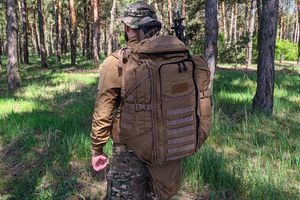
Today, this system is actively used by rescue workers, medics, hikers, photographers, and even office workers organizing an EDC kit in an urban backpack.
The MOLLE/PALS system is not just a design element; it is a functional standard that ensures adaptability, scalability, and efficient gear organization. It works equally well in military conditions, at the range, on a hike, or in an urban environment. An expert's golden rule: choose quality materials and trusted manufacturers – then MOLLE will work exactly as intended.


Vitalii Buniak — article author
Military gear consultant
Before 2022, he worked as a sales assistant at the Panisher store. After the start of the full-scale invasion, he joined the Armed Forces of Ukraine, gaining real combat experience.
Thanks to his combat experience and deep knowledge of tactical gear, Vitalii serves as a personal expert of the Panisher online store in the fields of:
- Clothing and footwear
- Equipment
His recommendations help customers choose reliable and functional gear for any conditions.
FAQ. Answers to Frequently Asked Questions
1. How are MOLLE pouches attached?
2. Are pouches from different manufacturers compatible?
3. Which is better: Classic MOLLE or Laser Cut?
4. Is MOLLE suitable for everyday use?