Just a hundred years ago, most major battles were fought in open terrain. Fields, forests, rivers, and high ground determined the success of operations, while cities served mostly as critical strategic points. However, the rise of urbanization, shifts in conflict, and the rapid growth of metropolises have gradually transformed the very nature of warfare. Today, decisive events are taking place less frequently in open fields and more often among high-rises, industrial zones, underground utilities, and residential blocks.
It is in this environment that the concept of CQB (Close Quarters Battle) – fighting in enclosed spaces – was formed. It is neither a distinct type of weapon nor a specific tactic, but a comprehensive set of skills, specialized gear, psychological preparation, and technological solutions that help military personnel operate in one of the most complex environments of modern warfare.
Today, CQB is no longer a narrow specialization reserved for elite special forces. The experience of recent decades shows that urban combat skills have become relevant for a wide range of military personnel. Furthermore, the development of unmanned systems, digital communications, and modern equipment continues to reshape approaches to executing urban missions. So, let’s dive deeper into the topic together with a specialist from the military store Punisher.

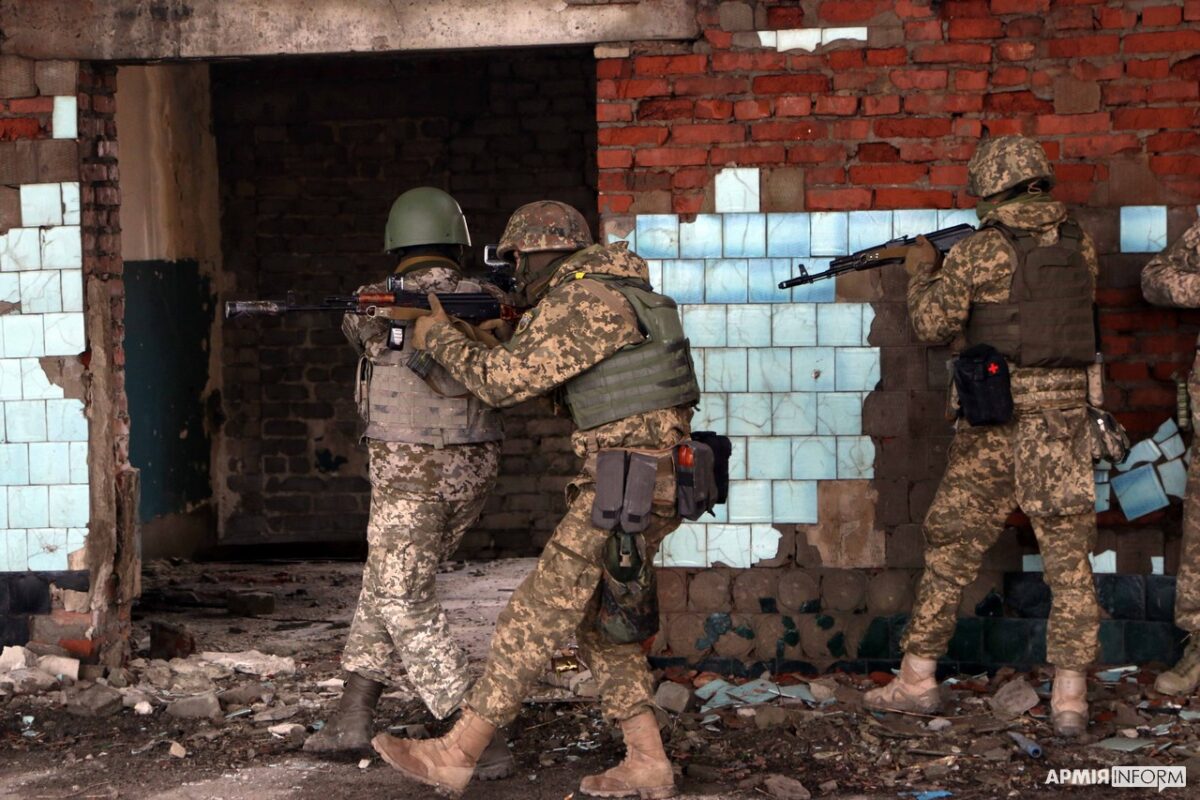
Where Did CQB Come From?
The idea of conducting battle in confined spaces has always existed – dating back to castle sieges and shipboard boarding actions. However, CQB began to take shape as a distinct discipline only at the beginning of the 20th century. One of the cities that influenced the development of this field was Shanghai. In the 1920s and 1930s, due to high building density, a complex criminal environment, and active operations by international police forces, a need arose for new methodologies for operating inside buildings. It was then that principles for acting in narrow hallways, stairwells, and other enclosed spaces began to be systematized.
During World War II, this accumulated experience found new momentum. British Commandos, US Rangers, and other specialized formations faced the necessity of fighting for ports, ships, fortified structures, and industrial facilities. It became evident that urban combat possesses its own specific dynamics, significantly different from open-terrain actions. After the war, these developments were gradually integrated into training programs for many of the world's militaries, eventually forming the foundation of the modern CQB concept.
The term Close Quarters Battle gained widespread traction only in the second half of the 20th century. Before this, various countries used other terms – ranging from "house fighting" to "close combat in built-up areas". Despite differing terminology, they all described one common problem: how to operate in conditions where space is limited, and the situation changes in a fraction of a second.
How Cities Transformed Modern Warfare
In the 21st century, warfare less and less frequently takes place far from civilization. The vast majority of strategically vital targets – power plants, logistics hubs, factories, ports, airfields, administrative centers – are located squarely in cities. Consequently, urban environments serve not merely as a backdrop for combat operations, but as one of the primary factors dictating their character.
According to UN data, over 56% of the global population lives in urban areas today, a figure projected to rise to nearly 70% by 2050. This means that future conflicts will increasingly unfold within urbanized environments. For military personnel, this demands operating amidst residential blocks, industrial plants, transportation infrastructure, and multi-level underground utilities.
That is why the world’s leading militaries invest substantial resources into developing specialized training centers where soldiers hone their urban operations. These training grounds often consist of entire "mock towns" complete with high-rise buildings, narrow streets, pedestrian underpasses, bridges, and industrial zones. Their goal is not to teach soldiers to "memorize a single route", but to prepare personnel for the unpredictability of a real-world environment.
The largest training centers in the US, Great Britain, France, and Germany feature entire simulated cities. They feature working traffic lights, public transit, ambient sound systems, and role-player civilians portrayed by specially trained actors. These facilities allow for modeling highly realistic conditions without exposing specific operational scenarios.
From Wood to Carbon: How Military Gear Evolved
If a soldier from the early 1990s were placed among today's loadouts, they would hardly recognize most of it. Just thirty years ago, a standard kit consisted of a steel helmet, a heavy body armor vest, load-bearing suspenders, iron sights, and a minimal set of auxiliary gear. Flashlights were bulky, communications equipment was massive, and extra accessories often had to be carried separately. Today, the situation has changed drastically. Modern gear is designed as an integrated ecosystem where every element complements the next.
A modern loadout may include:
-
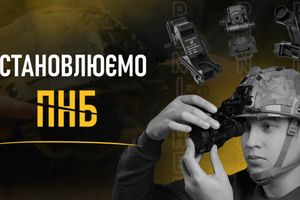
Light ballistic helmet with night vision/accessory mounts;
-
Modular plate carrier with MOLLE/PALS webbing;
-
Multifunctional utility pouches for essential kit.
The primary trend in recent years has been weight reduction without losing functionality. Where gear was once made of heavy steel and dense canvas, today high-strength polymers, aviation-grade aluminum, titanium, composite materials, and ultra-durable synthetic fibers dominate.

A modern mid-tier ballistic helmet delivers a significantly higher level of protection than steel models from the second half of the 20th century, while weighing almost half as much. In turn, reducing strain on the neck and shoulder girdle positively impacts a soldier's endurance during prolonged wear.
The Red Dot Sight Changed More Than It Seems
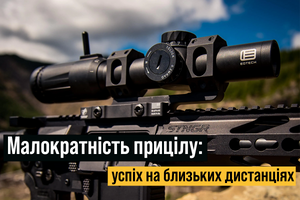
One of the most noticeable shifts in recent decades has been the mass adoption of red dot sights. As recently as the 1980s, they were considered expensive equipment reserved for elite units. Today, the red dot is practically standard issue across modern militaries. The reason is simple: it allows for faster target acquisition by placing the aiming reticle on the target without needing to align front and rear iron sights.
Alongside red dot sights, magnifiers gained widespread popularity, offering the ability to magnify images when observing targets at longer distances without replacing the optic itself. This has made weapon systems far more versatile, especially when the distance to a target can change in seconds.
Tactical flashlights became equally essential. While once viewed as a secondary accessory, compact LED models now deliver high output, long runtimes, and reliability even in harsh weather conditions.
The first LED tactical flashlights in the late 1990s seemed revolutionary, yet their output was only a few dozen lumens. Modern compact models can produce over 1,000 lumens while remaining lightweight enough for daily carry.
Drones Opened a New Era
One of the most significant technological breakthroughs of the past decade has been the widespread adoption of unmanned aerial systems. While drones were once associated primarily with open-terrain aerial reconnaissance, their range of application today is far broader. Compact drones are used to inspect large structures, industrial complexes, hangars, warehouse areas, and other architecturally complex facilities. They help units quickly gain situational awareness, identify potential obstacles, or assess structural integrity.
In parallel, ground-based robotic platforms are rapidly advancing. These systems can be deployed for cargo transport, casualty evacuation, engineering reconnaissance, or equipment delivery – reducing risk to personnel. It is precisely this combination of robotic systems, digital comms, thermal imaging technology, and modern gear that shapes the future of military operations in complex urban environments.
Ukraine is currently among the countries leading the rapid integration of unmanned technologies in the defense sector. The experience gained by Ukrainian specialists during full-scale warfare is being actively analyzed by defense departments worldwide. It influences not only drone development, but also the design of new gear, communications equipment, and unit command systems.
Psychology of CQB: When the Brain Works at Its Limits
Urban combat is not just a test of physical conditioning; it is first and foremost a severe test of human psychology. That is why modern instructors increasingly emphasize that a soldier’s main "weapon" is not their carbine, but their ability to process information quickly and make sound decisions under extreme psychological pressure.
Military psychology research shows that under acute stress, the body instantly enters a state of maximum mobilization. Heart rate spikes, adrenaline and cortisol production surge, breathing accelerates, and the brain hyper-focuses on the most immediate stimuli.
However, this response has a downside. Many individuals experience what is known as tunnel vision – peripheral vision temporarily narrows, impairing the brain’s ability to process information from the sides. Another well-documented phenomenon is auditory exclusion, where a person barely notices deafening sounds or perceives them as muffled. That is why, after extreme stress, soldiers often recall having no memory of certain loud sounds or even gunshots, despite them being captured on video.
Interestingly, many combat veterans describe an altered perception of time. For some, events seem to slow down, allowing them to notice minute details; for others, it feels as though everything transpired in a split second. Neurophysiologists attribute this to how memory and attention function under extreme conditions. Consequently, modern training focuses heavily on developing stress resilience rather than solely mechanical skills. The more a soldier trains in realistic conditions, the more effectively their brain adapts to operating under strain.
Experiments using eye-tracking systems revealed that well-trained operators scan rooms significantly more efficiently than novices. They do not fixate on a single object for too long, spot environmental changes faster, and distribute their attention more effectively. This confirms that experience shapes not only physical skills, but the very way information is perceived.
How Modern Soldiers Train
21st-century training facilities look very little like traditional shooting ranges. Their goal is to replicate real urban environments as closely as possible while maintaining participant safety.
Many countries utilize specialized facilities consisting of dozens of multi-purpose buildings: residential houses, offices, schools, hospitals, factory floors, train stations, and even subway stops. Some of these structures feature modular, movable walls, allowing instructors to alter floor plans on short notice to create fresh training scenarios.
Video recording systems are extensively used. Cameras are mounted both inside rooms and on participants' gear. Following exercises, instructors conduct detailed After-Action Reviews (AARs), analyzing footage to evaluate teamwork, communication, attention management, and decision-making. This approach identifies mistakes and refines training without relying on static, repetitive scenarios.
In recent years, virtual and augmented reality technologies have been actively integrated into training. While they do not replace live-action drills, they allow units to model diverse scenarios, analyze participant behavior, and practice team coordination in a controlled environment.
Certain modern training facilities utilize software that automatically alters drill scenarios. The system can vary lighting, ambient noise, furniture placement, or spawn unexpected hazards, ensuring no two training runs are identical.
Artificial Intelligence and the Future of Training
A few years ago, artificial intelligence was associated primarily with text processing or image generation. Today, its capabilities are far broader, and the defense sector is actively exploring its potential.
One promising direction is the analysis of the training process. Algorithms can process vast volumes of video data, identify patterns in participant actions, evaluate drill effectiveness, and highlight areas requiring instructor intervention. This does not replace human evaluation, but renders it faster and more objective.
Another direction involves integrating AI with robotic platforms, sensor suites, and digital command networks. These solutions aim to heighten situational awareness and reduce information overload on combatants.
At the same time, experts stress that despite rapid technological growth, final decision-making in critical scenarios must remain with humans. Human experience, ethical judgment, and the ability to evaluate context remain essential pillars of modern military preparation.
Defense analysts predict that over the coming decades, increasing focus will be placed on integrating loadouts into unified digital ecosystems. Communications, navigation, health monitoring, and optics will exchange data seamlessly, helping soldiers process environmental data and monitor equipment status faster.

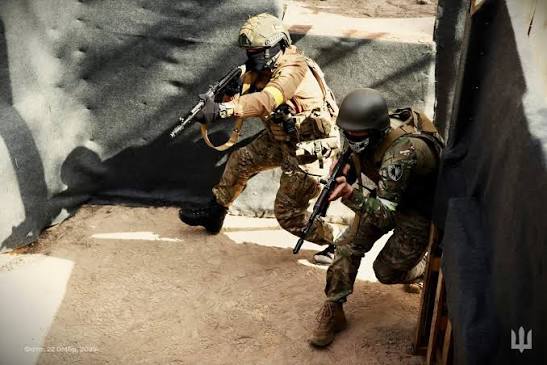
A Dozen CQB Myths Pushed by Movies and Video Games
Most people are introduced to CQB not through military doctrine or professional literature, but through movies, TV shows, and video games. The issue is that media prioritizes cinematic spectacle over authenticity. As a result, numerous myths surround close-quarters battle that bear little resemblance to reality.
Myth #1: A single operator can cover every angle
In action movies, the protagonist moves effortlessly through any building, instantly spots every threat, and maintains 360-degree control.
Reality: Human attention has strict cognitive limits. That is why modern training places massive emphasis on teamwork, sector assignments, and mutual coverage.
Myth #2: Expensive gear automatically makes a soldier effective
Social media is flooded with photos of high-end optics, accessories, and boutique gear, creating the impression that success is determined by price tags.
Reality: Even the most advanced equipment cannot replace experience, discipline, and constant training. Technology merely helps an operator apply existing skills.
Myth #3: The more gear you pack, the better
Novices often try to load up with as much gear as possible. However, operational history across world militaries shows the opposite trend.
Reality: Over the last twenty years, loadouts have become significantly lighter, more compact, and functional. Modern philosophy centers on efficiency rather than sheer volume.
When testing new gear, engineers increasingly rely on biomechanical studies. Sensors track movement to measure how extra pounds impact fatigue, movement speed, and joint strain.
Myth #4: The future belongs entirely to robots
Sci-fi films portray a near future where autonomous machines handle all dangerous work.
Reality: While robotic systems are advancing rapidly, they remain tools that assist humans. The complexity of urban environments, unpredictable variables, and the need for contextual judgment make human decision-making irreplaceable.
Myth #5: Night turns everything pitch black
Many imagine night operations take place in total darkness where nothing is visible without specialized gear.
Reality: Modern urban areas generate massive amounts of ambient light – streetlights, signage, vehicles, industrial lighting. Modern observation systems continuously evolve to navigate complex matrices of light and shadow.
Myth #6: All buildings are structured the same
At first glance, an office center, a school, or an apartment building might seem similar. In reality, every building type possesses unique architectural logic, layouts, and engineering features.
Reality: Urban warfare training covers familiarity with diverse architectural styles and structural engineering principles.
Myth #7: Speed is everything
To an audience, it seems that whoever runs fastest wins.
Reality: Rushing without situational control leads to fatal mistakes. Experienced instructors value discipline, methodical observation, and coordination far above raw speed.
Myth #8: CQB is just about shooting
Reality: A major portion of training is dedicated to communication, room navigation, combat medicine, stress management, team coordination, and safe movement.
Myth #9: Suppressors make gunshots practically silent
Hollywood depicts gunshots as a faint "whisper".
Reality: Even suppressed firearms remain loud – especially indoors where sound waves bounce off concrete walls.
Myth #10: Active hearing protection is only for Special Forces
Today, hearing protection is standard issue for many regular infantry and shooters. It preserves hearing while amplifying command comms and subtle ambient sounds.
Myth #11: You can "master CQB" in a few training sessions
Professional mastery requires years of training and constant skill maintenance. Even seasoned operators routinely undergo refresher courses.
Myth #12: Video games accurately simulate real CQB
While games can build reaction speed and spatial awareness, they cannot replicate physical fatigue, extreme noise, exhaustion, fear, or real-world stakes.
Studies examining how video games affect combat perception revealed that people without real-world experience consistently overestimate how fast one can clear an unfamiliar building. After their first live training runs, most participants admitted that real environments are far more complex than expected.
CQB in World Militaries: Common Ground
Despite differences in gear and military doctrines, leading armies share several core principles regarding urban combat training.
|
Country/School |
Defining Characteristic |
|
United States |
Massive modular urban training sites and heavy tech integration |
|
United Kingdom |
Strong emphasis on team coordination and communication |
|
Israel |
Training tailored specifically to dense urban environments |
|
France |
Blend of military and tactical police (Gendarmerie) doctrines |
|
Germany |
High level of training process standardization |
|
Ukraine |
Rapid adaptation to real-world modern warfare combat experience |
The Ukrainian experience is particularly unique. Due to the scale of modern conflict, solutions had to be fielded rapidly – from digital comms to integrating tactical drones into daily squad operations. This capacity for rapid adaptation draws close attention from international military analysts.
Ukrainian instructors frequently participate in international training programs as practitioners carrying unique, real-world experience from modern high-tech warfare.
Little-Known Facts About CQB
Fact #1: The toughest opponent isn't the enemy – it's the building
Military instructors note a consistent pattern: the greatest difficulty in urban clearing stems not from the adversary, but from the architecture. Long corridors, stairwells, tight doorways, elevator shafts, large windows, reflective surfaces, furniture, and utilities create a complex environment that constantly shifts sightlines, acoustics, and spatial awareness. That is why training centers build varied layouts – two buildings that look identical from the outside can have radically different interior floor plans.
Fact #2: Indoor acoustics play tricks on you
Humans locate sound direction relatively well in open spaces. Indoors, concrete, metal, tile, and glass reflect sound waves repeatedly. As a result, a simple conversation can sound much closer or further away than it actually is. Modern active headsets are valued not just for ear protection, but for their ability to process spatial audio accurately.
Fact #3: Wall color matters
Designers of military shoot-houses pay attention even to wall finishes. Light surfaces reflect light, while dark ones absorb it. Glossy finishes create glares, whereas matte finishes obscure fine details. Training centers vary surface finishes to prepare soldiers for diverse visual environments.
Fact #4: The biggest advancements over the last 20 years weren't in small arms
Comparing a soldier's kit from the early 2000s to a modern set reveals that rifle design has changed relatively little. Instead, the true revolution took place in optics, body armor materials, comms, digital mapping, drones, battery tech, and night vision devices. Today's soldier receives far more environmental data than their counterpart twenty years ago.
Fact #5: Today's soldier carries more electronics than an early 2000s infantryman
Radios, active headsets, thermal optics, red dots, flashlights, GPS, smart devices, and power banks all require power. Batteries have become a critical logistical consideration, prompting manufacturers to design unified central power systems that run multiple devices off a single battery hub.
Ukraine as a Driver of Modern Tactical Equipment
Full-scale war forced Ukrainian manufacturers and military personnel to adapt swiftly to new challenges. Within a few years, domestic manufacturing of the following expanded exponentially:
-
Plate carriers.
-
Tactical apparel.
-
Load-bearing systems.
-
IFAKs and medical gear.
-
Tactical pouches.
-
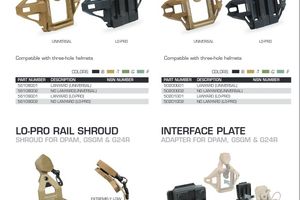
Mounting/attachment systems.
-
Camouflage systems.
-
Unmanned ground/aerial platforms.
Many designs were born directly from frontline user feedback, allowing rapid iteration and optimization for harsh field conditions. Simultaneously, foreign gear manufacturers study Ukrainian battlefield lessons. New materials, modular designs, and ergonomic improvements are increasingly integrated into products designed for the global defense market.
Before 2022, most tactical gear manufacturers designed equipment primarily around Middle Eastern operational experiences. Today, a significant portion of new gear design is informed by lessons from full-scale warfare in Ukraine, combining urban clearing, heavy drone usage, precision strikes, and modern digital technology.
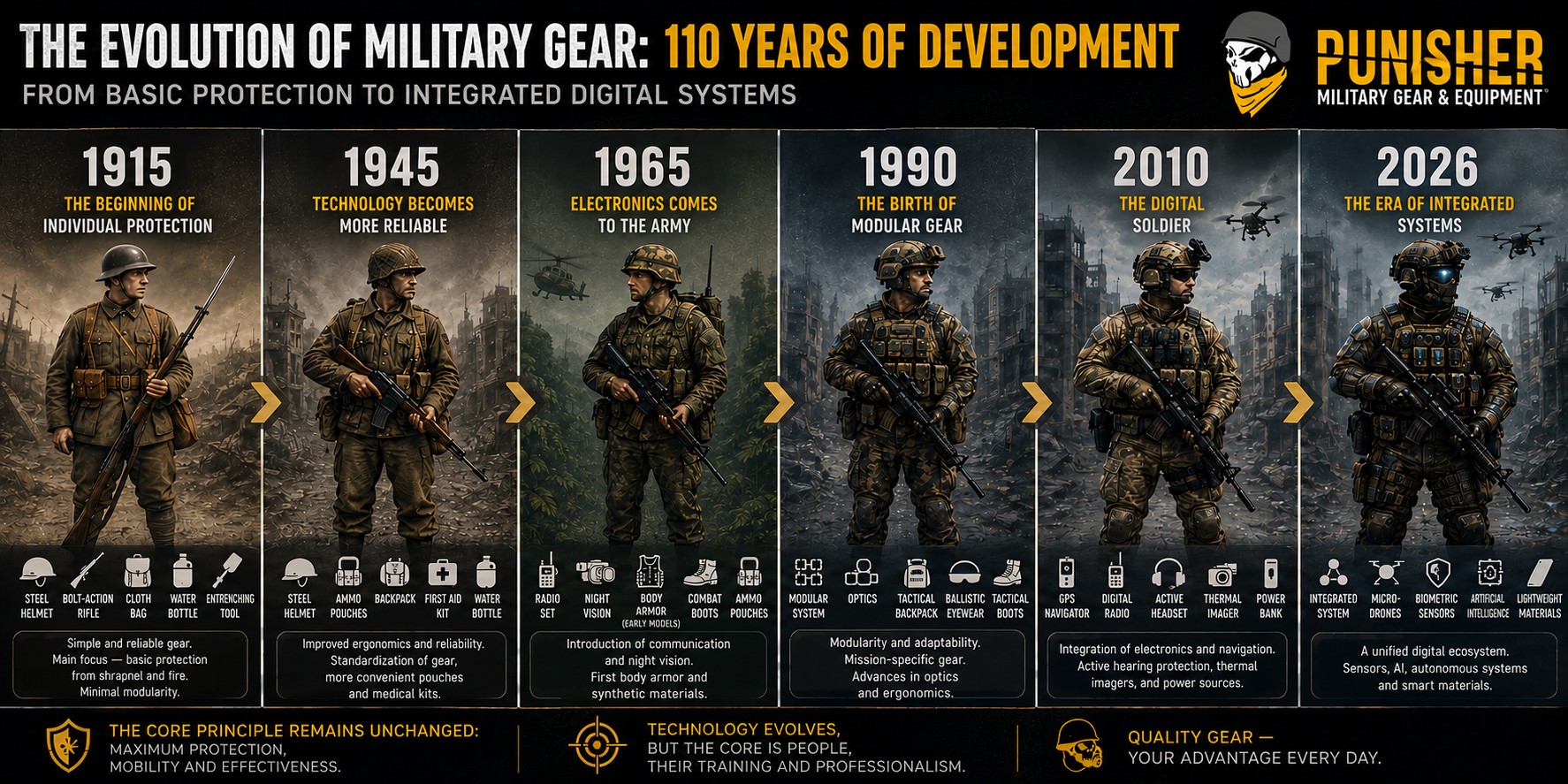
Timeline of Military Gear: 110 Years of Evolution
The history of military equipment is a constant balance between protection, mobility, and functionality. Over a century, the infantryman's loadout has transformed so dramatically that a modern soldier carries more technology on their body than the crew of an armored vehicle in the mid-20th century.
1915 – The Dawn of Personal Protection
During WWI, mass artillery bombardment forced armies to adopt steel helmets, drastically reducing shrapnel head injuries. A soldier's kit was rudimentary:
-
Steel helmet;
-
Bolt-action rifle with iron sights;
-
Leather load-bearing webbing;
-
Canvas duffel bag;
-
Canteen;
-
Entrenching tool.
The load was heavy, cumbersome, and offered zero modularity.
1945 – Improved Reliability and Utility
By the end of WWII, gear became far more practical. Key developments included:
-
New canvas and fabric weaves.
-
Improved ammo pouches.
-
Refined rucksacks.
-
Standardized field dressings.
-
Lighter helmets.
-
Compact field radios for small units.
Engineers prioritized ergonomics as mobility proved to be as critical as basic protection.
1965 – Electronics Enter the Battlefield
The second half of the 20th century kicked off an electronics revolution in infantry kit:
-
Portable squad radios;
-
Early night vision devices (NVDs);
-
Lighter synthetic fabrics (nylon);
-
Early body armor developments.
Though bulky, these technologies laid the foundation for modern digital soldier systems.
Early portable night vision devices weighed several pounds and required bulky, separate external battery packs. Modern NVDs are a fraction of the weight, compact, and offer vastly superior image clarity.
1990 – The Birth of Modular Gear
At the close of the 20th century, manufacturers abandoned "one-size-fits-all" loadouts in favor of modularity:
-
Modern plate carriers and Kevlar vests.
-
Modular load-bearing vest systems (PALS/MOLLE).
-
High-strength polymers.
-
Red dot optics.
-
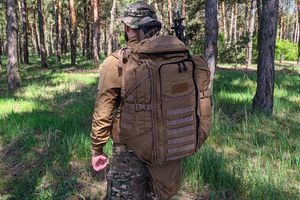
Lightweight tactical backpacks.
Soldiers gained the ability to customize their loadouts for specific mission parameters rather than carrying a single rigid standard issue kit.
2010 – The Digital Infantryman
Electronics integration became the standard. Standard infantry loads began incorporating:
-
GPS receivers;
-
Secure digital radios;
-
Active noise-canceling headsets;
-
LED weapon lights;
-
Thermal imagers;
-
Ruggedized tablets;
-
Portable power banks.
This introduced a new logistical challenge: managing power generation and battery weight.
A modern soldier can carry more spare batteries by weight than a 1980s infantryman carried in total electronic equipment.
2026 – The Era of Integrated Systems
Today, loadouts function as unified digital platforms. Helmets, headsets, comms, optics, navigation, medical sensors, and power sources are engineered as interconnected systems. Manufacturers focus development on:
-
Ultra-lightweight composite materials.
-
Next-generation ceramic armor plates.
-
Smart textiles.
-
Automated gear status monitoring.
-
AI integration for data processing.
Modern soldier systems are no longer collections of loose items, but integrated ecosystems where every element complements the rest.
What Lies Ahead?
Experts predict that over the next 10-20 years, innovation will focus on networking existing items into a seamless digital ecosystem. Promising directions include:
-
Next-gen flexible body armor materials;
-
Higher energy-density compact power cells;
-
Smart textiles with embedded vital sensors;
-
Integrated casualty monitoring systems;
-
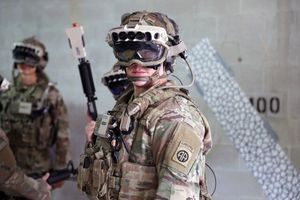
Heads-Up Displays (HUDs) integrated into eye protection or helmet visors;
-
Expanded use of ground robots and drones for squad support;
-
Automated real-time radio translation and signal filtering.
Nevertheless, experts agree: even by 2040, human factors will remain decisive – discipline, teamwork, psychological resilience, and judgment under uncertainty.
Comparing an infantry kit from 1915 to a modern 2026 loadout, the biggest gap lies not in small arms lethality, but in information processing capacity. Today's soldier interacts with navigation, digital comms, optics, active ear protection, and thermals – technologies that would have seemed like science fiction a century ago. Prototyped helmets can already project navigation prompts, radio data, and gear status directly onto transparent visors.
Why Gear Is Getting Smarter
Modern military equipment has long ceased to be a simple collection of standalone items. Comparing an early 2000s loadout to a modern one reveals a huge shift: gear used to operate in isolation, whereas today, manufacturers build cohesive systems where armor, comms, optics, lighting, and medical gear work in sync. When selecting gear today, compatibility with existing equipment matters just as much as standalone specs.
For modern military personnel, it is not merely a matter of buying tactical gear, but assembling a balanced system tailored to specific mission profiles, operating environments, and individual needs.
Emerging developments feature sensors integrated directly into combat uniforms to monitor core body temperature, physical exertion, fatigue signs, and vital metrics in real time – systems currently undergoing live testing in several countries.


Over the past century, CQB has evolved from a niche police methodology into one of the most critical training disciplines for modern armies. Urbanization, technological advances, and shifting warfare dynamics have made the urban landscape one of the most complex battlefields, raising the bar for equipment, comms, observation tools, and training.
Yet the primary lesson of recent decades remains unchanged: technology does not replace the human element. Drones, thermals, digital radios, red dots, and active headsets dramatically expand a soldier's capabilities, but professional competence, discipline, mental resilience, and teamwork remain the ultimate decisive factors.
When selecting military gear, it pays to look beyond individual specs to evaluate how well an item meets modern standards for ergonomics, durability, and system integration. High-quality gear is not about comfort – it is a core component of effectiveness and survival on the modern battlefield.
NEED HELP CHOOSING?
Our specialists will help you navigate our range and select the right gear for your needs.
Get a consultation

Vitalii Buniak — article author
Military gear consultant
Before 2022, he worked as a sales assistant at the Panisher store. After the start of the full-scale invasion, he joined the Armed Forces of Ukraine, gaining real combat experience.
Thanks to his combat experience and deep knowledge of tactical gear, Vitalii serves as a personal expert of the Panisher online store in the fields of:
- Clothing and footwear
- Equipment
His recommendations help customers choose reliable and functional gear for any conditions.
FAQ: Answers to Frequently Asked Questions
1. What does the acronym CQB stand for?
2. How does CQB differ from general urban warfare?
3. Why do modern militaries place such a high emphasis on CQB?
4. Can robots completely replace human soldiers in CQB?