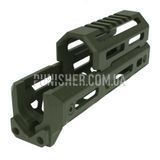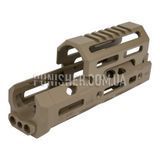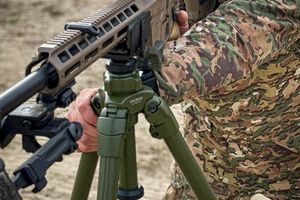
A handguard is a component of a firearm located beneath the barrel or around its front section. It provides a comfortable grip on the firearm, helps protect the hands from contact with heated components, and, in modern designs, serves as a platform for mounting additional equipment. Depending on its design, it also protects the components underneath from mechanical damage. For example, the U.S. Army M16/M16A1 operator's manual specifically notes that removing the handguard exposes the gas tube, damage to which may interfere with the firearm's operation. This highlights that the handguard serves not only as a support for the hand but also as a protective component.
An assault rifle handguard can be a simple wooden or polymer part or a modular assembly made of aluminum and composite materials. Its shape, weight, mounting method, and compatibility with a specific platform determine its ergonomics and the options available for equipping the firearm.
This article examines what a handguard is, which designs are used in modern firearms, how M-LOK, KeyMod, and Picatinny differ, and what to consider when choosing a handguard.

What Is a Handguard and What Is It Used For?
A handguard is the component used to hold the front section of a firearm. In Russian-language sources, it is called “tsevie,” while English-language technical terminology uses the terms handguard or fore-end. The specific design depends on the firearm's construction.
A handguard performs several functions:
-
Protecting the hands from heated components. During firing, the barrel and other components can heat up. The handguard provides a gripping surface that separates the hands from these components. Some models offer additional protection through heat shields;
-
Improving handling. The shape, diameter, and surface texture affect grip comfort. An excessively thick or uncomfortable handguard can make the firearm harder to hold, while well-designed geometry helps maintain better control over its position;
-
Mounting accessories. Modern modular designs may feature interfaces for compatible lights, foregrips, sling swivels, and other devices. This allows the equipment configuration to be adapted to specific needs;
-
Maintaining structural compatibility. The handguard must match the firearm model, its mounting points, and other design characteristics. Two parts that look similar are not necessarily interchangeable.
Therefore, a handguard is more than a decorative cover. Its design affects handling comfort, thermal protection for the hands, and the ability to mount additional equipment.
Main Types of Handguards
Handguards are classified by purpose, design, material, and mounting interfaces. It is important to understand that these characteristics are not mutually exclusive: a tactical handguard can be made of aluminum, polymer, or carbon fiber and can also feature a Free Float design.
Standard Handguard
A standard handguard is primarily intended to provide a comfortable grip and protect the hands from heated components. Traditional designs were made of wood, while polymers became increasingly common with the development and adoption of modern materials.
The standard AK-74 handguard is one example. Its design is adapted to the layout of the corresponding rifle and does not necessarily provide for mounting additional equipment.
The main advantage of a standard design is simplicity. If the configuration suits the firearm's intended purpose and modular equipment is not required, the absence of additional rails and slots is not a disadvantage.
However, modernization options depend on the specific model. If modern mounting interfaces are needed, a compatible replacement handguard should be considered.
Tactical Handguard
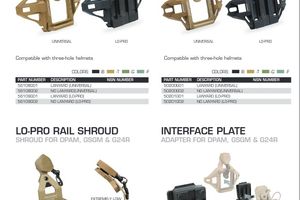
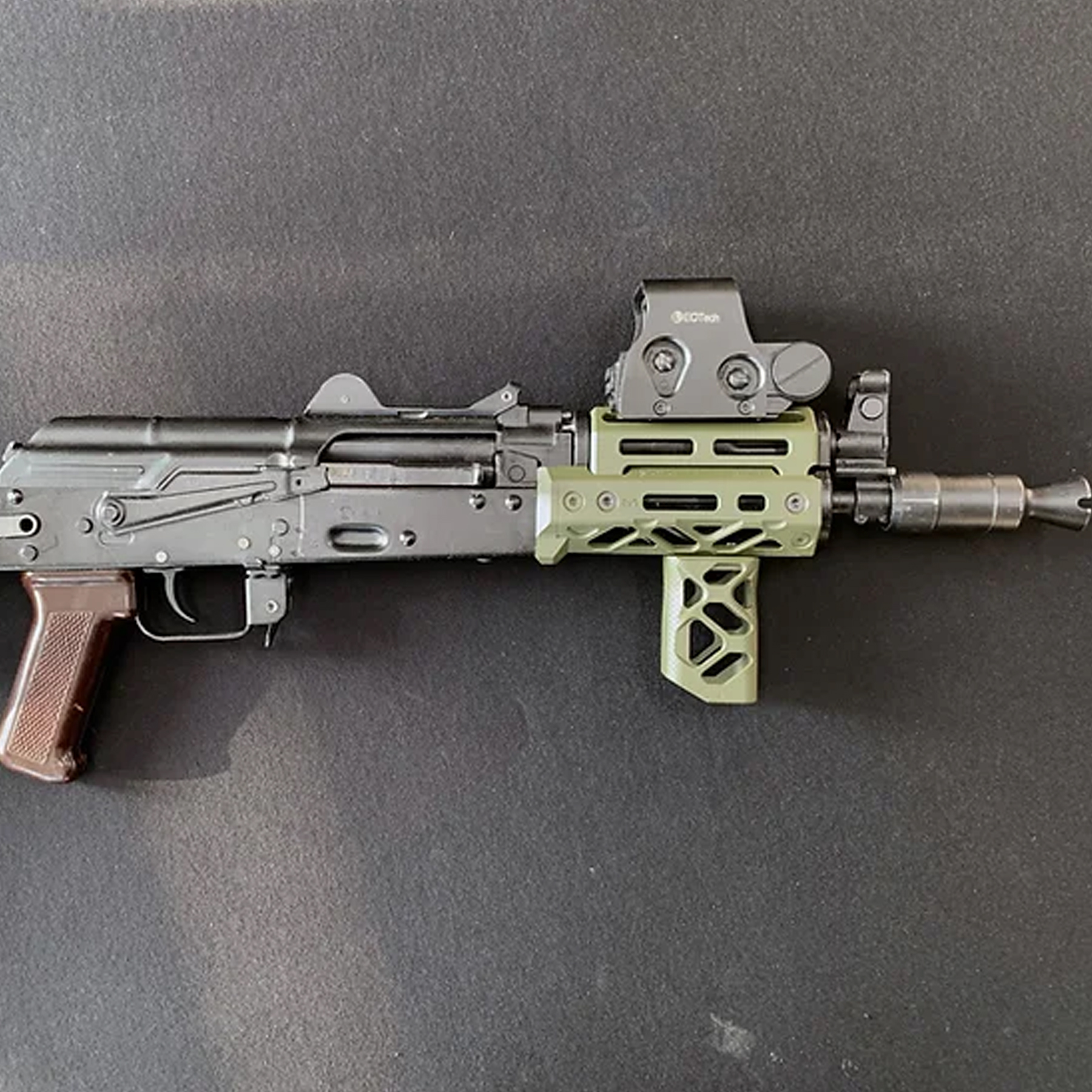
A tactical handguard is designed for firearms that accommodate additional accessories or allow the equipment configuration to be changed. Depending on the model, it may feature Picatinny rails, M-LOK or KeyMod slots, as well as a textured surface or additional panels.
These handguards are made from aluminum alloys, reinforced polymers, and composites. Each material has its own characteristics, so the term “tactical” does not determine the product's specific weight or strength.
For example, a polymer handguard with modular slots may be lighter than a particular metal model, but comparisons must be based on the specifications of individual products. Weight depends not only on the material but also on the length, wall thickness, mounting design, and presence of additional components.
Free Float Handguard: What Does the Free-Floating Design Mean?
Free Float, or a free-floating handguard, is a design in which the handguard does not contact the barrel and is mounted in a way that minimizes the transfer of external loads to it.
In traditional designs, external pressure applied to the handguard may, under certain conditions, be transferred to the barrel through contact points. A free-floating system reduces this effect, which may help improve the consistency of shooting results.
However, Free Float does not automatically guarantee increased accuracy. Results also depend on barrel characteristics, ammunition, manufacturing quality, mounting, and other factors.
The term free float handguard appears particularly often in descriptions of modern AR-15 handguards. Designs for the AK family may also use different mounting principles, but compatibility depends on the specific firearm model.
Free Float describes how the handguard is mounted, not the material or the accessory mounting system. For example, a free-floating handguard can be made of aluminum and feature an M-LOK interface.

What Materials Are Handguards Made Of?
The material affects weight, rigidity, thermal conductivity, and resistance to mechanical loads. However, evaluating a handguard based on material alone is not appropriate: its design, manufacturing quality, and operating conditions also matter.
Aluminum Handguards
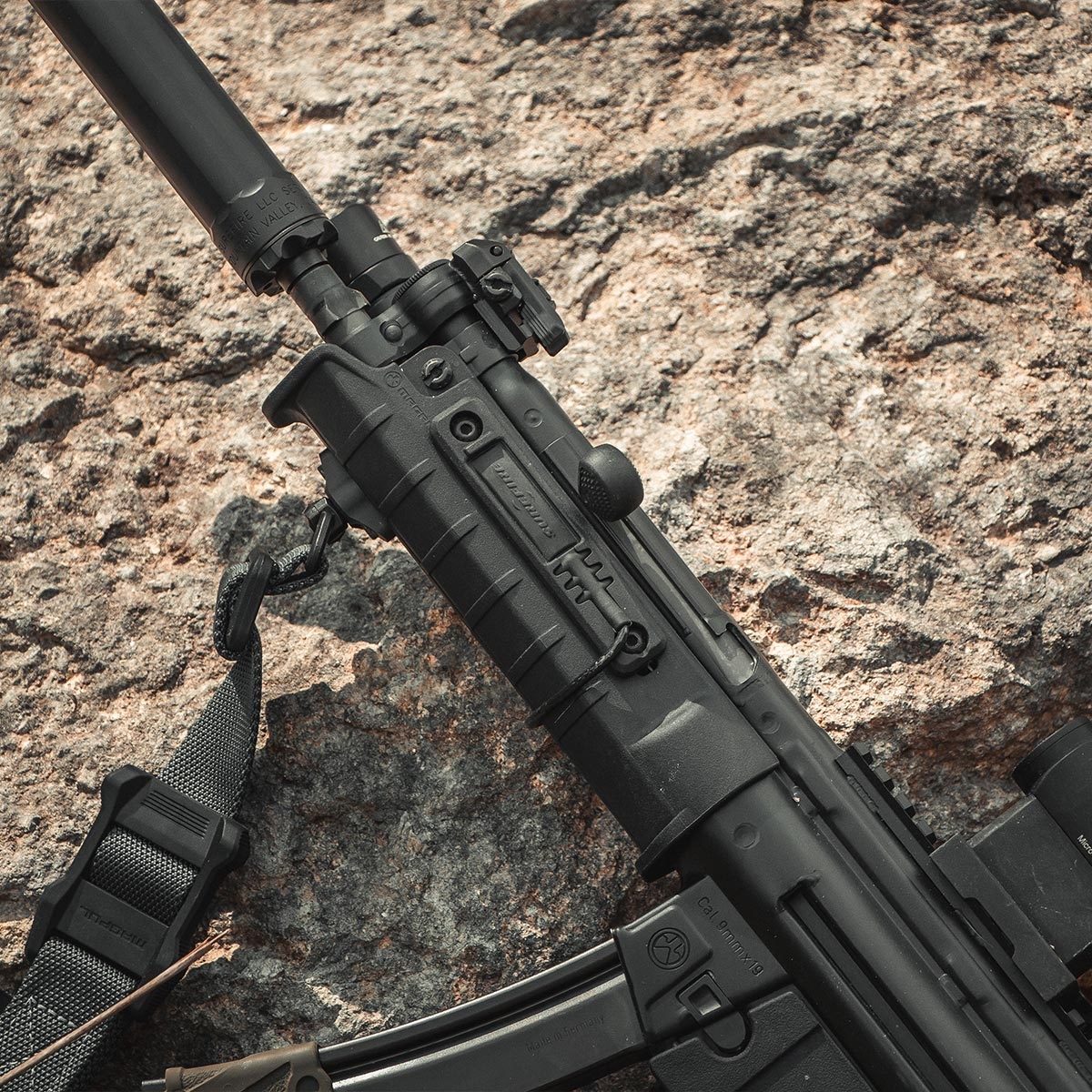
Aluminum alloys are widely used to manufacture modern modular handguards. They allow manufacturers to create rigid structures with accessory mounting slots while maintaining a moderate weight compared with many other metal solutions.
At the same time, aluminum has high thermal conductivity. During intensive firing, a metal handguard can heat up, and the temperature felt at the surface will depend on its design and operating conditions.
The advantages of aluminum models are particularly evident where structural rigidity and the ability to use modular mounting systems are important. However, not every aluminum handguard will be lighter or more durable than a polymer equivalent; this depends on the specific product.
Polymer Handguards
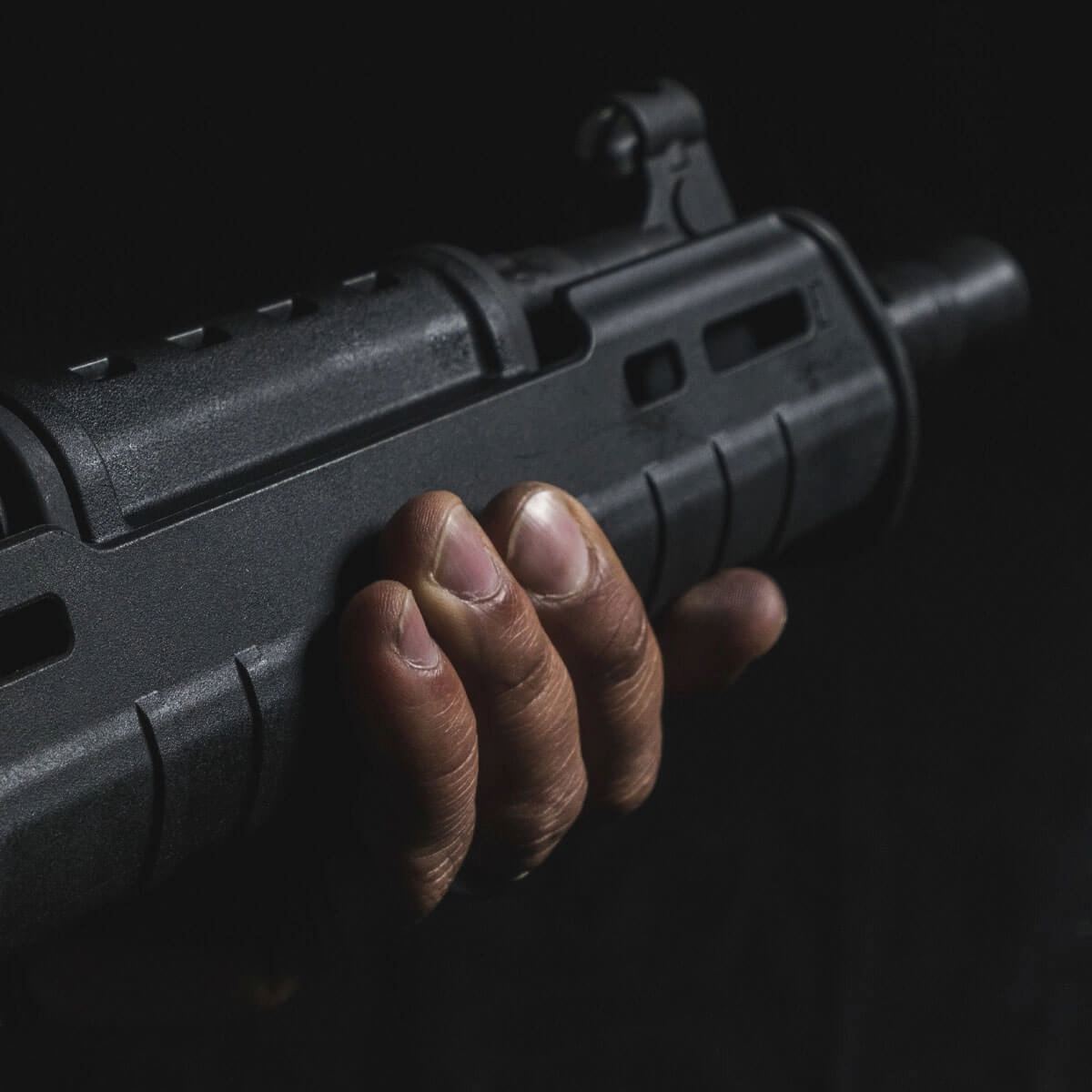
Polymer handguards are made from synthetic materials, sometimes reinforced to increase rigidity. They can offer low weight, a comfortable texture, and lower thermal conductivity than metal.
Polymer is widely used in standard designs across various firearm platforms. For example, manufacturer Magpul offers MOE AK series handguards for certain AK-47, AKM, and AK-74 variants.
The specifications for two models in this series list the following parameters:
-
MOE AK, model MAG619: length up to 7.8 in, weight with the upper handguard panel – 7.8 oz.
-
MOE AKM, model MAG620: length up to 7.3 in, weight with the upper handguard panel – 7.4 oz.
These are specifications for two specific products, not standard values for all polymer handguards. They are also not a fully direct comparison because the models are designed for different front mounting assemblies. The manufacturer separately warns that variations in the tolerances of some firearms may make fitting necessary.
The use of polymers in firearms did not begin with modern tactical accessories. The American M16, which entered service in the 1960s, already incorporated non-metallic materials in certain external components. This reflected the broader trend toward reducing firearm weight and using materials whose properties could be adapted to individual components. However, early polymer components and modern reinforced composites should not be considered identical in composition or performance.
Carbon Fiber Handguards
Carbon fiber handguards are made from carbon-fiber-based composites. These materials can combine high rigidity with low weight, making them useful in designs where reducing weight without excessive loss of rigidity is important.
However, carbon fiber properties depend on fiber orientation, resin type, wall thickness, and component design. A composite may perform well under certain types of loads but be more sensitive to others, particularly localized impacts.
The search term “carbon fiber handguard” appears in English-language catalogs, but when choosing a product, it is worth focusing on the specifications of the particular model rather than the material name. Carbon fiber is not universally superior to aluminum or polymer under all conditions.
Wooden Handguards
Wooden handguards are characteristic of traditional firearm designs, including classic versions of the AK family. Wood has relatively low thermal conductivity and can provide a comfortable grip.
However, its properties depend on the type of wood, the processing method, and operating conditions. Moisture, damage, and prolonged exposure to unfavorable environments can affect the condition of the component.
Today, wooden handguards remain relevant for restoring the traditional appearance of firearms and for certain configurations that do not require numerous modern mounting interfaces.
Accessory Mounting Systems for Handguards
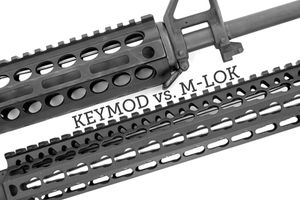
The mounting system determines how compatible accessories are attached to a handguard. The most common options are Picatinny, M-LOK, and KeyMod. They differ in geometry and attachment methods, so they are not interchangeable without the appropriate adapters.
Picatinny
Picatinny is a standardized rail interface whose geometry is defined by the military standard MIL-STD-1913. It uses transverse slots that secure compatible mounts.
The width of the upper part of the rail is approximately 0.83 in, while the nominal distance between the centers of adjacent transverse slots is about 0.39 in. This standardized geometry allows compatible accessories from different manufacturers to be used.
The main advantage of Picatinny is its broad compatibility with corresponding equipment. However, continuous rails can increase a handguard's weight and overall dimensions, especially when installed on surfaces where accessories are not actually used.
M-LOK
M-LOK is a modular mounting system developed by Magpul. Instead of a continuous rail, it uses dedicated slots to which compatible accessories or short sections of Picatinny rail can be attached.
A typical M-LOK slot has approximate dimensions of 1.26 × 0.28 in, and the distance between adjacent slots is about 0.31 in. These are approximate interface parameters; the system's technical documentation should be used for manufacturing and compatibility verification.
M-LOK allows accessories to be positioned where needed without installing long rails across the entire handguard surface. However, compatibility must be checked for each device: a Picatinny-mounted accessory may require a suitable adapter rail.
KeyMod
KeyMod is another modular mounting system that uses specially shaped openings. Compatible accessories are secured through these openings using corresponding mounting hardware.
Like M-LOK, KeyMod allows equipment to be installed at specific points without using a continuous rail along the entire length of the handguard. However, the geometry of these systems differs, so an M-LOK mount cannot automatically be installed in KeyMod slots, or vice versa.
Picatinny is not the name of a handguard manufacturer but the name of a system associated with Picatinny Arsenal in the United States. The geometry of the rail interface was formalized in the military standard MIL-STD-1913, whose baseline edition is dated February 3, 1995. The standard defines measurement methods and rail geometry for mounting accessories on small arms. Its purpose is to ensure compatibility between mounts manufactured by different companies.
Handguard Features for Different Firearm Platforms
Handguards for different platforms vary in length, shape, attachment method, and internal layout. Even models that look similar may be incompatible.
AK-74, AKM, and AKS-74U Handguards
An AK-74 handguard must match the design of the specific rifle. Standard configurations use traditional designs, while modern replacement models may feature a polymer body or modular accessory mounting interfaces.
The AKM belongs to the same family, but this does not mean that every AK-74 handguard will automatically fit it. Compatibility depends on component geometry, the design of the mounting assemblies, and the specific product configuration.
The AKS-74U has a shorter design and a different layout in the front section of the firearm. Therefore, a handguard designed for a full-size AK-74 cannot be assumed to be universally compatible with this model.
If a product description states “AK-74 handguard” or “AKS-74U handguard”, it is necessary to check which specific variant the product is designed for. For example, Magpul states that its MOE AK models are compatible with certain AK-47, AKM, and AK-74 variants, but explicitly excludes some other designs from its compatibility list, including firearms with milled receivers and Yugo variants.
This illustrates why the name of a firearm family alone is insufficient to confirm compatibility.
AR-15 and AR-10 Handguards
The AR-15 and AR-10 share similar general layout principles but differ in dimensions and design parameters. Handguards for these platforms should not be considered interchangeable merely because they look similar.
Modular handguards featuring M-LOK, KeyMod, or Picatinny are common for the AR-15, including Free Float designs. Compatibility depends on the mounting assembly, barrel nut, handguard length, and other parameters.
For the AR-10, the manufacturer's specifications must be checked because different implementations of this platform may vary. The AR-10 designation alone does not guarantee compatibility with every handguard designed for another model in this family.
How to Choose a Handguard for a Firearm
When choosing a handguard, start by checking compatibility rather than focusing on the material or appearance. An incompatible component may not install correctly or may fail to meet the manufacturer's requirements:
-
Compatibility with the firearm model. Check the exact model and variant. This is particularly important for the AK family and for the AR-15 and AR-10, where externally similar designs may use different mounting systems;
-
Length and dimensions. The handguard must match the firearm's design. When comparing models, consider length, width, internal clearance, and compatibility with other components;
-
Material and weight. Aluminum is often used for rigid modular designs, polymer for lightweight components with relatively low thermal conductivity, and carbon fiber for composites with a high stiffness-to-weight ratio. Wood remains an option for traditional designs. Compare the actual specifications of individual models;
-
Accessory mounting type. If Picatinny, M-LOK, or KeyMod accessories are required, check interface compatibility in advance. Do not assume that one system allows equipment from another system to be mounted directly;
-
Design. A standard handguard may meet basic needs, while a tactical model provides more options for mounting compatible accessories. Free Float should be treated as a separate design characteristic rather than a synonym for a tactical handguard;
-
Installation. Check the package contents, manufacturer requirements, and whether the standard component is designed for direct replacement. If the design requires specialized installation work or modifications to other firearm assemblies, these should be entrusted to a qualified professional.
What Accessories Can Be Mounted on a Handguard?
Depending on the design and interface, compatible foregrips, lights, laser aiming device mounts, sling swivels, and protective panels can be installed on a handguard.
Suitable mounting hardware is required to install equipment. For example, an accessory with a Picatinny rail interface may require an adapter rail to be installed on an M-LOK handguard. Before purchasing, check whether the specific model supports the required mounting method.
Protective panels can change the surface texture and make the grip more comfortable. However, each additional component increases weight or overall dimensions, so its actual usefulness should be considered.
If you are selecting components for your platform, browse the handguard selection in the Punisher military store catalog. When choosing, pay attention to compatibility with the specific firearm model, material, design, and interface type.


A handguard is an important component of a firearm's design that affects handling comfort, protection of the hands from heated components, and the ability to mount accessories. Standard models perform basic functions, while tactical designs offer more equipment options. Free Float, in turn, describes the handguard mounting method and the reduction of external loads transferred to the barrel.
When choosing a handguard, compatibility, material, weight, length, and mounting system must be considered. Differences may exist even between models within the same platform, so the designation “AK-74 handguard” or “AKS-74U handguard” alone does not confirm interchangeability.
The best choice is not necessarily the most expensive or most modular handguard, but the design that matches the specific firearm model, the manufacturer's requirements, and the user's needs.

Vitalii Buniak — article author
Military gear consultant
Before 2022, he worked as a sales assistant at the Panisher store. After the start of the full-scale invasion, he joined the Armed Forces of Ukraine, gaining real combat experience.
Thanks to his combat experience and deep knowledge of tactical gear, Vitalii serves as a personal expert of the Panisher online store in the fields of:
- Clothing and footwear
- Equipment
His recommendations help customers choose reliable and functional gear for any conditions.
FAQ. Frequently Asked Questions About Handguards
1. How does a tactical handguard differ from a standard one?
2. What does Free Float mean, and what is a free-floating handguard used for?
3. How do M-LOK, KeyMod, and Picatinny differ?
4. Can an AK-74 handguard be installed on an AKM or AKS-74U?