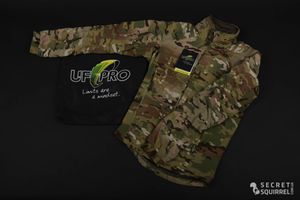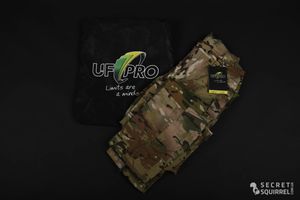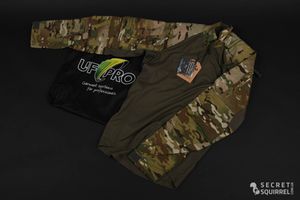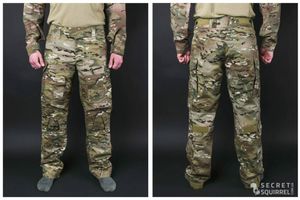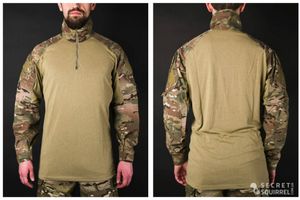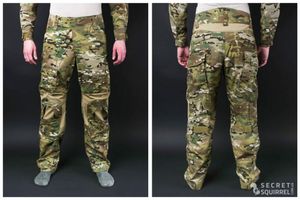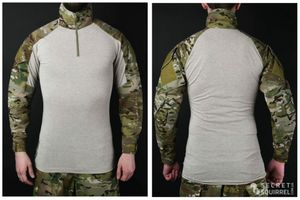
ECWCS Level 6 is the sixth layer of the ECWCS Gen III clothing system, designed to protect against strong wind, rain, and wet snow. Unlike insulating layers, it creates an outer barrier against bad weather while allowing you to wear it over other equipment components. That is why the ECWCS Gen III Level 6 set includes a membrane jacket and trousers designed for field use in adverse weather conditions.
GORE-TEX Paclite technology plays a key role in this clothing's performance, combining waterproofness, wind protection, and breathability with low weight and compactness. In this review from Punisher military store, we will examine the construction of ECWCS Level 6, the features of the jacket and trousers, and the practical details worth considering when using a membrane clothing set.


Sixth-Layer Jacket (L6) Jacket Extreme Cold/Wet Weather
The ECWCS L6 jacket is a rather distinctive product, quite unlike other membrane waterproof jackets made from Gore-Tex material. It differs from earlier waterproof jackets from other ECWCS generations and is strikingly different from the version used by the U.S. Marine Corps. This is a genuinely interesting product with well-designed functionality and a distinctive construction. It stands out among comparable products, and understanding it is not the easiest task.
Unlike other versions, the Multicam version of the jacket has no Velcro panels for attaching identification or other insignia – no national flag patches, name tapes, unit patches, or morale patches. Other jacket versions, including the Marine Corps version, have such panels. Unfortunately, the exact reason for this is unknown. However, given the presence of similar panels on other elements of the layering system, an obvious explanation is a straightforward simplification of the design to reduce costs.


Nevertheless, certain identification insignia can still be attached to the jacket. For this purpose, it has a central Velcro epaulet for securing rank insignia. However, current U.S. Army regulations have discontinued the attachment of these insignia to camouflage uniforms, so this functional element of the jacket has become unnecessary and unused. Against the background of the absence of panels for attaching patches, this seems somewhat strange.
The jacket fastens with a central zipper – unfortunately, it is not waterproof, but it is of reasonably good quality (a similar zipper is also used on L5). Fortunately, however, the zipper is covered by a double windproof and waterproof storm flap secured with a textile hook-and-loop fastener, which provides appropriate protection against precipitation.


The jacket is equipped with two vertical openings in the chest area to access the chest pockets of the uniform worn underneath. This may be a field uniform, the fifth layer (L5) made from Soft Shell fabric, or insulating layers (L3 or L7). The pockets are accessed through zippers similar to the central zipper, meaning that these are also not waterproof.
The jacket sleeves have reinforcement in the elbow area. The reinforcement material is quite durable, and the same type of material is used in the Marine Corps set. The reinforced area is fairly extensive. This is a major advantage because reinforcing this high-wear area helps extend the jacket's service life.


The jacket sleeves have a straight cut, with cuffs adjustable by means of Velcro. The cuffs themselves offer a fairly limited adjustment range and are quite tight even when the jacket is worn on its own. They are somewhat uncomfortable when worn over thick insulating layers, so the cuffs are often simply left unfastened when the jacket is worn with other layers.
The jacket has a bottom adjustment system using an elastic shock cord and cord locks. This is undoubtedly useful because it reduces cold wind entering from below and limits the jacket's billowing in the wind. The jacket is tightened from the inside to maintain a neat appearance and prevent excess cord from protruding and getting in the way. The cord locks have a slightly unconventional design, but they are quite convenient and comfortable to use.


The jacket has a large hood that can easily be worn over bulky headgear or ballistic helmets without any problems; it fits easily over a standard size M ACH helmet. The hood is equipped with a visor. Its depth can be adjusted with Velcro, and it also has a drawcord adjustment around the face. The hood is convenient to adjust: it does not fall over the face, does not obstruct the field of view, and can be adapted to any situation.
If necessary, the hood can be rolled into the collar and secured with Velcro when it gets in the way or when weather conditions or the nature of the activity call for it. Given the overlapping layers of material, this solution is not convenient for every user, and many simply leave the hood unsecured – this is entirely optional. Rolling the hood into a reasonably neat collar is also somewhat difficult at first, but becomes fairly easy with experience.

The jacket is made from Gore-Tex Paclite material (cut from a single piece, without seams and, accordingly, without seam taping). It is lighter than classic three-layer membrane Gore-Tex, while providing substantial protection against moisture and wind. The jacket provides good protection against wind, rain, and snow, but the material also has a drawback: it is noisier and rustles more than classic Gore-Tex. To be fair, however, it should be noted that, subjectively, the Multicam version is the least noisy of all those used by the U.S. Army. It is even quieter than the version used in the Marine Corps membrane set. This is a subjective assessment, though, and the material is not 100% silent.
GORE-TEX Paclite technology was introduced in 1999 as a lightweight and compact solution for protection against bad weather. One of the first Paclite jacket samples was given to a representative of Berghaus, who tested it while hiking, cycling, and kayaking. According to GORE-TEX, the trials covered more than 700 hours of use and 1,400 miles (approximately 2,253 km). This extensive testing demonstrates that the material's compactness was not solely about reducing weight; its performance characteristics were also put to the test.


The jacket material has good compression properties and packs down exceptionally well – the jacket can be packed into a relatively small space. However, it should be noted that many people, including the article's author, continue to prefer the Marine Corps APECS or second-generation membrane jackets. These are heavier and less packable, but provide more noticeable protection against precipitation.
This jacket is unlike any of its military counterparts. It is lightweight and functional, and it provides good, although not perfect, protection against precipitation. It has its advantages and disadvantages. The product performs its intended role of protecting against moisture, wind, and snow, although it falls behind other examples over the long term. It is also somewhat specialized and is unlikely to suit everyone. Nevertheless, it can be recommended – this clothing item has its place.

A complete range of ECWCS Level 6 membrane jackets and pants for protection against rain, snow, and wind in challenging weather conditions.
Buy Gore-Tex Level 6 Jackets and Pants


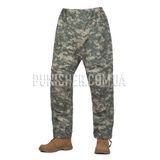
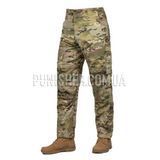
Trousers of the Sixth Layer of the ECWCS Layering System
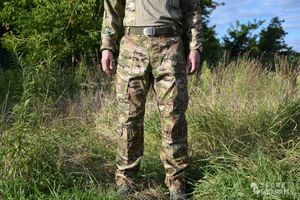
At first glance, these trousers stand out for their simple, austere cut. However, they are a fairly important and necessary part of this set, offering numerous positive and genuinely useful functional features that prove beneficial both when worn on their own and when used together with other components of the uniform.
The trousers are indeed simple. Their design includes no pockets of any kind – neither cargo pockets nor various types of inset pockets. They are designed to be worn over a service member's field uniform (at temperatures up to +11 °C), as the fifth layer (L5) of this system, represented by Soft Shell trousers, or as the seventh layer (L7), which provides insulation. Of course, these trousers can also be worn individually over various materials and insulating layers (L1, L2), but their full functionality is best realized when they are worn together with other field-uniform trousers or trousers from the layering system. The absence of pockets is dictated by this intended use and by the desire to provide maximum waterproof protection and preserve the contents of underlying pockets, since it is impossible to make pockets absolutely watertight and completely protect their contents from moisture. Naturally, this can be disappointing, especially during prolonged wear, when thigh cargo pockets are quite important for conveniently carrying various essential items. Nevertheless, this design choice – the absence of pockets – is more of an advantage than a disadvantage.


At the rear, the trousers have reinforcement in the seat area. It is fairly extensive, covering almost the entire seat and reliably protecting it from wear. A similar solution is used in the Marine Corps waterproof set in the MarPat pattern. It is practical and justified because it extends the trousers' service life.
At the bottom, the trousers have an adjustment system using a textile hook-and-loop fastener. The design itself is not new; it was also used in older generations of the set, where it proved quite convenient and practical. It helps protect the trouser cuffs from getting wet and from wind entering underneath, while also reducing the billowing of the trouser legs in the wind. There are, however, some drawbacks: the hook-and-loop fastening areas are significantly smaller than those on similar elements in previous generations of the set, negatively affecting fastening reliability. The quality of the Velcro itself is also worse – it collects debris more easily and wears out quickly. However, this is not a critical drawback, as it is easy to replace, even in field conditions.


The trouser legs themselves are equipped with zippers to make it easier to put the trousers on over a uniform, other layers of the set, and footwear. The zippers extend to the knees. Waterproof zippers are used here and, for additional protection, as on the jacket, they are covered by a double windproof and waterproof flap secured with Velcro. This brings us back to the question of quality: it is advisable to keep a repair kit in reserve, as these components do not inspire confidence. The design allows the trousers to be put on quickly and conveniently when necessary without compromising their overall protective performance.
The trousers also have reinforcement in the knee area. It is fairly large and made from dense material, positively affecting the overall durability of the trousers because it protects areas subject to wear. This is especially important given the low durability of the trousers' main material.


The trousers have Velcro-secured openings that provide access to the inset pockets of field trousers or other trousers worn underneath. This can sometimes be quite useful, but in most cases the feature is hardly used because access to the contents is awkward and the openings often do not align with the pockets on the uniform. In addition, it is easy to forget that these are merely openings rather than actual pockets, put an item inside, and lose it while walking. In this respect, the feature is not particularly well designed.
Waist adjustment is achieved with an elastic cord and two cord locks. There are also belt loops, which are rarely used because the shock-cord adjustment is usually sufficient. In addition, the trousers have a fly secured with a snap fastener, making them easier to put on and take off and making it more convenient to attend to bodily needs.


The trousers are made from Gore-Tex Paclite material. It is lighter than classic three-layer membrane Gore-Tex while providing substantial protection against moisture and wind. The trousers protect well against wind, rain, and snow, but the material also has a drawback: it is noisier and rustles more than classic Gore-Tex. To be fair, however, it should be noted that, subjectively, the Multicam version is the least noisy of all those used by the U.S. Army. It is even quieter than the version used in the Marine Corps membrane set.
According to the manufacturer, the GORE-TEX membrane is made from expanded polytetrafluoroethylene (ePTFE) and contains more than 1.4 billion microscopic pores per 1 cm². This structure helps combine waterproofness with the outward transfer of water vapor. This balance of properties is important for membrane clothing: the outer layer protects against precipitation, while breathability helps reduce the accumulation of moisture from perspiration during physical activity.
These are genuinely simple, austere, even primitive trousers, but they are quite functional and were created for one purpose only – to provide proper protection against atmospheric precipitation. They perform this task excellently. They are lightweight, pack down well, offer good breathability, and protect against all kinds of rain, wind, and snow. Yes, they are somewhat specialized; yes, they are not as stiff as the trousers from the second generation of “ECWCS”, or the Marine Corps set, but they still have their place. We confidently recommend them.
ECWCS Level 6 is a functional outer layer of the ECWCS Gen III layering system, designed to provide protection against bad weather without the need to use heavy insulated clothing as the primary barrier against precipitation. The GORE-TEX Paclite membrane construction combines waterproofness, wind protection, and breathability with compactness, which is important for field equipment.
At the same time, the sixth layer should not be considered universal clothing for every temperature: its effectiveness depends on correctly selected inner layers and the conditions of use. Understanding the purpose of Level 6 and the construction of its jacket and trousers helps assess the capabilities of the set and integrate it properly into a clothing system for service, training, or extended periods outdoors.
NEED HELP CHOOSING?
Our specialists will help you choose a membrane jacket or pants, taking into account weather conditions, intended use, and your needs.

Vitalii Buniak — article author
Military gear consultant
Before 2022, he worked as a sales assistant at the Panisher store. After the start of the full-scale invasion, he joined the Armed Forces of Ukraine, gaining real combat experience.
Thanks to his combat experience and deep knowledge of tactical gear, Vitalii serves as a personal expert of the Panisher online store in the fields of:
- Clothing and footwear
- Equipment
His recommendations help customers choose reliable and functional gear for any conditions.
FAQ: Frequently Asked Questions About ECWCS Level 6
1. What is ECWCS Level 6?
2. What weather conditions is the ECWCS Level 6 set designed for?
3. What is GORE-TEX Paclite, and how does it differ from classic three-layer GORE-TEX?
4. How does ECWCS Level 6 differ from Level 5?