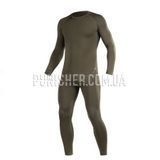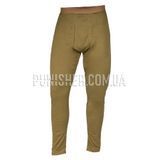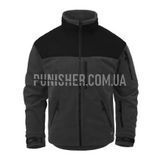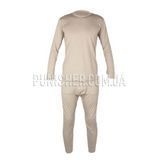
When discussing PCU (Protective Combat Uniform) and ECWCS (Extended Cold Weather Clothing System), the first three levels are often automatically labeled as "winter layers". This is one of the most common misconceptions. In reality, L1-L3 are not three progressive stages of winter clothing, but rather part of a body microclimate management system designed for year-round operation. Different weather conditions simply alter the balance required between moisture wicking, thermal insulation, and environmental protection.
Imagine a vehicle with automatic climate control. Its purpose isn't strictly to heat the cabin at all times. Sometimes it needs to heat, sometimes cool, and other times merely dehumidify. PCU and ECWCS operate under very similar logic: the system must respond not only to the ambient outdoor temperature, but also to human physical exertion.
Therefore, the right question is not "At what temperature should I wear L2?", but rather "How much heat and moisture am I currently generating, and how fast do they need to be wicked away or retained?" Based on this principle, let's break down Levels 1 through 3 in practice – from sweltering summer heat to extreme cold. “Punisher”, a specialist at the military supply store, answered these and other questions honestly.


The First Rule of Layering: Temperature Is Far From the Only Factor
Consider this scenario: two identical jackets worn by two identically dressed individuals in 41 °F (+5 °C) weather. One person is stationary. The other is walking at a rapid pace while carrying a 33 lb (15 kg) rucksack. They will not experience the cold in the same way. The first generates almost no excess body heat and requires added insulation. The second relies on active muscle engagement, producing significant heat and sweat, which can lead to overheating even while wearing the same garment. This is why layering systems rely on more than just:
-
temperature;
-
wind;
-
precipitation;
they also critically depend on:
-
physical activity level;
-
duration of exertion;
-
intensity of the workload;
-
ability to quickly shed or add a layer;
-
environmental humidity.
Sometimes the difference between staying comfortable and suffering hypothermia depends not on what you put on, but when you put it on.
Level 1: The All-Season Base Layer
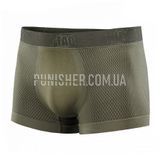
If you had to pick the single most versatile layer out of the entire system, it would be Level 1. Its core function is not insulation, but moisture management. L1 material sits directly against the skin, actively pulling sweat away from the body to accelerate evaporation. This makes L1 equally essential in both winter and summer – in fact, its role in summer can be even more critical than in winter.
L1 in Summer: When Overheating, Not Cold, Is the Main Threat
Picture a typical summer day at 82 °F (+28 °C). You are moving, working, and carrying tactical gear. Your body cools itself primarily through sweat evaporation. If your shirt gets saturated with moisture and remains wet, it clings to the skin, causing severe discomfort and inhibiting efficient thermal regulation. A high-performance base layer functions differently: it rapidly transfers excess moisture away from the skin without trapping evaporation. Thus, L1 in summer is not a "layer to keep warm", but an essential thermoregulation tool.
What’s Wrong with a Standard Cotton T-Shirt?
For casual urban wear, nothing. For high-exertion tasks in hot weather, it’s a different story. Cotton absorbs moisture well, but it dries extremely slowly and lacks functional wicking properties. After a few hours of exertion, you are left with a familiar sensation: a soaking-wet shirt clinging to your torso, making you want to shed it even more than your heavy pack. This becomes especially problematic the moment you stop moving. You are soaked, a breeze picks up, and the very garment that was helping you cool down suddenly causes a rapid, chilling drop in body temperature.
L1 in Shoulder Seasons (Spring/Autumn)
Now shift to autumn at 54 °F (+12 °C). You are on the move. L1 under your uniform jacket may be completely sufficient. A few hours later, the temperature drops to 45 °F (+7 °C) or wind speeds pick up, at which point you layer L2 underneath. This highlights the primary advantage of a modular layering system: you don't dress for the absolute worst-case weather from the start. You begin with a minimal setup and add functional layers only when needed.
L1 in Winter
In sub-freezing weather, its mission remains unchanged. Even at 14 °F (−10 °C), L1 primarily manages moisture. This is vital because sweat is one of your greatest enemies in cold environments. While moving, a damp base layer might feel like a minor annoyance. The moment you halt, however, that trapped moisture accelerates conductive heat loss, risking severe hypothermia. A solid winter system never begins with a thick outer parka; it begins with moisture control directly against the skin.

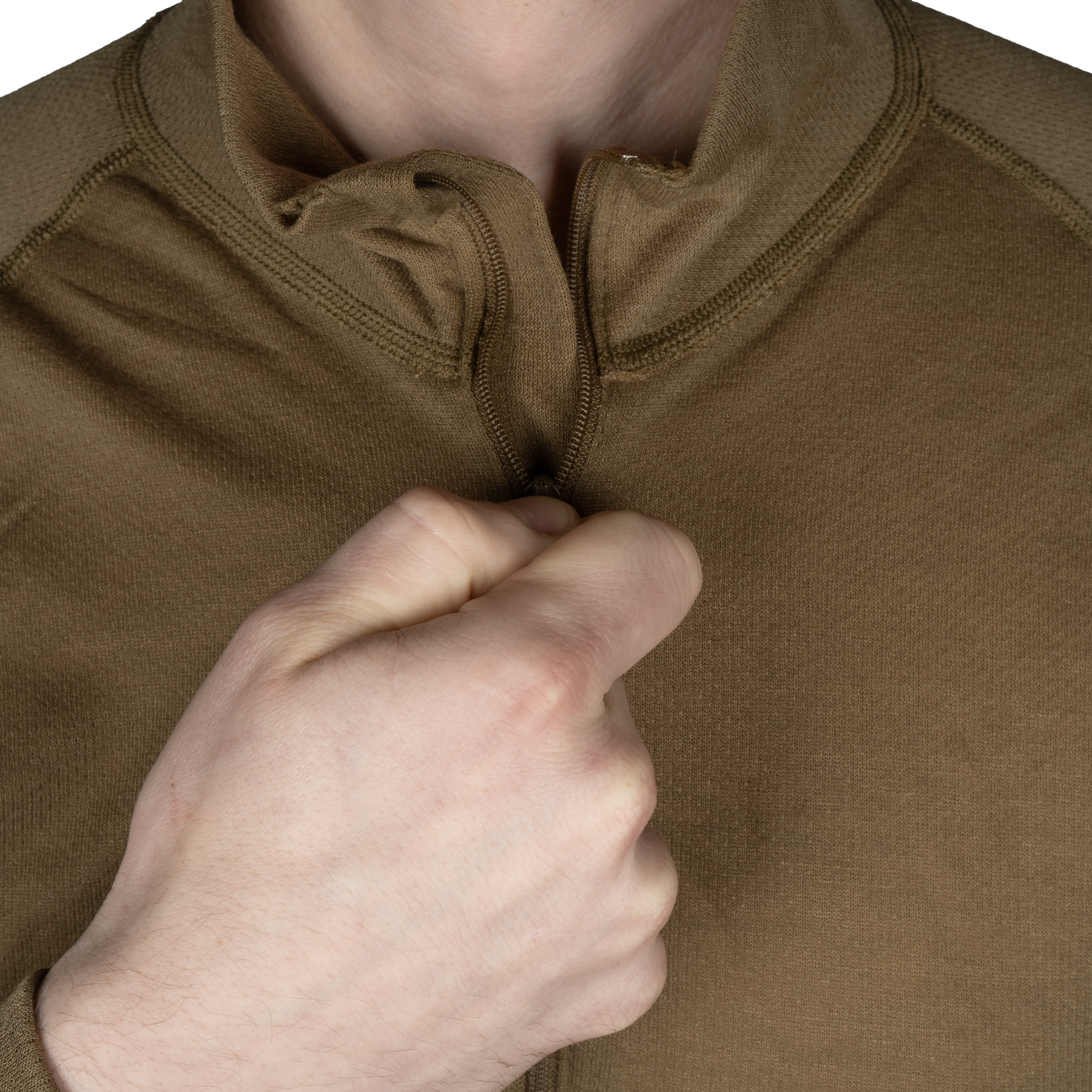


THERMAL UNDERWEAR LEVEL 1
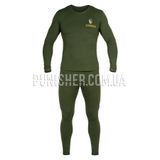
Our catalog features a full range of Level 1 moisture-wicking thermal underwear
Browse and choose yours!
Base layers are often mistakenly associated exclusively with cold weather. In reality, their role in summer can be even more critical: functional performance fabrics wick sweat off the skin to speed up evaporation. L1 works year-round not as a "warming layer", but as a dynamic microclimate control tool.
Level 2: Adding Warmth Without Turning You Into a Sauna
L2 represents the next step. In ECWCS Gen III, L2 consists of a lightweight grid fleece. Its purpose is to provide supplementary thermal insulation while maintaining high air permeability during active movement. This is precisely why L2 excels far beyond winter conditions.
L2: The Shoulder-Season Workhorse
Consider this scenario: 46 °F (+8 °C) on a chilly morning. You step outside in L1 + L2. An hour later, the sun rises, you are moving briskly, and the ambient temperature feels closer to 54 °F (+12 °C). L2 becomes redundant, so you shed it, stow it in your pack, and press on. This is vastly more efficient than wearing a single heavy jacket that forces you to choose between sweltering or shedding all protection.
L2 in Summer: Necessary or Not?
In true summer heat, usually not. However, during crisp summer mornings, at high elevations, during nighttime operations, or during sudden temperature drops, it can be essential. For example, if it's 63 °F (+17 °C) by day and drops to 46 °F (+8 °C) at night, L1 suffices during the daytime, while L2 provides the exact thermal boost needed after dark. L2 is not a "winter fleece"; it is a lightweight thermal reserve adaptable to any season based on temperature and activity.
L2 in Winter: The Active Mover's Best Friend
In below-freezing temperatures, L2 becomes invaluable during physical exertion. For instance, at 27 °F (−3 °C) while moving fast under a heavy load, L1 alone may be insufficient. L1 + L2 creates a comfortable balance. However, if your pace accelerates after 30-40 minutes and you begin to sweat heavily, shedding the L2 layer is the correct move. Modular layering does not require every garment to remain on your body all day long.

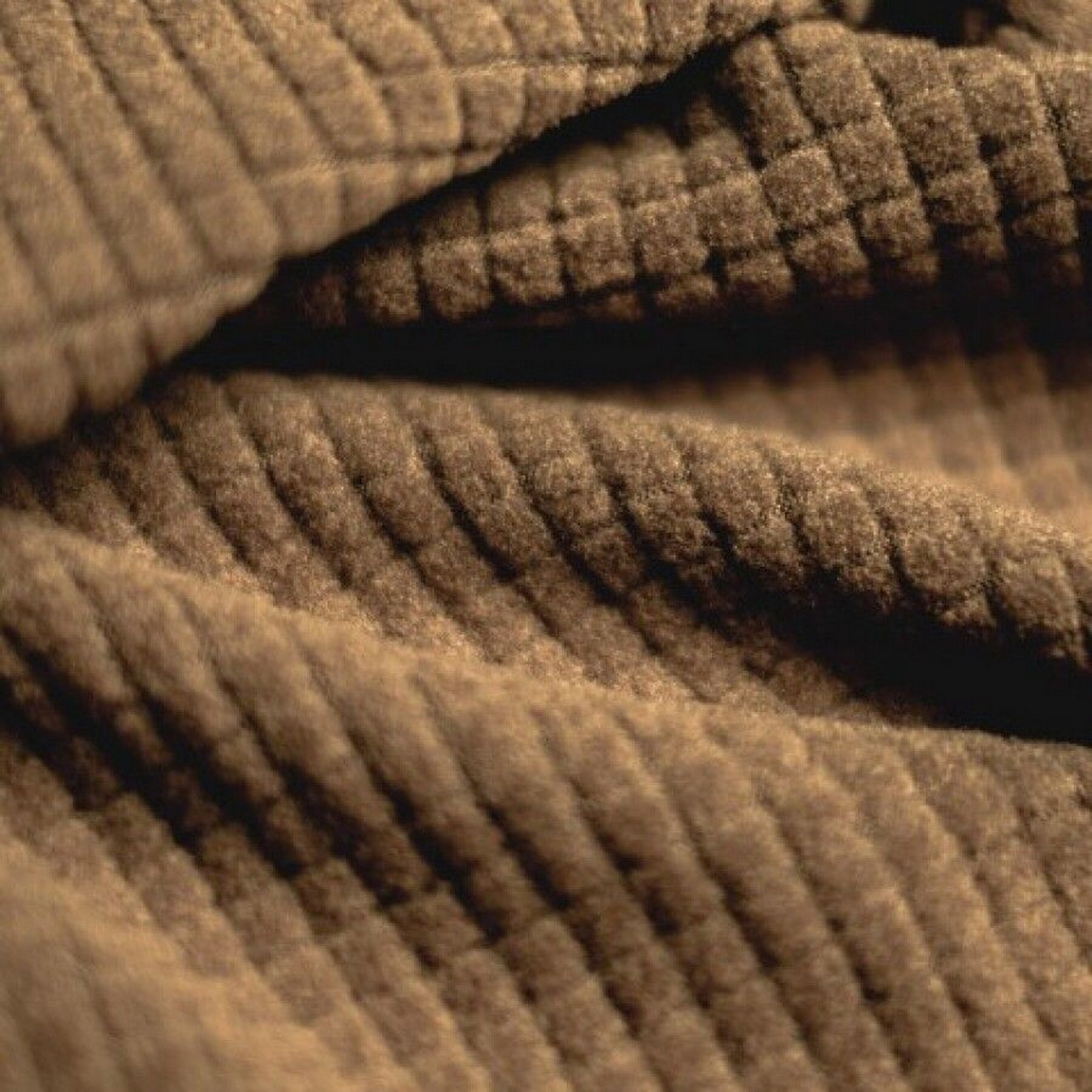

THERMAL UNDERWEAR LEVEL 2
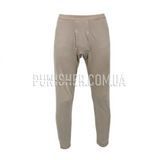
Our catalog features a full range of warming Level 2 thermal underwear
Browse and choose yours!
The distinct "waffle" or grid structure of L2 fleece is not just a visual design choice. The recessed channels create air pockets that trap insulating warmth while simultaneously allowing excess moisture and air to circulate. As a result, grid fleece is significantly lighter and more breathable than traditional dense fleece during active movement.
Level 3: Preserving Thermal Energy When Regulation Isn't Enough
L3 is a heavy-duty thermal insulation layer. In ECWCS Gen III, it features high-loft fleece (often synthetic shearling or shag), which traps substantial amounts of dead air for maximum thermal retention. Unlike L1, its primary focus is direct heat preservation. Yet even here, ambient temperature alone does not dictate its use.
Why 41 °F (+5 °C) Sometimes Demands L3 While 23 °F (−5 °C) Does Not
It sounds counterintuitive, but compare these two scenarios:
Scenario #1
Standing stationary for two hours in 41 °F (+5 °C) weather.
Scenario #2
Walking at a brisk pace with a loaded rucksack in 23 °F (−5 °C) conditions.
Who freezes first? Very often, the person standing stationary at 41 °F. In the second scenario, active muscle engagement generates massive amounts of internal metabolic heat. Therefore, wearing L3 in Scenario #1 is far more logical than wearing it while trekking at 23 °F.
Paradoxically, an individual moving actively at 23 °F (−5 °C) may feel much warmer and more comfortable than someone remaining motionless at 41 °F (+5 °C). Body heat output depends heavily on physical exertion, not just ambient air temperature. This is why over-insulating during exertion often poses a greater threat than under-insulating.


L3 Is Not Strictly a "Winter Layer"
This distinction is critical: L3 is required whenever your body cannot produce enough heat to offset environmental heat loss. This occurs during:
-
Freezing weather conditions.
-
Extended stationary halts.
-
Night operations.
-
Low physical activity periods.
-
Prolonged wait times.
-
Working inside unheated facilities.
-
Cool shoulder seasons during low exertion.
Thus, L3 is accurately categorized as a heavy insulation component rather than strictly "winter clothing".
FLEECE JACKET LEVEL 3
Our catalog features a full range of Level 3 fleece jackets
Browse and choose yours!
The First Three Levels in Summer
Returning to the warmest season of the year:
When temperatures reach 77 °F to 95 °F (+25…+35 °C), L1 is your primary garment. L2 and L3 are completely unneeded in most situations.
Between 59 °F and 77 °F (+15…+25 °C), setup depends entirely on activity: L1 alone, or L1 + L2 during cooler hours.
Between 41 °F and 59 °F (+5…+15 °C), L1 + L2 is common, though L2 may become excessive during high exertion.
Autumn and Spring: The True Domain of Modular Layering
Shoulder seasons showcase the system at its best. Imagine a day that starts at 39 °F (+4 °C), warms up to 55 °F (+13 °C) by midday, and cools down to 43 °F (+6 °C) by evening. Wearing a single heavy jacket forces constant micro-adjustments (zipping, unzipping, taking off, putting back on). A modular layering system allows you to wear L1 continuously, adding L2 during cool morning and evening hours while stowing it in your pack at midday. It is an adjustable microclimate system, not just a set of clothes.
Winter: L1 + L2 or L1 + L3?
There is no one-size-fits-all setup for winter:
-
High exertion/active movement: typically L1 + L2;
-
Moderate activity: L1 + L2 or L1 + L3;
-
Low activity/stationary posture: L1 + L3;
-
Extreme cold + minimal movement: L1 + L2 + L3 combined.
Note: This addresses thermal base and mid-layers only. Outer levels L4 through L7 manage wind, precipitation, environmental protection, and extreme cold insulation.
The Golden Rule: Do Not Confuse Warmth with Comfort
A person can be warm while simultaneously being extremely uncomfortable. Imagine moving vigorously in 50 °F (+10 °C) weather while wearing L1 + L2 + L3. You feel warm – excessively so. Within 20 minutes, your layers are soaked with sweat. After stopping for a break, those wet layers rapidly strip away body heat. The ultimate goal of a layering system is not to make you as warm as possible, but to maintain your body within a comfortable thermal range with minimal moisture accumulation.
The numeric designation "Level 1-3" implies that all three layers must be worn sequentially on top of each other. In reality, it is a modular toolkit from which you select specific combinations. In summer, L2 and L3 stay behind; in autumn, L2 stays packed until needed; in winter, L3 may only be donned during static halts. This ability to adapt configurations quickly is the system's greatest asset.


Temperature vs. Activity: Which Is More Important?
To simplify operational logic:
-
High activity: The body generates high metabolic heat, requiring minimal insulation.
-
Moderate activity: May occasionally call for L2.
-
Low activity: L3 becomes significantly more relevant.
-
Complete halt: Requires adding insulation before you begin to feel chilled.
Practical Scenario #1: Summer Day
82 °F (+28 °C), high physical activity. You wear L1. After an hour of hard work, your shirt remains relatively comfortable as moisture is transferred and evaporated. L2 and L3 are unnecessary, but high L1 fabric quality is vital.
Practical Scenario #2: Crisp Morning
54 °F (+12 °C) early morning start. You wear L1 + L2. An hour later, temperatures reach 63 °F (+17 °C) and activity increases. L2 goes into your rucksack. By evening, temperatures drop to 48 °F (+9 °C), and L2 goes back on. No magic – just practical layer management.
Practical Scenario #3: Winter Movement
23 °F (−5 °C), fast-paced march with a rucksack. Initial configuration: L1 + L2. As internal heat builds up, you shed L2. When halting an hour later, you immediately put L2 back on. If it's an extended stop in plunging temperatures, L3 may be added over top.
Practical Scenario #4: Cold Night
45 °F (+7 °C), minimal movement over an extended static period. L1 + L2 may be insufficient, making L3 the logical addition. This clearly illustrates why temperature alone does not dictate clothing selection.
Practical Scenario #5: Drastic Weather Shift
Morning: 50 °F (+10 °C). Midday: 64 °F (+18 °C). Evening: 43 °F (+6 °C). Layering acts as a manual climate control setup where L1 is the foundation, L2 is the fine-tuner, and L3 is the thermal buffer. Carrying specific functional layers beats carrying a generic "extra warm sweater".
If you know you will be standing static after an hour of intense exertion, don your L2 or L3 mid-layer before you actually stop and cool down. Once body heat dissipates, recovering warmth is significantly harder. Layering works much like vehicle brakes: applying it proactively is far more effective than trying to compensate after the fact.
What if?
Can you mix and match PCU and ECWCS garments?
Yes. This is one of the practical advantages of a functional layering philosophy. You do not need a complete set from a single manufacturer or contract specification. For example, pairing ECWCS L1 with PCU L2 and ECWCS L3 works seamlessly, provided the garments fit properly and complement each other functionally. The performance role of the garment matters far more than the tag label.
Do you always have to start with L1?
System logic dictates that L1 serves as the essential base layer, particularly during physical activity. However, this does not mean you mechanically layer every subsequent level over it in all conditions. In summer, L1 alone is sufficient. In autumn, L1 + L2. In cold weather, L1 + L2 or L3. Outer layers (L4-L7) are added separately based on wind, rain, and environmental exposure.
What happens if you skip L1?
For instance, wearing a standard cotton T-shirt under L2 and an outer shell. While physically wearable, you lose the primary benefit of a technical layering system during exertion: skin-level moisture control. When building a loadout for sustained active operations, L1 should be treated as the foundation of the system rather than just "another t-shirt".
How can you tell if your layering combination is wrong?
Look for these key indicators:
-
Consistently hot/sweaty: You are over-insulated for the workload;
-
Consistently wet: The setup is too warm for your exertion level, or the base layer has poor wicking capability;
-
Chilled immediately upon stopping: You accumulated excess moisture during movement or waited too long to put on insulation;
-
Comfortable while moving, but freezing when static: A normal state if you haven't adjusted your layer setup to match your current activity level.
The Biggest Mistake: Selecting Layers Based Strictly on Temperature
There is no universal rule stating "50 °F (+10 °C) = Level 2." At 50 °F, a runner might overheat in L1 + L2, while someone standing static in strong winds for two hours might freeze even in L1 + L3. Ambient temperature is a baseline reference point, not a complete answer.
The philosophy behind systems like ECWCS and PCU is not to create a single "do-it-all jacket" for every condition. Instead, it offers a modular toolkit to adapt to shifting activity levels and environments. This is why the same garment remains useful across totally different seasons. L1 is the prime example: it is equally effective in sweltering summer heat, cool shoulder seasons, and deep winter freezes by serving one core function – managing skin-level moisture and microclimate.
Quick Reference Guide: Which Layer When?
|
Environmental Conditions |
Base Configuration |
|
77 °F to 95 °F (+25…+35 °C), active |
L1 |
|
59 °F to 77 °F (+15…+25 °C) |
L1 / L1 + L2 |
|
41 °F to 59 °F (+5…+15 °C), active |
L1 / L1 + L2 |
|
41 °F to 59 °F (+5…+15 °C), low activity |
L1 + L2 / L3 |
|
14 °F to 32 °F (−10…0 °C), active movement |
L1 + L2 |
|
14 °F to 32 °F (−10…0 °C), low activity |
L1 + L3 |
|
Extreme Cold |
L1 + L2 + L3 as required |
Note: This chart serves as a general guideline, not a rigid temperature standard. Actual configurations depend on workload intensity, wind speed, relative humidity, load-bearing equipment, and personal metabolic rates.
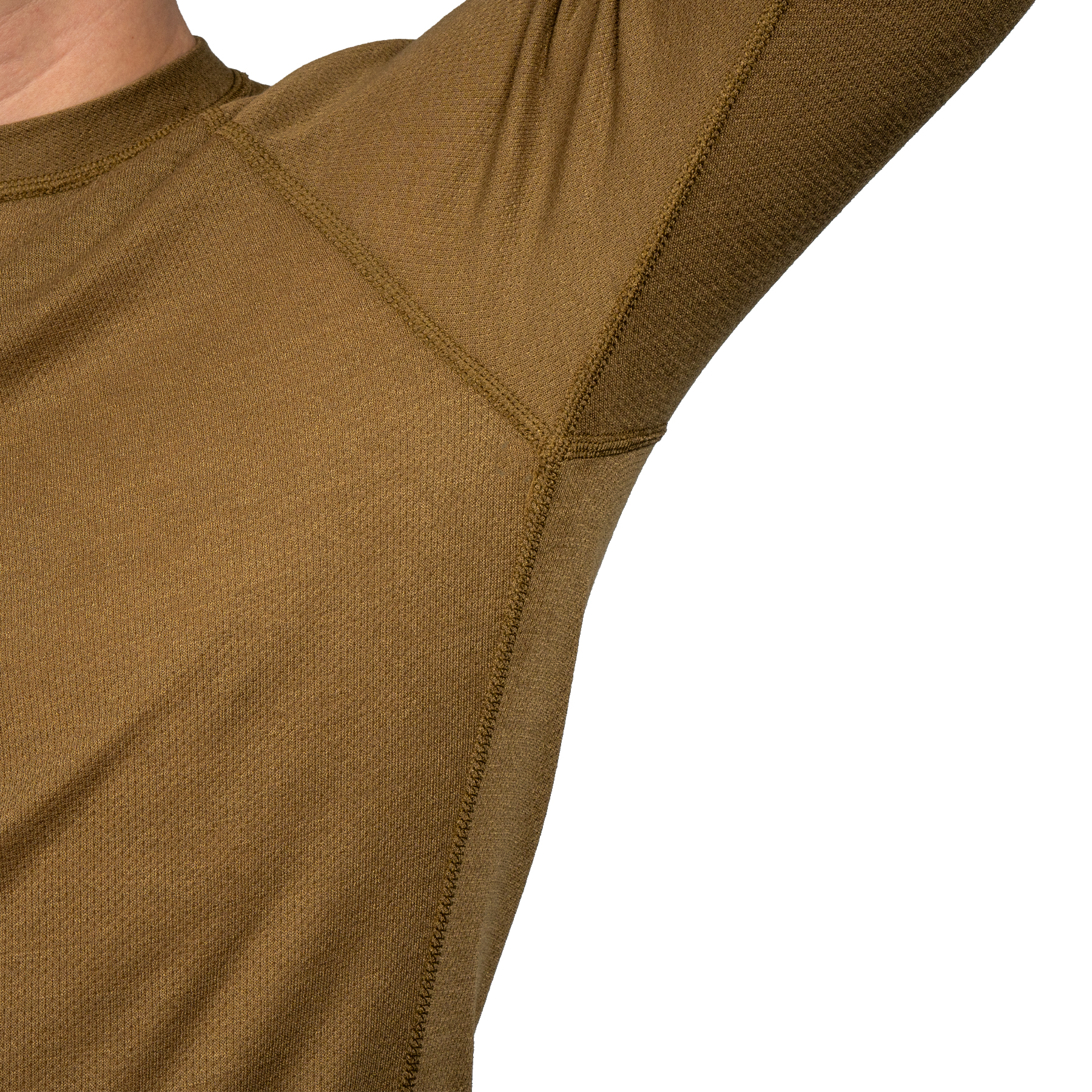


The first three levels of PCU and ECWCS are best understood not as "three winter layers", but as a year-round thermal and moisture management system. L1 manages skin contact and sweat evaporation, L2 adds lightweight breathable insulation, and L3 provides heavy thermal retention. None of these garments are bound to a single universal operating temperature.
In summer heat, L1 stands alone. In spring and autumn, L2 provides modular warmth. In winter, choosing between L2 and L3 depends heavily on physical exertion: the more active you are, the less insulation you require. When physical activity drops, extra insulation must be added – ideally before you start to chill.
This highlights the core philosophy of PCU and ECWCS: you don't dress for the static outdoor temperature; you tune your clothing system to your body, the weather, and your operational workload. The best system is not the warmest one available, but the one that keeps you dry, regulates body heat, and prevents overheating from the first mile to the final halt.
NEED HELP CHOOSING?
Our specialists will help you navigate our range and choose the right thermal clothing according to your needs and intended conditions of use
Get a consultation

Vitalii Buniak — article author
Military gear consultant
Before 2022, he worked as a sales assistant at the Panisher store. After the start of the full-scale invasion, he joined the Armed Forces of Ukraine, gaining real combat experience.
Thanks to his combat experience and deep knowledge of tactical gear, Vitalii serves as a personal expert of the Panisher online store in the fields of:
- Clothing and footwear
- Equipment
His recommendations help customers choose reliable and functional gear for any conditions.
FAQ: Answers to Frequently Asked Questions
1. Are Levels 1 through 3 strictly winter layers?
2. Is L2 needed in the summer?
3. Why is L1 + L2 often enough at 23 °F (−5 °C), while 41 °F (+5 °C) might require L3?
4. Do you need to wear all three levels simultaneously?
This video reveals the purpose of 1-3 layers of the American army: